 Everett
 Why Pinehurst Roofs Wear on Their Own Schedule
Pinehurst sits close enough to Puget Sound and the broader Everett shoreline environment that homes here deal with a mix most inland Snohomish County neighborhoods don't see as heavily: salt-laden air, long stretches of driving rain off the water, and a moss season that can run from fall clear through spring. None of these alone is unusual for Western Washington. Together, applied to the same roof year after year, they change what "correct installation" actually means.
Salt air accelerates corrosion on exposed metal fasteners, flashing, and vent components. Driving rain finds any weak point in a roof plane, especially at low-slope transitions and valleys, and pushes water sideways rather than letting it run straight off. And moss doesn't just sit on shingles looking messy — its root structure lifts granules and holds moisture against the roof deck, which is how a roof that looks fine from the driveway ends up with soft decking underneath. A new roof installed for Pinehurst needs to be built for all three at once, not just to code minimums.
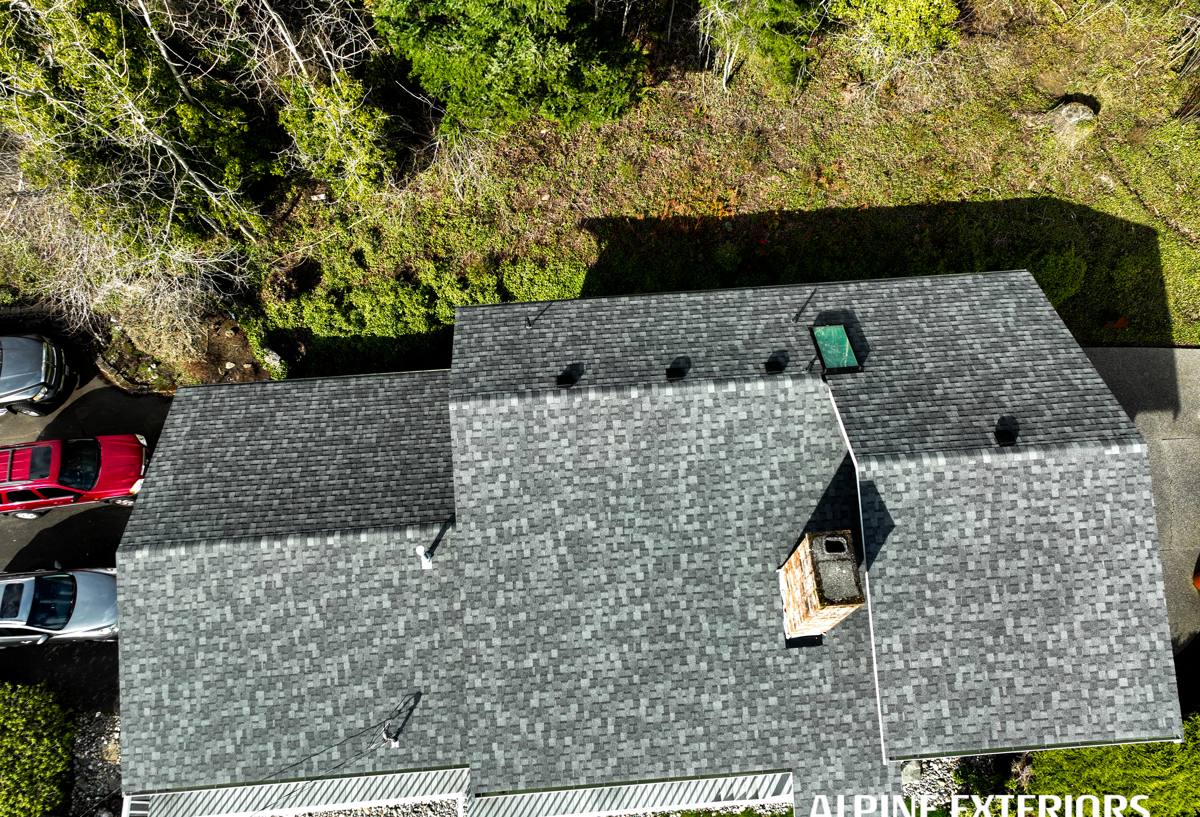
What a Correct New Roof Installation Actually Involves
A new roof is more than laying shingles over the old ones. Done right, it's a full system, and skipping any layer shows up later as a leak, a mold problem, or a roof that needs replacing again years before it should.
Full Tear-Off, Not an Overlay
We remove the existing roofing down to the deck. This is the only way to actually inspect the sheathing for rot, soft spots, or old damage that's been hidden under layers of shingles — a common finding on older Pinehurst homes that have seen decades of coastal moisture cycle through the attic and roof deck.
Deck Repair Before Anything Goes Down
Any damaged or delaminated sheathing gets replaced before underlayment goes on. Installing a new roof over a compromised deck just locks the problem in and voids most manufacturer warranties anyway.
Ice and Water Shield at the Vulnerable Points
Valleys, eaves, and roof-to-wall transitions get self-adhering waterproof membrane, not just standard underlayment. These are the spots where driving rain and wind-driven moisture push past typical shingle overlap, and they're the first place a marginal roof fails.
Synthetic Underlayment Across the Field
Modern synthetic underlayment holds up better than old felt paper in wet, humid conditions and gives the deck a second line of defense while the crew is working and afterward.
Proper Flashing at Every Penetration
Chimneys, vents, skylights, and wall step-flashing are where most roof leaks actually originate — rarely the field of the shingles themselves. New, correctly lapped flashing at every one of these points is not optional, and it's one of the easiest things for a rushed installation to shortcut.
Material Choices: What Actually Holds Up Here
There's no single "best" roofing material for every home — it depends on your roof's slope, your home's style, and your budget. What we won't do is recommend a system that fights the climate. Below is an honest breakdown of the main options homeowners in Pinehurst weigh, including where each one needs extra attention in this environment.
| Material | Typical Lifespan Here | Moss & Moisture Behavior | Coastal Air Consideration |
|---|---|---|---|
| Architectural asphalt shingles | 25–30 years | Good with proper ventilation; algae-resistant granule options help slow moss growth | Minimal metal exposure; low maintenance |
| Standing seam metal | 40–50+ years | Sheds moisture and moss very well due to slick, low-friction surface | Requires marine-grade or coated fasteners and finishes to resist salt corrosion |
| Synthetic composite shingles | 30–40 years | Resists moisture absorption better than natural wood-look products | Stable in coastal humidity swings |
| Cedar shake | 20–25 years in coastal exposure | Absorbs moisture, needs regular treatment to resist moss and rot | Higher maintenance burden near salt air |
We don't install cedar shake as a first recommendation for homes this close to the water — not because it's a bad-looking product, but because the maintenance schedule needed to keep it performing well in salt air and heavy moss pressure is a real ongoing cost most homeowners underestimate when they're comparing sticker prices.
What Drives Cost on a Pinehurst Roof
- Roof pitch and access — steeper roofs and homes with limited yard access for equipment take longer and cost more
- Number of layers to remove — tear-off pricing depends on how many old layers are coming off
- Deck condition — hidden rot found after tear-off adds material and labor
- Material selection — asphalt, metal, and composite options span a wide price range
- Ventilation upgrades needed — older homes often need added intake or exhaust venting to meet current standards
- Flashing and penetration count — more chimneys, skylights, and vents mean more detail work
Ventilation: The Part Homeowners Never See Until It Fails
Ventilation is where a lot of otherwise good roofs go wrong in this climate. Without balanced intake at the eaves and exhaust at the ridge, warm moist air from inside the home gets trapped against the underside of a cold roof deck — and in a long, damp moss season, that trapped moisture doesn't get a chance to dry out between storms the way it might in a drier climate. Over time it shows up as sheathing rot, mold in the attic, and premature granule loss from underneath the shingles, none of which is visible from the ground.
Every new roof installation should include a ventilation assessment, not just a shingle swap. On many older Pinehurst homes, adding proper ridge and soffit venting during the reroof is one of the highest-value upgrades available, and it's far cheaper to do while the roof is already open than to retrofit later.
Our Installation Process
- On-site inspection and estimate — we walk the roof, check the attic for existing moisture or ventilation issues, and measure for an accurate, itemized quote.
- Material selection — we go over the honest trade-offs between shingle, metal, and composite options for your specific roof and budget.
- Permitting — we handle the permit process with Everett or Snohomish County as applicable before work begins.
- Tear-off and deck inspection — old roofing comes off, the deck is inspected, and any damaged sheathing is flagged and repaired.
- Waterproofing and underlayment — ice and water shield at vulnerable points, synthetic underlayment across the field.
- Ventilation correction — intake and exhaust venting is added or corrected as needed.
- Flashing and material installation — new flashing at every penetration, then the roofing material itself, installed to manufacturer spec.
- Final walkthrough and cleanup — a full site cleanup including magnetic nail sweep, and a walkthrough so you know exactly what was done and what your warranty covers.
Timeline, Permits, and Warranty
Most single-family roof replacements in and around Pinehurst take one to three days of actual installation once permitting and material delivery are squared away, weather permitting — and weather is always the variable in this part of Snohomish County. Permits are typically required for a full reroof; we pull them as part of the job rather than leaving that step to the homeowner. Warranty coverage depends on the manufacturer and material chosen, and we walk through exactly what's covered — material defects versus workmanship — before any work starts, so there are no surprises later.
Signs Your Pinehurst Home May Need a New Roof
- Granules collecting in gutters or at the base of downspouts
- Moss or dark streaking covering more than a small patch of the roof
- Shingles that are curling, cupping, or visibly brittle
- Soft spots or noticeable sagging along the roofline
- Daylight visible through the attic roof boards
- A roof that's 20+ years old and has never had a full tear-off
- Rising energy bills that may point to attic moisture or ventilation problems
Why a Crew That Already Works Pinehurst Matters
A roof installed by a crew unfamiliar with this specific stretch of coastline is still a roof — but the details that matter here are easy to miss if you're not used to building for salt air, driving rain, and a real moss season all at once. That means the right fastener coatings, the right ventilation ratios, the right underlayment at the right spots, and flashing details that account for wind-driven rain rather than just vertical rainfall. It also means knowing which materials genuinely hold up in this specific microclimate versus which ones look fine on a spec sheet written for a different part of the country. Local experience isn't a marketing line — it's the difference between a roof that needs attention again in eight years and one that goes the full distance of its expected lifespan.
If you're considering a new roof for your Pinehurst home, we're glad to come take a look, walk the attic and roofline with you, and put together a straightforward, no-pressure estimate. Use the form below to get started.