 Everett
 What LP SmartSide Actually Is
LP SmartSide is an engineered wood siding product. The core is made from wood strands bonded with resin under heat and pressure, similar in concept to oriented strand board (OSB), then treated with a zinc borate additive for insect and decay resistance and finished with a factory-applied primer or resin-saturated coating. It comes in lap boards, panels, and trim, and it installs a lot like traditional wood siding — you can nail it, cut it with standard tools, and it takes paint well.
It has real advantages. It's lighter than fiber cement, which makes it faster and less physically demanding to install. It costs less per square foot than James Hardie in most markets. And LP has genuinely improved the product over the past two decades, particularly around edge treatment and moisture resistance compared to the OSB-based wood sidings that gave engineered wood a bad name in the 1990s. We're not here to tell homeowners it's a bad product across the board — in a dry climate with disciplined maintenance, it can perform reasonably well for a long time.
The problem is that Everett isn't a dry climate, and "disciplined maintenance" is doing a lot of work in that sentence.
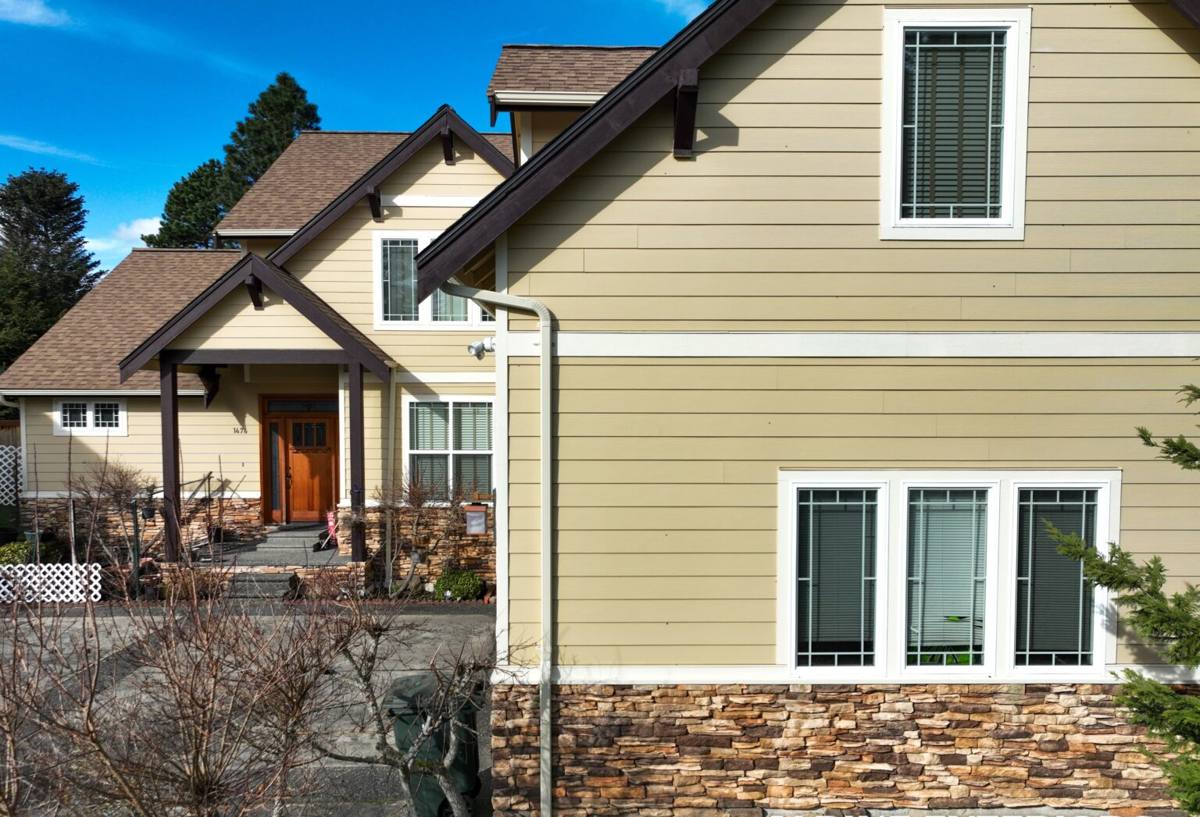
Everett's Climate Is a Tough Environment for Wood-Based Siding
Snohomish County sits on Puget Sound, and that proximity to salt water matters more than most homeowners realize. Salt-laden air accelerates corrosion of fasteners and metal flashing, and it interacts poorly with any siding product whose long-term performance depends on an intact factory or field-applied coating. Add in the region's driving, wind-blown rain — which hits walls at an angle instead of just running down them — and you get sustained wetting on wall assemblies that a lot of siding products simply weren't tested for.
Then there's moss. Everett's long, mild, wet season (realistically eight or more months of the year with meaningful moisture) creates ideal conditions for moss and algae growth on north-facing and shaded walls. Moss doesn't just look bad — it holds moisture against the siding surface for extended periods, which is exactly the condition that engineered wood products are most vulnerable to.
None of this means LP SmartSide is doomed to fail in every installation. It means the margin for error — in installation quality, in caulk maintenance, in repainting schedule — is much thinner here than it would be in a drier inland climate.
Why This Matters More for Engineered Wood Than for Some Other Products
Wood-strand siding manages moisture differently than fiber cement or vinyl. The manufacturer's own installation instructions require field-caulking and sealing at every horizontal and vertical joint, every cut edge, and every location where the factory coating has been breached — because the strand substrate underneath is wood, and wood swells when it absorbs water repeatedly. If a seam opens up, if caulk fails, or if a cut edge doesn't get field-primed and painted as specified, water finds its way into the substrate. In a climate with occasional hard rain, that's a manageable risk. In a climate with near-constant damp and driving rain off the Sound, it's a maintenance item that has to be caught early and every time.
Installation Sensitivity: Where the Real Risk Lives
Most of the failures we've seen with engineered wood siding over the years trace back to installation, not the product itself sitting in a warehouse. LP's own technical bulletins are specific about clearances, fastening patterns, caulking requirements, and paint maintenance intervals — and those specifications exist because the product's performance is genuinely sensitive to whether they're followed exactly.
That's a hard standard to hit consistently on every job, especially on multi-day installs in variable Pacific Northwest weather where crews are working around rain delays. It's not that installers are careless — it's that the product gives you very little room for a missed caulk line or a cut edge that didn't get primed before the next rain came through.
- Cut edges must be field-treated (primed and painted) before installation — every time, on every piece.
- Butt joints and panel seams require correct caulking with a compatible sealant, maintained over the life of the siding.
- Ground clearance and flashing details have to be followed precisely to avoid wicking moisture up from grade or from horizontal trim.
- The factory finish has a repainting interval — skip it, and the substrate underneath loses its protection.
Fiber cement is far more forgiving on all of these points, because the substrate itself doesn't absorb and swell the way a wood-strand product does.
Maintenance Burden Over the Life of the Siding
This is the part that matters most to homeowners deciding what to put on a house they plan to keep for a couple of decades.
| Maintenance Factor | LP SmartSide (Engineered Wood) | James Hardie Fiber Cement |
|---|---|---|
| Repainting interval | Typically needed on a shorter cycle to protect the substrate | ColorPlus factory finish holds significantly longer before repainting is needed |
| Caulk/seam inspection | Required on an ongoing basis; lapses lead directly to moisture entry | Less dependent on caulk integrity for basic weather resistance |
| Moisture/swelling risk | Present if coating or seams fail | Not a concern — cement substrate doesn't swell from moisture the way wood does |
| Moss and algae exposure | Trapped moisture from moss growth is a real risk on shaded walls | Non-organic substrate is far less affected by sustained moss contact |
| Combustibility | Wood-based, combustible | Non-combustible |
None of this is a knock on LP as a company — they publish clear maintenance guidance and stand behind their product when it's installed and maintained to spec. But "installed and maintained to spec, indefinitely, in a marine climate" is a high bar to promise a homeowner, and it's not one we're willing to build our name on.
Warranty Structure
LP SmartSide's limited warranty is meaningful, but like most engineered wood siding warranties, it includes maintenance obligations — repainting on schedule, prompt caulk repair — as conditions of coverage. If those maintenance steps lapse, coverage can be affected. That's a reasonable structure for the manufacturer, but it puts the burden of tracking and executing ongoing maintenance squarely on the homeowner for the life of the product.
James Hardie's warranty structure, paired with the ColorPlus factory finish, requires far less from the homeowner to stay protected — there's no field-painting requirement driving the coverage, and the finish warranty and substrate warranty are both transferable, which matters if the home sells within the coverage period.
Why We Standardized on James Hardie
We made a decision several years ago to install one exterior siding system: James Hardie fiber cement. It's not because engineered wood or vinyl can't be installed correctly — it's because we wanted a product where correct installation, plus normal homeowner upkeep, reliably holds up against everything Snohomish County's climate throws at a wall assembly: salt air off the Sound, driving rain, and long stretches of damp weather that feed moss growth.
Fiber cement is non-combustible, doesn't swell or rot from moisture exposure, holds its factory finish far longer than field-painted or resin-coated wood products, and is engineered specifically for climate zones like ours through Hardie's HZ product lines. When we stand behind an installation, we want the product itself carrying weight — not depending on a homeowner catching every maintenance interval for the next 20 years.
What This Means If You're Comparing Bids
If another contractor is bidding LP SmartSide or another engineered wood product on your home, that doesn't necessarily mean they're doing something wrong — it may be a legitimate product for your budget and situation. What we'd encourage is asking pointed questions about installation detailing, caulk maintenance responsibility, and what the warranty actually requires of you as the homeowner over time.
Cost Considerations
| Factor | Engineered Wood (LP SmartSide) | Fiber Cement (James Hardie) |
|---|---|---|
| Upfront material + install cost | Generally lower | Generally higher |
| Long-term repainting cost | Recurring cost on a shorter cycle | Longer intervals between repaints |
| Repair risk from moisture issues | Higher if maintenance lapses | Lower |
| Resale/appraisal perception | Varies by buyer and market | Widely recognized as a premium, low-maintenance material |
The lower sticker price on engineered wood is real, and for some budgets it's the right call. Our position is simply that once you account for realistic maintenance in this climate, the total cost of ownership gap narrows — and the risk profile doesn't, in our view, favor the cheaper option.
A Practical Checklist Before You Decide
- Ask what substrate the siding is built on, and whether it's wood-based, cement-based, or vinyl.
- Ask what maintenance the manufacturer's warranty requires of you, and how often.
- Ask how cut edges and seams are treated during installation, and get it in writing.
- Ask how the product performs specifically in coastal, high-moisture, or moss-prone conditions — not just generic climate claims.
- Ask whether the warranty is transferable if you sell the home.
- Get a second opinion from a contractor who installs a different product, so you're not only hearing one company's pitch.
Our Honest Bottom Line
LP SmartSide isn't a scam product, and plenty of homes around the country wear it just fine. But we install exteriors for homes in Everett and the surrounding Snohomish County area specifically, and this climate — salt air, driving rain, and a moss season that runs most of the year — is a demanding environment for any wood-based siding. We'd rather put a non-combustible, climate-engineered fiber cement product on your home and stand behind it with confidence than sell you something that depends on a maintenance schedule holding up perfectly for two decades.
If you're weighing siding options for your home, we're happy to walk through what we see in this climate and give you a straight answer — including whether your project and budget might genuinely be better served by a different approach. Reach out for a free, no-pressure estimate and we'll talk through what actually makes sense for your house.