 Everett
 Cedar Siding Looks Beautiful. That's Not in Question.
There's a reason cedar siding has stuck around for a century in the Pacific Northwest. The grain, the warmth of the color, the way it ages if you let it — cedar has a look that fiber cement and vinyl spend a lot of marketing budget trying to imitate. If you love that look and you're willing to put in real, ongoing work to keep it, cedar can be a legitimate choice. We're not here to tell you it's a bad material. We're here to tell you honestly what owning it actually involves, because that's the part most contractors skip over on the way to a sale.
We don't install cedar siding at Everett Exterior. Not because it can't perform, but because we've watched what it takes to keep it performing in this climate over 10, 20, 30 years — and we'd rather stand behind a product that doesn't ask homeowners to become part-time wood finishers.
Why Cedar Is a Harder Sell in Snohomish County Specifically
Cedar's biggest enemy isn't cold. It's moisture that doesn't leave. Everett sits close enough to Puget Sound that homes get salt-laden air rolling in off the water, on top of the driving rain that comes sideways during fall and winter storms. Add in a moss season that, depending on the year, can run from October through April on shaded elevations, and you've got a wall assembly that rarely gets a long enough dry stretch to fully release moisture between soakings.
Cedar is naturally rot-resistant compared to other softwoods — that's genuinely true, and it's why it was used untreated for so long. But "rot-resistant" is not "rot-proof," and that resistance is concentrated in the heartwood. Modern cedar siding, especially lower grades, includes more sapwood than the old-growth boards installed decades ago. Sapwood doesn't carry the same natural preservatives, so a lot of today's cedar siding doesn't behave like the cedar people remember from an older house.
What Constant Damp Actually Does to a Wood Wall
- North and shaded elevations stay wet longer, which is exactly where moss and mildew take hold first
- Repeated wet-dry cycling causes cupping, checking, and cracking in the boards over years
- Moisture that gets behind the siding at butt joints or fasteners can sit against the wall sheathing far longer than it takes to dry the face
- Salt air accelerates the breakdown of exterior finishes, meaning coatings fail sooner near the water than they would inland
The Maintenance Schedule Nobody Puts in the Brochure
This is the part of cedar ownership that matters most and gets talked about least. Cedar siding is a finished wood product, and the finish is what's actually protecting it. Once that finish starts breaking down, the wood underneath is exposed to exactly the wet cycling described above.
| Task | Typical Frequency Here | Why It Can't Be Skipped |
|---|---|---|
| Re-stain or re-seal | Every 3-5 years (sun/weather side often sooner) | Finish is the primary moisture barrier; once it chalks or peels, bare wood absorbs water directly |
| Moss and mildew treatment | Annually on shaded/north sides | Moss holds moisture against the wood and roots into the grain over time |
| Caulk and joint inspection | Annually | Failed caulking at butt joints and trim is the most common entry point for water behind the siding |
| Full repaint (if painted vs stained) | Every 5-7 years | Paint film fails differently than stain and can trap moisture if it goes too long between coats |
| Board replacement | As needed, ongoing | Individual boards that split, cup, or rot get replaced piecemeal, which can leave visible color mismatch |
None of this is a one-time cost. It's a recurring line item for as long as you own the house, and skipping a cycle doesn't just cost you later — it often costs more later, because bare or under-finished wood degrades faster than wood that's been kept sealed.
Installation Sensitivity Most Homeowners Never Hear About
Cedar performs a lot better or a lot worse depending on details that have nothing to do with the wood itself:
- Back-priming. Boards that aren't sealed on the back and edges before installation absorb moisture from behind, where you can't see it happening.
- Fastener choice. Standard galvanized fasteners can react with cedar's natural tannins and streak the finish; stainless steel is the right call and costs more.
- Clearance and drainage. Cedar needs a rain screen gap or proper drainage plane behind it to shed the moisture that inevitably gets past the face. Skipping this is one of the most common corner-cuts on cedar jobs.
- Grade of lumber. Clear, vertical-grain heartwood performs very differently than lower-grade boards with more sapwood and knots, and the price difference between grades is substantial.
Get any one of these wrong and you can end up with a wall that looks fine for two or three years, then starts showing problems that trace back to a decision made on installation day, not a defect in the wood.
The Real Cost Picture
Cedar's upfront material and labor cost sits in a middle range — often less than higher-end fiber cement systems for the plain boards, but that number doesn't tell the whole story. What it doesn't include is the maintenance cost stacked on top over the life of the siding: refinishing labor, moss treatment, caulk work, and the board replacement that comes with age. Add those up over 20-30 years and cedar frequently costs more to own than it did to install, even before you count the time homeowners spend managing it themselves or coordinating contractors for the recurring work.
That's the trade-off in plain terms: cedar can cost less on day one and more over the life of the house, or you accept a shorter usable lifespan if the maintenance schedule slips.
Where Cedar Still Makes Sense
We'll say this plainly: cedar isn't a scam and it isn't automatically the wrong choice. It makes the most sense for owners who genuinely want that specific look, who plan to stay hands-on with maintenance, and who treat refinishing as a normal part of homeownership rather than a surprise. Accent areas — gable ends, entry features, small sections — are a reasonable way to get the cedar look with a much smaller maintenance footprint than siding an entire house in it.
Where it makes less sense is on a full exterior for an owner who wants to install once and not think about it again for a couple decades, or on rental and investment properties where nobody's tracking a refinishing calendar.
Why We Install James Hardie Instead
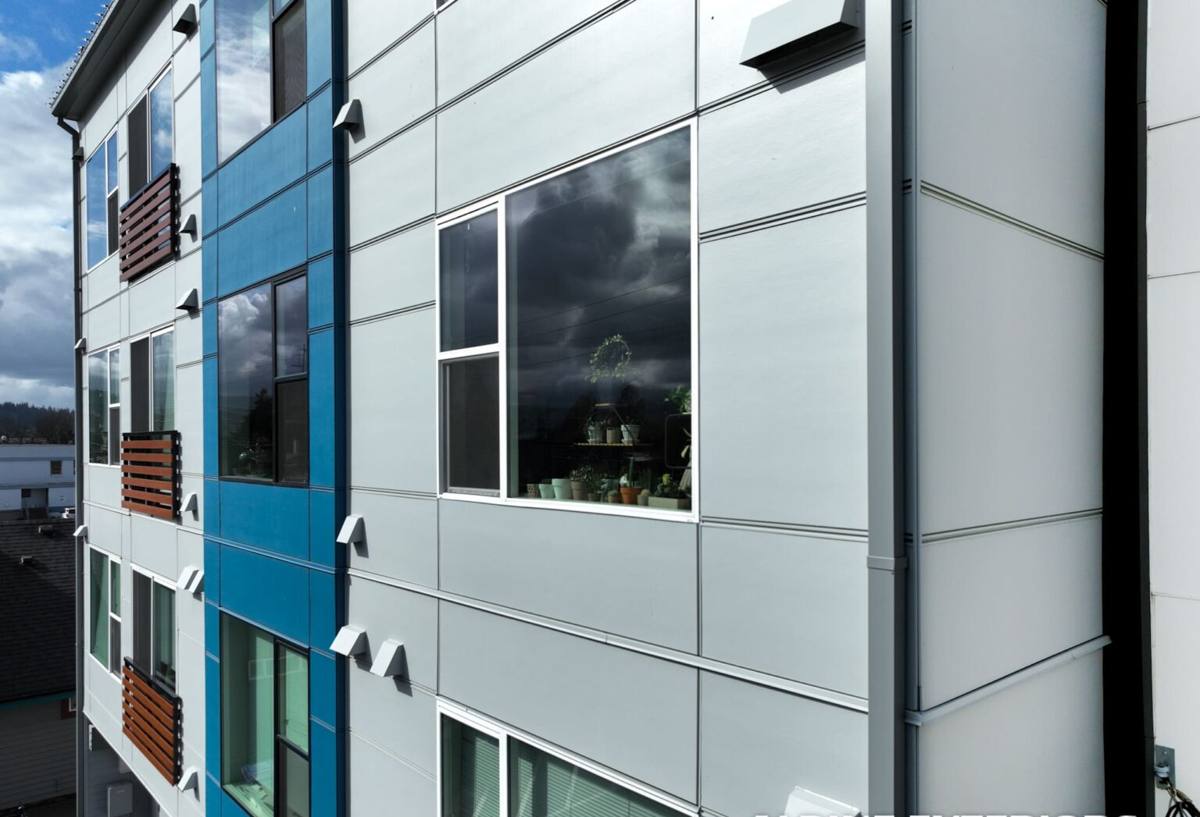
We standardized on James Hardie fiber cement for the homes we work on in Everett and around Snohomish County because it holds up to exactly the conditions that wear cedar down fastest — sustained damp, salt air, and long stretches without a real drying window. Fiber cement doesn't rot, doesn't feed moss the way bare or weathered wood can, and isn't fuel for fire the way wood siding is, which matters given how often wind-driven wildfire smoke and ember concerns come up in this region during dry summer stretches.
Hardie's ColorPlus factory finish is baked on under controlled conditions rather than applied on site, and it's built to go 15+ years before it needs attention — not 3-5. The HZ5 product line is specifically engineered for wet, moisture-heavy climates like ours. And because it's a factory finish rather than a field-applied stain, you don't get the streaking, uneven fading, or finish failure that comes from board-to-board variation in how a stain was brushed on. Hardie backs the product with a strong transferable warranty when installed to spec, which is a very different conversation than "check the boards again next spring."
We're not going to tell you cedar can't look good on an Everett home — it can, for the right owner with the right expectations. But when a homeowner asks us what we'd put on our own house given the moisture load this area sees, the answer is Hardie, and that's what we install.
Quick Checklist: Questions to Ask Before Choosing Cedar
- Am I prepared to budget for refinishing every 3-5 years, indefinitely?
- Was the siding back-primed and installed with a drainage gap behind it?
- Were stainless steel fasteners used, or standard galvanized?
- What grade of cedar is being quoted — clear heartwood or a mixed lower grade?
- Do I have the time or budget to hire out moss and mildew treatment annually?
- Am I choosing cedar for the whole house, or would an accent application get me the look with less upkeep?
If you're weighing cedar against fiber cement for a home in Everett or anywhere else in Snohomish County, we're happy to walk the exterior with you, point out what we'd watch for either way, and put together a free, no-pressure estimate — no obligation, just a straight answer.