 Everett
 North Everett's Exterior Is Working Harder Than Most
North Everett sits close enough to Port Gardner Bay and the broader Puget Sound that homes here deal with a slightly different set of exterior stresses than houses further inland in Snohomish County. Salt-tinged air off the water accelerates corrosion on fasteners, flashing, and cheaper trim materials. Driving rain that comes in sideways off the Sound during winter storms finds every gap in a building envelope. And the combination of marine humidity, tree cover, and long stretches of overcast, wet weather gives moss, algae, and mildew a season that runs far longer here than in drier parts of the country.
None of this is dramatic on its own. It's cumulative. A house that gets a few extra weeks of dampness every year, every year, for two or three decades, shows it — in siding that's swelling at the seams, a roof with a green cast to it, windows that fog between the panes, and a deck that's gone soft at the stair stringers. Exterior work in this neighborhood isn't about picking a look. It's about picking materials and installation details that hold up to a specific, known set of conditions.
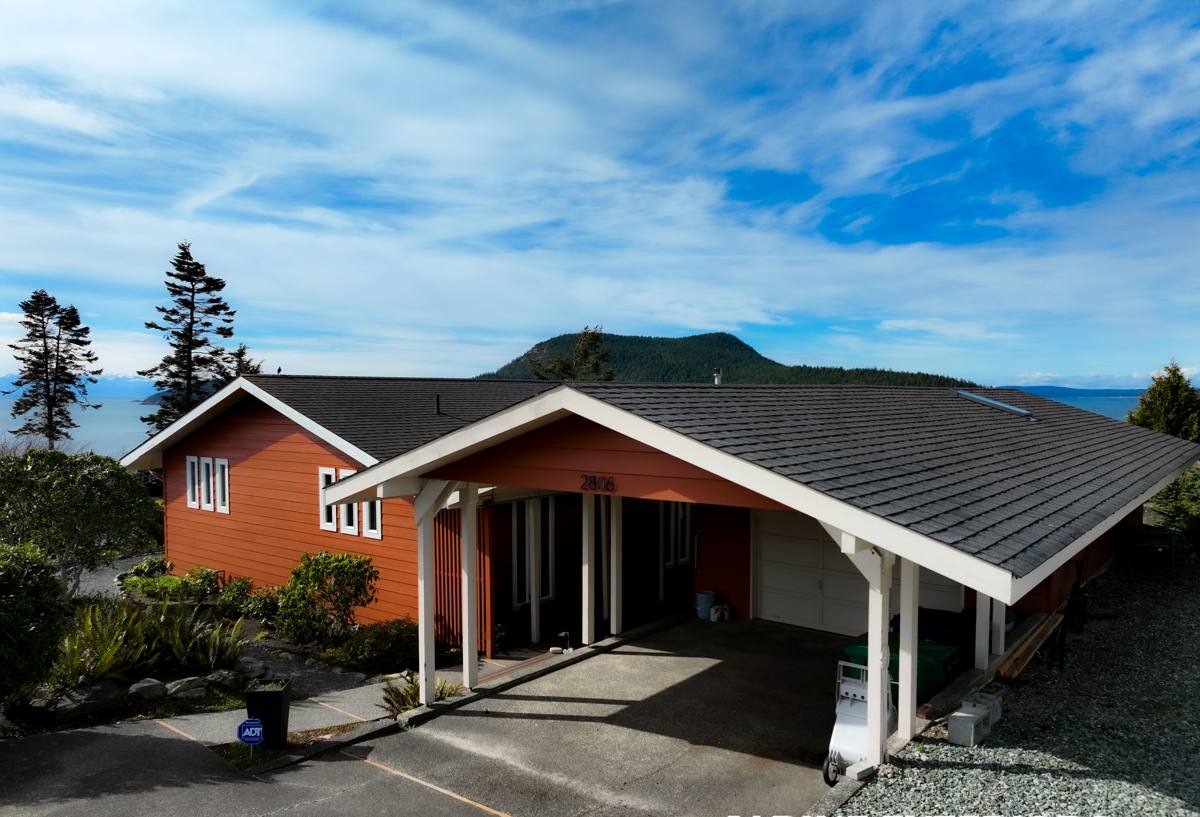
Siding: Why Material Choice Matters More Here Than Elsewhere
Siding is the single biggest factor in how well a North Everett home ages. It's also where homeowners get the most conflicting advice, because most siding materials are designed for a national market, not for a marine climate with a long wet season.
What we install, and why
We install James Hardie fiber cement siding exclusively. It's a non-combustible product engineered specifically for climate zones like ours — Hardie makes an HZ5 product line built for the moisture and temperature swings of the Pacific Northwest. It doesn't absorb water the way wood-based products can, it holds paint and factory-applied ColorPlus finishes far longer than site-painted materials, and it doesn't provide the same food source for moss and mildew that cedar and some engineered wood products do.
What we don't install, and why
We don't install vinyl, LP SmartSide, Cemplank, Allura, primed spruce, or cedar siding, and we're upfront about the reasoning rather than pretending these are bad products across the board:
- Vinyl is affordable and low-maintenance in mild climates, but it expands and contracts more than fiber cement in temperature swings, and seams can allow wind-driven rain behind the panel over time — a real concern with the Sound's winter storm patterns.
- LP SmartSide and similar engineered wood products perform well when detailing is perfect, but they're wood-based, meaning any breach in the factory coating — a scratch, a poorly sealed cut edge, a nail hole — creates a point where moisture can get into the substrate and swell it.
- Cedar is a beautiful, traditional Pacific Northwest material, but it demands ongoing maintenance — refinishing, caulking, moss treatment — to keep performing in a climate this wet. Skipped maintenance years show up fast as cupping, splitting, and rot at butt joints.
- Primed spruce and unrated composite panels generally aren't engineered for sustained marine exposure and tend to be a short-term cost saver with a longer-term maintenance bill.
The trade-off with Hardie is upfront cost and the fact that it's heavier and less forgiving to install than vinyl — which is exactly why installation quality matters as much as the product itself.
Siding Material Comparison for Coastal Snohomish County Conditions
| Material | Moisture / Rot Resistance | Salt-Air Durability | Maintenance Burden | Fire Rating |
|---|---|---|---|---|
| James Hardie Fiber Cement | High — cement-based, doesn't rot | Strong with proper fasteners/flashing | Low — factory finish, occasional wash | Non-combustible |
| Vinyl | Moderate — seams can trap moisture | Can chalk and become brittle | Low, but limited repair options | Combustible |
| LP SmartSide / Engineered Wood | Moderate — vulnerable at cut edges/damage | Moderate | Moderate — coating touch-ups needed | Combustible |
| Cedar | Low without consistent upkeep | Moderate, weathers quickly | High — refinishing, sealing, moss control | Combustible |
Roofing: Moss Is the Real Enemy, Not Just the Rain
Everett gets plenty of rain, but the roofing failures we see most often in North Everett aren't from rain volume alone — they're from moss and organic growth that holds moisture against roofing materials year-round. Shaded, tree-lined lots in this neighborhood are especially prone to it. Moss lifts shingle edges, traps debris that clogs gutters and valleys, and keeps the roof deck damp far longer than it should be between storms.
Good roofing work in this area accounts for that reality: proper ventilation to let the attic and roof deck dry out between wet spells, ice-and-water shield in valleys and at eaves, gutter systems sized for real storm volume rather than minimums, and moss-resistant materials or treatments where tree cover is heavy. A roof that's technically watertight but ignores moss and ventilation will still fail early in this climate — usually at the flashing and valleys first.
Windows: Condensation and Wind-Driven Rain
Two window problems show up repeatedly in older North Everett homes: fogged or failed seals on double-pane units (a sign the gas fill has escaped and the seal is gone), and water intrusion around window flanges during wind-driven winter storms. Both point back to the same root causes — aging window units past their functional lifespan, and flashing details that weren't built for sideways rain.
Replacing windows in this climate is as much about the installation detail — proper flashing, house wrap integration, and sill pan drainage — as it is about the window unit itself. A high-efficiency window installed with a gap in the flashing will leak; a mid-grade window installed correctly, with attention to how water sheds around it, will outperform it.
Decks: Built for a Climate That Doesn't Dry Out Fast
Decks in North Everett spend a lot of the year damp, especially on shaded or north-facing lots common near the water and tree-lined streets. That means ledger board flashing, joist protection, and gap spacing between deck boards matter more here than in drier climates — standing water and trapped moisture are what rot a deck from the inside out, usually starting at the ledger connection to the house or at fastener penetrations.
We build decks with moisture management as a first principle: proper flashing where the deck meets the house, drainage that doesn't dump water back against the foundation, and hardware rated for the corrosion that comes with marine air. Material choice (wood versus composite) is a homeowner preference question, but the structural moisture details underneath are non-negotiable regardless of what decking surface goes on top.
Why a Local Crew Matters for This Neighborhood
General contractors who work all over Western Washington or beyond can do fine work, but there's real value in a crew that works Snohomish County's coastal microclimate regularly. Flashing details that are optional in a drier region aren't optional here. Knowing which lots hold moss longer because of shade and tree density changes how a roof or siding job gets sequenced. Understanding how salt air affects fastener choice over a 20-30 year horizon isn't something you get from a national installation manual — it's something you learn from doing the work in this specific area, on this specific coastline, season after season.
What to Expect From an Exterior Project Here
Every project starts with an honest look at what's actually happening on the house — not just what's visible, but what the moisture and rot patterns suggest is happening underneath. From there, the scope gets built around the actual problem, not a generic package.
A homeowner's pre-project checklist
- Check for moss or dark streaking on the roof, especially on shaded slopes — early moss removal is cheaper than deck or shingle repair later
- Look at siding seams and butt joints for swelling, gaps, or paint failure, which often signal moisture getting behind the material
- Check window corners and sills for soft wood, peeling paint, or fogged glass
- Inspect deck ledger boards and any spot where the deck attaches to the house for staining or soft wood
- Confirm gutters are clear and pitched correctly — most exterior water damage traces back to poor drainage, not roof or siding failure itself
- Ask any contractor bidding the job how they handle flashing at penetrations and transitions — it's the detail that separates work that lasts from work that doesn't
Siding, Roofing, Windows, and Decks as One System
These four trades aren't really separate on a house — they all manage the same enemy, which is water finding a way in and staying there. A roof that sheds water but dumps it against poorly flashed siding just moves the problem. Windows installed without attention to the surrounding siding's drainage plane create a weak point regardless of window quality. Treating the exterior as one connected system, rather than four unrelated projects, is what actually keeps a North Everett home dry through the wet season.
If you're seeing moss buildup, siding that's swelling or fading unevenly, a deck that feels soft in spots, or windows that fog between the panes, it's worth getting a straightforward, no-pressure look at what's going on and what it would take to fix it right. We're happy to walk the property, explain what we see, and put together an honest estimate — no obligation either way.