 Everett
 Siding Replacement in Lynnwood: Built for Snohomish County's Wet Climate
Lynnwood sits in the southern end of Snohomish County, close enough to Puget Sound and the marine weather system that moves through this part of Washington to feel its full effect on a home's exterior, year after year. Salt-tinged air drifts in off the water, driving rain comes in sideways during fall and winter storm systems instead of falling straight down, and a moss season that can run most of the year takes hold on shaded, north-facing walls and tree-covered lots. Siding is the first line of defense against all three, and it's also the exterior component homeowners most often underestimate — the damage is usually well underway behind the surface before anything looks wrong from the curb.
Everett Exterior works siding replacement projects throughout the Everett area and the rest of Snohomish County, including Lynnwood, and this page is specifically about that one job: what a Lynnwood home's siding is actually up against in this climate, how to tell when a re-side is the right call instead of another round of patching, what correct installation involves, and how our process works from first look to final walkthrough.
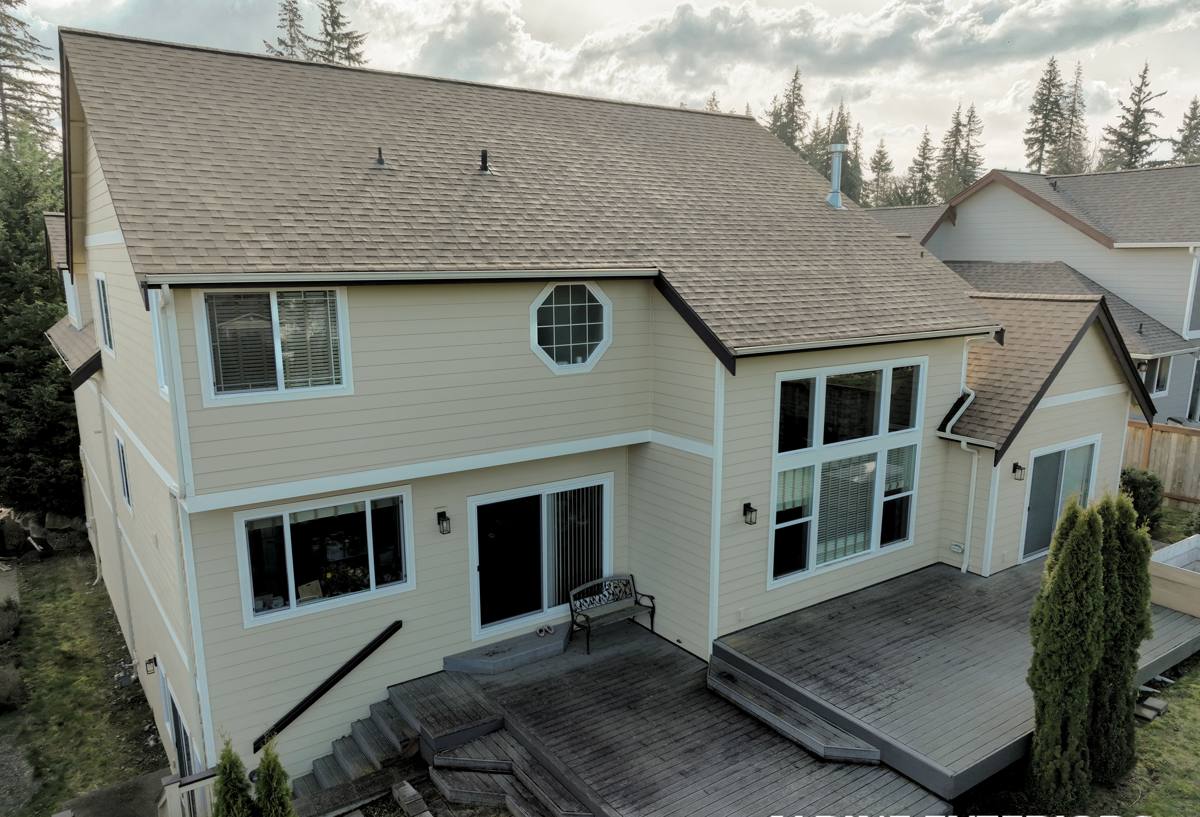
What Snohomish County's Climate Does to Lynnwood Siding Over Time
None of the mechanisms below are unique to Lynnwood, but the combination of salt air, driving rain, and a long moss season is more persistent here than in drier parts of the state, and it compounds. A siding system that would hold up fine for decades in a dry inland climate can start showing real wear in half that time here if it wasn't built and installed with this specific exposure in mind.
Salt Air and Corrosion
Salt-laden air moving in off Puget Sound accelerates corrosion in exposed fasteners, flashing, and metal trim faster than it would further inland. Once a fastener starts corroding, it loses holding strength and can open a small gap where it penetrates the siding — a direct entry point for moisture that gets worse over time, not better, and one that's easy to miss during a casual walk-around inspection.
Wind-Driven Rain
Straight-down rain is relatively easy for any siding system to shed. Wind-driven rain isn't, because it hits the wall at an angle and gets pushed into laps, seams, and trim lines that were only ever designed to handle water moving downward. Storm systems coming off the Sound push rain sideways into Lynnwood walls on a regular basis, testing every seam, corner, and window or door penetration at once. Where flashing is missing, undersized, or installed out of sequence with the water-resistive barrier behind the siding, this is exactly where water finds its way through.
A Long Moss Season
Mild temperatures combined with near-constant moisture from fall through spring give moss and mildew a long growing season across this part of Snohomish County, and shaded or tree-covered walls are where it takes hold first. Moss doesn't just look bad — it holds moisture against the siding surface long after a storm has passed, extending every wet cycle the material underneath goes through and giving corrosion and, on organic materials, rot more time to work.
Signs a Lynnwood Home Needs Siding Replacement, Not Just a Patch
Not every siding problem calls for a full re-side. A cracked board here or a failed caulk joint there is often a legitimate repair. But certain signs point to a wall assembly that's been compromised more broadly, where patching individual spots just delays a bigger and more expensive problem later.
- Boards that are soft, spongy, or visibly bowing when pressed, especially near the bottom edge or around window and door trim
- Paint or finish that's peeling, bubbling, or failing faster and more widely than normal weathering would explain
- Persistent moss or mildew staining that keeps coming back within a season or two of cleaning
- Visible gaps, cracks, or separation at seams, corners, and butt joints
- Rising energy bills or noticeably drafty interior walls with no other obvious cause
- Musty smells, soft drywall, or visible staining on interior walls that back up to exterior siding
- Siding that's original to a home more than twenty-five to thirty years old, particularly wood-based or early-generation engineered products
Any one of these on its own might be a repair. Several showing up together, especially across more than one wall, usually means the water-resistive barrier and flashing behind the siding have been compromised for a while, and a full replacement is the more honest recommendation.
Replacement vs. Repair: How We Make the Call
We don't default to recommending a full re-side just because it's the bigger job. Plenty of Lynnwood homes we look at genuinely need a repair, not a replacement, and we'll say so. The distinction usually comes down to whether the damage is isolated and cosmetic or whether it points to a systemic problem with the wall assembly behind the siding.
| Condition | Repair Usually Makes Sense | Replacement Usually Makes Sense |
|---|---|---|
| Isolated cracked or damaged board, sound surrounding area | Yes — spot repair | Only if it recurs in the same area repeatedly |
| Single failed caulk joint or seam | Yes — reseal and inspect | Not on its own |
| Soft or rotted sheathing found behind the siding | Rarely a lasting fix | Yes |
| Widespread moss staining and finish failure across multiple walls | Cleaning buys time, doesn't solve it | Yes |
| Original wood-based or early engineered siding, 25+ years old | Diminishing returns on repair | Yes, in most cases |
| Interior signs — musty smell, staining, soft drywall | Only if isolated to a single small area | Yes, once it's showing up inside |
Why We Install Only James Hardie Fiber Cement
Everett Exterior installs one siding product on every job we take on in Lynnwood and the rest of our service area: James Hardie fiber cement. We don't offer vinyl, LP SmartSide, Cemplank, Allura, primed spruce, or cedar, and that's a deliberate professional standard, not a limited product lineup. Each of those alternatives gets something right. Vinyl is inexpensive and low-maintenance in milder climates. Engineered wood products install quickly and take paint well. Cedar has genuine natural character that some homeowners specifically want. But each carries a trade-off we think matters too much in a climate like this one to put our name behind.
Vinyl can warp and grow brittle with age and temperature swings, and its seams and J-channels are exactly the kind of gap wind-driven rain works into over time. Wood-based products, however well treated at the factory, still have an organic core that depends on flawless field priming and caulking at every cut edge to keep sustained moisture out — a demanding standard to hold across an entire crew, on every job, for the full life of the siding. Cedar and primed spruce are attractive materials, but they're organic too, and they ask for real ongoing upkeep — refinishing, sealing, moss control — to keep performing through a moss season that doesn't leave much of a dry stretch to recover in between storms.
Fiber cement handles the core problem differently because it isn't organic. There's no wood substrate for moisture to work into, and it doesn't feed moss and mildew growth the way wood-based products can. James Hardie also builds climate-engineered HZ product lines matched to a region's moisture and temperature exposure, rather than selling one generic formulation nationwide. Paired with a factory-applied ColorPlus finish — baked on under controlled conditions instead of painted on-site — it holds color and resists cracking longer than most field-applied finishes manage through a wet Snohomish County winter. It also carries a strong, transferable warranty, which matters if you ever sell the home before the siding's working life is up.
What a Correct Siding Replacement Involves
A siding product is only as good as its installation, and that's especially true in a climate that punishes shortcuts. A quality material installed with poor flashing and sequencing can fail faster than a modest material installed correctly, because the wall behind your siding is a system, and every layer depends on the ones around it doing their job.
Tear-Off and Sheathing Inspection
A real siding replacement starts with full tear-off, not installation over the top of what's already there. That's the point where we can actually see the sheathing underneath and confirm whether it's sound or whether moisture has already been working into it. Any soft or damaged sheathing gets replaced before new siding goes up — covering it over doesn't fix the problem, it just hides it for a while longer.
Water-Resistive Barrier and Flashing
A continuous, properly lapped water-resistive barrier goes on next, with no gaps or reversed laps that would let water bypass the drainage plane. Flashing at every window, door, and wall penetration gets installed to shed water outward and downward, in the correct sequence with that barrier — not caulked over after the fact as a substitute for real flashing. This is the layer that determines whether incidental moisture drains away or gets trapped against the wall.
Fastening, Joints, and Finish
Fastener type, spacing, and depth need to match the specific Hardie product and the wind exposure of the wall being sided. Cut edges get sealed and primed where the manufacturer specifies. Joint and caulk treatment gets adjusted for sun-exposed versus shaded, moss-prone wall faces rather than treated identically across the whole house. Clearance between the bottom of the siding and grade, decks, or roof lines is kept to spec so the lowest, most vulnerable edge isn't sitting in standing moisture.
- Full tear-off with sheathing inspected and any damage repaired before new siding goes up
- Continuous, correctly lapped water-resistive barrier with no gaps
- Flashing integrated at every window, door, and penetration — not caulked over as a shortcut
- Fastener pattern and spacing matched to the specific Hardie product and local exposure
- Sealed and primed cut edges wherever the manufacturer requires it
- Proper clearance from grade, decks, and rooflines to keep the bottom edge out of standing water
Our Siding Replacement Process and What It Costs
We walk every Lynnwood project through the same sequence, whether it's a full re-side or a partial replacement on one elevation.
- On-site assessment of the existing siding, visible trouble spots, and a look at what's likely happening behind the surface
- A written scope of work and quote before any contract is signed, so you know exactly what's included
- Full tear-off and a sheathing inspection, with any hidden damage flagged and addressed before moving forward
- Water-resistive barrier and flashing installed at every window, door, and penetration
- James Hardie siding installed to manufacturer spec, with joint and fastener detailing adjusted for each wall's actual sun and shade exposure
- Final walkthrough so you can see the finished work and ask questions before we consider the job done
Cost Factors for a Lynnwood Siding Replacement
We don't publish blanket pricing because it wouldn't be an honest number — every home is different, and the real cost drivers are specific to the house in front of us. That said, the factors that move a project's cost up or down are consistent enough to lay out plainly.
| Factor | How It Affects Cost |
|---|---|
| Existing exterior and sheathing condition | Hidden moisture or rot damage found during tear-off adds repair scope |
| Home size and wall complexity | More corners, gables, and penetrations mean more flashing detail and labor time |
| Siding profile and trim package | Board-and-batten or heavier trim details run higher than standard lap siding |
| Access and site conditions | Tree cover, tight lot lines, or difficult staging can affect labor time |
| Scope of tear-off | Full re-side versus a single-elevation replacement changes both material and labor totals |
Why a Local Snohomish County Crew Matters in Lynnwood
A crew that works Lynnwood and the rest of Snohomish County regularly already knows how differently a shaded, tree-covered lot ages compared to an open, south-facing one a few blocks over, and adjusts flashing, joint treatment, and maintenance advice accordingly. That judgment comes from doing this work repeatedly in this specific climate, not from a general specification sheet written for the whole country. It also means someone local is reachable years down the road if a warranty question or a flashing detail needs a second look, rather than chasing down a crew that's moved on to another region entirely.
Caring for Your New Siding
Even correctly installed Hardie siding benefits from basic seasonal attention in a climate like this one. Keeping gutters clear ahead of the wet season prevents overflow from soaking siding and trim at the eaves. Checking shaded, north-facing walls periodically for early moss growth and addressing it before it spreads keeps moisture from sitting against the surface for extended periods. A quick look at caulked joints every year or two catches small gaps before wind-driven rain finds them. None of this is heavy maintenance, but it's real, and we'll walk you through exactly what to watch for on your specific house before we leave the job site.
If you're weighing a siding replacement on a Lynnwood home — or you're just not sure whether what you're seeing needs a repair or a full re-side — we're happy to take a look and give you a straight, no-pressure assessment. Reach out below for a free estimate.