 Everett
 Siding in West Everett Has a Harder Job Than It Looks
West Everett sits close enough to Port Gardner Bay and the greater Puget Sound corridor that homes here deal with a mix of exposures most siding products were never really engineered for: salt-laden air rolling off the water, wind-driven rain that hits walls sideways instead of straight down, and a moss and algae season that runs long and wet for much of the year. None of these things individually is unusual for Western Washington. Together, on the same house, year after year, they add up to a much faster failure rate for siding that isn't built or installed for the job.
Salt air is corrosive to exposed metal fasteners and trim, and it accelerates the breakdown of certain paints and coatings faster than inland exposure does. Driving rain doesn't just wet the surface of a wall — it tests every seam, every piece of flashing, and every fastener penetration, looking for a way in. And moss doesn't just look bad; it holds moisture against the siding surface for weeks at a time, which is exactly the condition that rots wood-based products and de-laminates the wrong composites. A siding installation in West Everett has to be planned around all three of these realities at once, not treated like a generic re-side job.
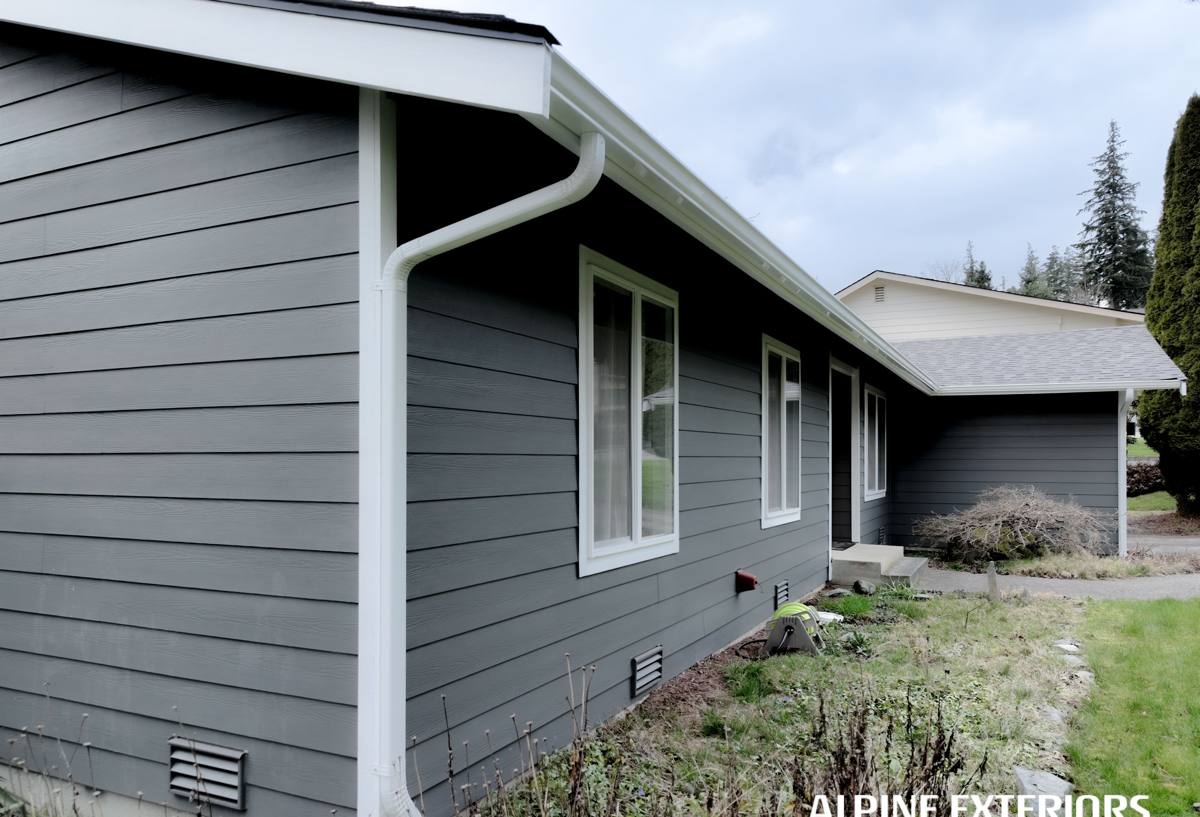
What "Correct" Siding Installation Actually Means Here
Most siding failures we get called out to inspect in Everett aren't failures of the product — they're failures of the installation. A weather-resistant siding material installed with the wrong fastener pattern, no gap tolerance, or a weak water-resistive barrier underneath it will fail just as fast as a poor product installed correctly. In a climate like this one, a handful of details matter more than they would somewhere drier:
- Weather-resistive barrier (WRB): a continuous, properly lapped barrier behind the siding, integrated with window and door flashing so water that gets past the siding surface has a way out, not a way in.
- Flashing at every penetration: windows, doors, hose bibs, light fixtures, and vents all need proper head flashing and kick-out flashing where rooflines meet walls — a very common leak point in driving-rain conditions.
- Fastener choice and placement: corrosion-resistant fasteners, installed at the manufacturer's specified location and spacing, not just "close enough."
- Expansion gaps: proper clearance at butt joints, trim, and inside/outside corners so the material can move seasonally without cracking the caulk line and opening a water path.
- Bottom clearance: siding held up off decks, patios, and grade so it isn't sitting in standing water or splash-back, which is a major driver of moss and rot at the bottom courses.
Skip any one of these and the house looks fine for a year or two, then starts showing staining, soft spots, or bubbling paint right around the areas that took the brunt of the rain and salt exposure.
Why We Only Install James Hardie Fiber Cement
We standardized on James Hardie fiber cement siding for every home we side, including here in West Everett, and we don't install vinyl, LP SmartSide, Cemplank, Allura, or primed wood siding. That's not a marketing position — it's a decision based on what actually holds up under sustained coastal exposure with minimal maintenance.
Fiber cement is non-combustible, which matters for wildfire-adjacent insurance considerations even on the wet side of the state, and it doesn't absorb and swell with moisture the way wood-based products can. James Hardie's ColorPlus factory-applied finish is baked on under controlled conditions and backed by its own finish warranty, which holds up better against the fading and chalking that field-applied paint experiences under UV and salt exposure over time. For homes in this part of Snohomish County, we specify Hardie's HZ5 product line, which is engineered specifically for wetter, harsher climate zones — it's built with the moisture and freeze-thaw behavior of the Pacific Northwest in mind, not a generic national spec.
The combination that matters for West Everett specifically is durability against driving rain (dense, engineered fiber cement doesn't wick and swell like wood), resistance to the surface staining and pitting salt air causes on lesser materials, and a factory finish that sheds moss and mildew better than porous or textured alternatives — plus a transferable warranty that carries real weight if you sell the home down the road.
How Hardie Compares to the Alternatives in This Climate
| Material | Salt air behavior | Driving rain / moisture | Moss & algae resistance | Maintenance |
|---|---|---|---|---|
| James Hardie fiber cement | Doesn't corrode; factory finish resists salt staining | Dense material, doesn't swell or wick | Smooth factory finish sheds growth better | Occasional wash; no repainting for years |
| Vinyl | Can chalk and become brittle faster near salt air | Seams and J-channels are common leak points | Textured surfaces can hold moss longer | Low, but panels can warp or crack over time |
| LP SmartSide (engineered wood) | Coating wears; exposed edges vulnerable | Wood-based core swells if moisture gets in | Prone to moss/algae if not maintained | Requires regular inspection and recaulking |
| Cedar / primed wood | Salt accelerates finish breakdown | Absorbs water; prone to rot without upkeep | High — organic material, needs regular treatment | Highest — repainting/staining on a cycle |
Our Installation Process for West Everett Homes
Every job starts the same way, regardless of house size or style: we look at what the walls are actually dealing with before we talk about products.
- On-site assessment: we walk the exterior and check exposure direction (which walls take the worst of the driving rain and prevailing wind), existing moisture damage, current WRB condition if any is exposed, and trim/flashing condition around windows and doors.
- Tear-off and sheathing check: old siding comes off and we inspect the sheathing underneath for rot or soft spots before anything new goes on. Covering up hidden damage is how small problems become expensive ones.
- WRB and flashing installation: a continuous, properly lapped weather-resistive barrier goes on first, with flashing detailed at every window, door, and penetration before a single piece of siding is hung.
- Hardie installation to spec: HZ5 panels or planks installed with correct fastener spacing, expansion gaps, and bottom clearance, following James Hardie's published installation requirements — which is also what keeps the manufacturer's warranty intact.
- Trim, caulking, and final detail: corners, trim boards, and joints are sealed and finished so water sheds away from the wall assembly instead of pooling at transitions.
- Final walkthrough: we go over the finished exterior with you, point out any maintenance basics, and answer questions before we call the job done.
Signs Your Current Siding Is Losing the Battle
A lot of West Everett homeowners call us after noticing something that's been building for a while, not something that happened overnight. Common warning signs worth a closer look:
- Persistent green or black staining that comes back within weeks of washing
- Soft, spongy, or bubbling spots, especially near the bottom courses or under windows
- Paint that's peeling, chalking, or fading unevenly, particularly on rain-exposed walls
- Visible gaps, cracking, or warping at seams and corners
- A musty smell or visible moisture damage on interior walls that back up to exterior siding
- Fasteners that are rusting, bleeding, or backing out of the surface
Any one of these on its own might just mean a wash and some caulk. Several at once, especially on the walls that face the prevailing weather, usually means the siding system itself is starting to fail and a patch job won't hold for long.
What Drives the Cost of a West Everett Siding Job
Every home is different, and we'll never quote a number without seeing the house, but the main variables that move the price on a siding installation here are consistent:
| Cost factor | Why it matters |
|---|---|
| Tear-off scope | Full removal of old siding down to sheathing costs more than installing over a sound existing surface, but it's often the right call when there's hidden moisture damage. |
| Sheathing repair | Rot found during tear-off has to be repaired before new siding goes on — this is common enough in wetter neighborhoods that we always budget contingency for it. |
| Home size and complexity | Square footage, number of stories, and how many corners, gables, and window/door openings there are all affect labor time. |
| Product line and profile | HZ5 lap siding, panel siding, and shingle-style profiles are priced differently, and factory ColorPlus finishes vary by color and texture. |
| Access and site conditions | Steep lots, limited driveway access, or tight setbacks between homes can add time for scaffolding and material staging. |
Why It Matters That We Already Work in West Everett
A crew that already works this specific part of Everett knows what the walls facing the water are up against before we even start the assessment, knows how Snohomish County permitting and inspection typically runs, and has already made (and fixed) the mistakes that come from treating a coastal-exposure home like a standard suburban re-side. That local familiarity shows up in small decisions — which walls get extra flashing attention, how tight the fastener schedule needs to be given the wind exposure, where moss is likely to become a recurring problem — that a crew unfamiliar with this specific stretch of Snohomish County wouldn't necessarily catch on the first pass.
It also means we're not learning on your house. We've seen what driving rain and salt air do to siding installed without the right prep, and we build every job to avoid repeating those failures.
Ready for a Straight Answer on Your Siding?
If your siding is showing its age, or you're planning ahead before it becomes a bigger problem, we're happy to come take a look and give you an honest read on what your home actually needs — no pressure, no upsell into a product we wouldn't put on our own homes. Request a free estimate using the form below and we'll get back to you with next steps.