 Everett
 Why West Everett Siding Takes a Different Approach
West Everett sits close enough to Puget Sound that homes here deal with a mix of conditions that inland Snohomish County properties don't see nearly as often: salt-laden air drifting off the water, wind-driven rain that gets pushed sideways into wall assemblies, and a moss season that can stretch from late fall well into spring. Any siding product installed here has to handle all three at once, year after year, without babying from the homeowner.
Fiber cement, and specifically James Hardie fiber cement, was engineered for exactly this kind of exposure. But the product is only half the equation. How it's installed, flashed, and finished determines whether a home stays dry and good-looking for decades or starts showing problems within a few winters. This page is about what that correct installation looks like for a West Everett home specifically.
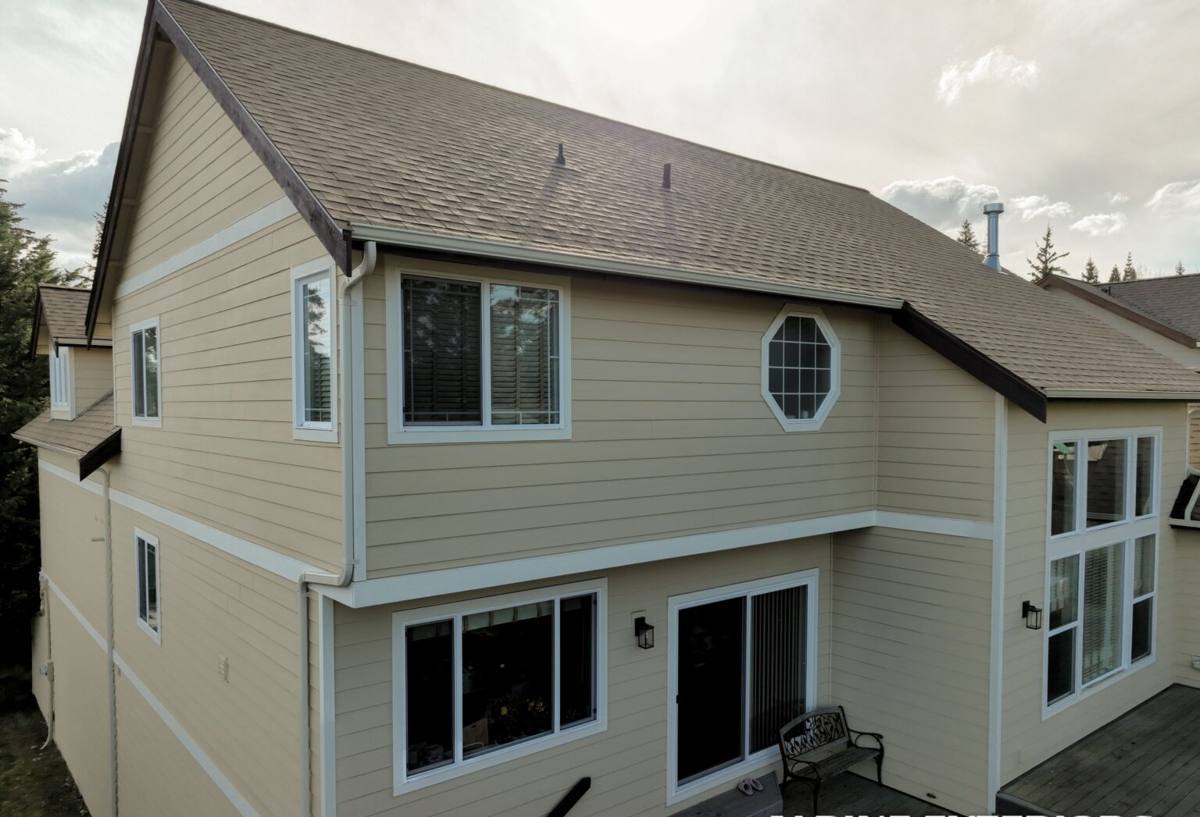
What Salt Air, Rain, and Moss Actually Do to Siding
Salt Air
Airborne salt is corrosive to metal fasteners, flashing, and trim components. It also accelerates the breakdown of lower-grade coatings and finishes, which is why paint on wood or engineered wood siding near the water tends to chalk, fade, or peel faster than the same product would inland. Fiber cement itself doesn't corrode, but every metal component tied into the assembly — nails, flashing, screws — needs to be rated for the exposure or it becomes the weak point.
Driving Rain
Wind off the Sound doesn't just fall on siding, it drives into it horizontally, working its way into seams, laps, and penetrations that would stay dry in calmer conditions. This is a water-management problem as much as a material problem. The siding panel matters less than what's behind it: the water-resistive barrier, the flashing details around windows and doors, and the drainage gap that lets any moisture that does get in find its way back out.
Extended Moss Season
Moss needs moisture, shade, and time, and West Everett's tree cover combined with a long damp season gives it plenty of all three. Moss and algae growth on siding isn't just cosmetic — it holds moisture against the surface far longer than it would otherwise sit there, which matters a great deal for wood-based products and matters less, but not zero, for fiber cement with a factory-applied finish.
Why James Hardie Fiber Cement Fits This Environment
We install James Hardie exclusively, and in a marine-influenced climate like West Everett's, the reasoning holds up product by product. Fiber cement is non-combustible and dimensionally stable — it doesn't swell, cup, or rot the way wood and wood-based composites can when they take on repeated moisture cycles. Hardie's ColorPlus factory-applied finish is baked on under controlled conditions, which gives it better adhesion and UV/salt resistance than a field-applied paint job can typically match, and it comes with its own finish warranty.
Hardie also engineers specific product lines (HZ5, for example) for harsher climate zones, accounting for moisture exposure differently than their lines built for drier regions. For a home this close to the water, that climate-specific engineering is not a marketing detail — it's the reason the product holds up.
What We Don't Install, and Why
We don't install vinyl siding, LP SmartSide, Cemplank, Allura, or unfinished cedar or spruce siding. Each of those products has legitimate uses elsewhere, but in a salt-air, high-rain environment they each carry a trade-off we're not willing to build a reputation on: vinyl can warp and its seams are a long-term water-entry risk; wood-based engineered siding is more vulnerable to moisture-driven edge swelling if a cut edge isn't sealed correctly; raw wood siding demands a maintenance and refinishing schedule most homeowners don't want to keep up with. We'd rather install one product correctly than offer five and hope the cheapest one performs.
What a Correct Fiber Cement Job Involves
The siding panels themselves are the most visible part of the job, but the assembly behind them is what actually keeps a West Everett home dry. A correct installation includes:
- A continuous, properly lapped water-resistive barrier installed shingle-style so every layer sheds water downward and outward
- Correctly integrated flashing at every window, door, and roof-to-wall intersection — the majority of siding leaks we see trace back to flashing details, not the siding material
- A drainage gap or rainscreen strategy that lets incidental moisture behind the cladding drain and dry out instead of sitting against the sheathing
- Fasteners and trim hardware rated for coastal/marine exposure to resist corrosion from salt-laden air
- Correct nailing patterns and clearances per the manufacturer's installation manual — over-driven or improperly placed fasteners are a common warranty-voiding mistake
- Proper clearance between the bottom of the siding and grade, decks, or roof lines to keep splash-back and standing moisture away from the panel edge
- Factory-cut edges used wherever possible, with any field cuts sealed per Hardie's specification to prevent moisture wicking into the cut edge
Skipping any one of these doesn't usually cause an immediate, visible problem. It shows up two, five, or ten years later as a soft spot near a window, a stain at a butt joint, or moss and staining that won't wash off because moisture is trapped underneath.
Our Process for a West Everett Fiber Cement Project
We approach every fiber cement project the same disciplined way, adjusted for the specifics of the home:
1. Assessment and Moisture Check
We start by looking at the existing wall assembly, not just the siding surface — checking for signs of trapped moisture, past water intrusion, or areas where prior work cut corners on flashing.
2. Product and Line Selection
We spec the Hardie product line, plank exposure, and color/finish based on the home's exposure to wind, rain, and sun, factoring in how close the property sits to marine air and how much shade it gets (relevant to moss and algae growth).
3. Tear-Off and Substrate Repair
Old siding comes off, and any water-damaged sheathing or framing found underneath gets addressed before anything new goes up. Installing new siding over hidden rot just seals the problem in.
4. Water-Resistive Barrier and Flashing
This is the step that determines long-term performance more than any other. We install the barrier and flashing system to shed water at every seam, penetration, and transition.
5. Installation to Manufacturer Spec
Panels go up following James Hardie's installation manual precisely — fastener spacing, clearances, and joint treatment — because deviating from spec is also what can void the manufacturer's warranty.
6. Final Detailing and Walkthrough
Trim, caulking at appropriate joints, and a final inspection close out the job, with a walkthrough so the homeowner understands what was done and why.
Cost Factors for a West Everett Fiber Cement Project
Every home is different, but the same variables tend to move the price up or down. Rather than quote a number that won't fit your specific house, here's what actually drives cost:
| Factor | Why It Matters |
|---|---|
| Home size and wall complexity | More corners, gables, and transitions mean more cutting, flashing, and labor time |
| Substrate condition | Hidden rot or water damage found during tear-off adds repair scope before new siding goes up |
| Product line and plank style | HZ5 and specialty profiles (shingle-style, board-and-batten accents) cost more than standard lap siding |
| Trim and accent scope | Fascia, soffit, and trim board replacement alongside siding adds material and labor |
| Access and site conditions | Steep lots, mature landscaping, or tight access near the water can slow staging and increase labor |
| Color and finish selection | Factory ColorPlus finishes vary in cost by color family and coating level |
We walk through each of these during an estimate so you know exactly what's driving your number, not just a lump-sum figure.
Maintenance in a Marine-Influenced Climate
Fiber cement with a factory finish is low-maintenance compared to wood or vinyl, but "low-maintenance" doesn't mean "no maintenance" in an environment like West Everett's. A simple annual routine goes a long way:
- Rinse the siding once or twice a year to clear salt residue, dust, and organic buildup before it has a chance to feed moss or algae
- Keep gutters clear so overflow doesn't run down the siding face and create a constant damp strip
- Trim back vegetation that shades and holds moisture directly against a wall section
- Check caulking at trim joints and penetrations periodically, since caulk (not the siding itself) is usually the first thing to age out
- Have any soft spots, staining, or bubbling investigated promptly rather than waiting — small flashing issues are cheap to fix and expensive to ignore
Why Local Installation Experience Matters
A crew that only occasionally works near Puget Sound may install fiber cement correctly by the book and still miss the details that matter specifically here — the fastener corrosion resistance, the extra attention to flashing given the rain direction, or the finish choices that hold up better against sustained damp shade. Working regularly in Everett and greater Snohomish County means we're not guessing at how a marine-influenced climate treats a wall assembly over ten or twenty years; we're building to what we've already seen hold up and what we've seen fail when it wasn't done right.
If you're weighing a siding replacement for a West Everett home, we're happy to walk the property, look at what's there now, and talk through what a correct fiber cement installation would involve for your specific house. Reach out for a free, no-pressure estimate using the form below.