 Everett
 Siding Replacement Built for South Everett Homes
South Everett carries a mix of housing stock spanning several decades, and a large share of it is now old enough that the original siding is past the point of just needing paint or a patch — it's genuinely at the end of its usable life. Salt-tinged air moving up from Puget Sound, driving rain that comes in sideways more often than straight down, and a moss season that runs most of the year all put steady, cumulative pressure on exterior walls. None of that shows up overnight. It shows up as a home that looked fine five years ago and now has soft trim, discolored siding, and paint that won't hold anymore.
We handle siding replacement for homes throughout South Everett and the rest of Snohomish County, and we install James Hardie fiber cement exclusively. This page walks through what a South Everett home actually needs from a siding replacement, what correct installation involves, and how our process works from first look to final walkthrough.
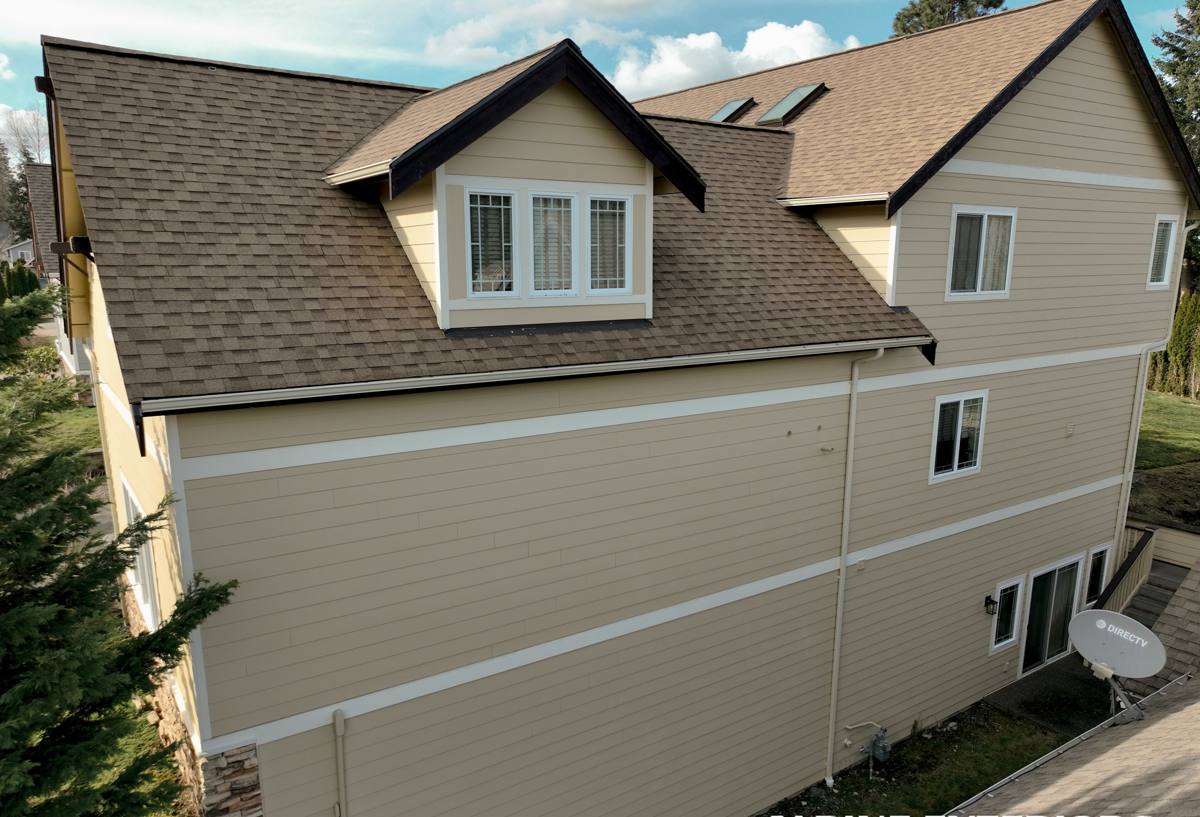
How to Tell a South Everett Home Actually Needs Replacement
Not every tired-looking exterior needs a full tear-off. Some problems are cosmetic and some are structural, and the difference matters a lot for both cost and timeline. A few signs point clearly toward replacement rather than a repair or repaint:
- Siding that's soft, spongy, or crumbles under light pressure — usually a sign moisture has gotten into the material itself
- Paint that keeps failing within a year or two of repainting, even after proper prep
- Visible warping, buckling, or panels pulling away from the wall
- Persistent moss or algae staining that comes right back after cleaning
- Gaps at seams, corners, or trim that let daylight or drafts through
- Rising energy bills that track with noticeably colder walls in winter
- Rot at the bottom courses, near ground contact, or around window and door openings
If what you're seeing is limited to a section or two — say, one wall that takes the worst of the weather — a targeted repair or partial re-side can sometimes make sense. But once moisture has worked its way into the sheathing or framing behind multiple sections of siding, patching individual boards usually just delays a bigger job and adds cost rather than avoiding it.
Why This Climate Is Hard on Siding
Salt Air
South Everett sits close enough to Puget Sound that salt-laden air is a real factor, not a coastal-town abstraction. Salt exposure accelerates corrosion on fasteners and hardware and speeds up the breakdown of coatings that aren't built to handle it, which is part of why field-applied paint tends to fail here faster than it would further inland.
Driving Rain
Wind pushes rain sideways into wall assemblies rather than letting it fall straight down and run off. That matters because sideways-driven rain reaches laps, seams, and fastener points that a calmer climate wouldn't test nearly as hard. Flashing and clearance details that would pass in a drier region often aren't sufficient here.
A Long Moss Season
Shaded walls, north-facing exposures, and lots with heavy tree cover — common throughout South Everett — stay damp for long stretches from fall through spring. That's exactly the environment moss and mildew need to take hold, and on wood-based or wood-look siding, sustained dampness isn't just an appearance problem. It leads to swelling, softening, and eventual rot at the edges and seams where water lingers longest.
Why We Install Only James Hardie Fiber Cement
We don't install vinyl siding, LP SmartSide, primed spruce, cedar, or other fiber cement brands. That's a professional standard, not a limitation on what we're capable of doing. Most of the products that struggle in a climate like this one share a common weakness: they absorb moisture directly, rely on a coating that has to be maintained indefinitely to keep water out, or expand and contract enough with temperature and humidity swings that seams gradually work loose.
James Hardie fiber cement is engineered to resist that kind of exposure. It's non-combustible, it doesn't swell, rot, or feed moss the way wood-based siding can, and its ColorPlus factory finish is baked on under controlled conditions with a warranty against the fading and chalking that constant moisture and UV cycling cause over time. Hardie also builds climate-specific HZ formulations rather than one generic board for the whole country, which matters in a region that stays wet as much of the year as Snohomish County does. Combined with a strong transferable warranty and installation done to the manufacturer's actual specifications, it's the system we trust to perform through a full South Everett year, not just look good on install day.
That doesn't mean the alternatives are dishonest products. Vinyl, engineered wood, and primed wood siding all have legitimate uses in the right climate and budget. But in a salt-air, high-rain, long-moss environment, the maintenance burden and moisture risk on those materials tends to land back on the homeowner within a decade or two — repainting, recaulking, or panel replacement that a properly installed fiber cement system doesn't ask for nearly as often.
What a Correct Siding Replacement Involves
Tearing off old siding and nailing up new boards isn't a siding replacement — it's the visible part of one. What actually determines how long the new siding lasts happens underneath it and at every seam:
- Full removal of old siding and inspection of the sheathing and framing underneath for hidden rot or moisture damage before anything new goes up
- Repair or replacement of any compromised sheathing, framing, or trim found during tear-off — not just siding over a problem
- A correctly lapped weather-resistive barrier that sheds water down and out rather than letting it track behind the cladding
- Flashing detailed at every window, door, and penetration so wind-driven rain has nowhere to collect
- Correct fastener type, spacing, and depth per Hardie's installation specifications
- Proper clearance above grade, roofline, and hardscape so lower courses aren't sitting in standing moisture
- Finish work — caulking, trim, and touch-up — done to hold up under sustained wet-weather exposure, not just look clean on install day
Skipping or shortcutting any one of these steps can undercut the material's real-world performance no matter how good the siding itself is. A lot of the siding failures we get called out to inspect trace back to one of these details being missed during a previous install, not to the material failing on its own.
What Drives Cost on a South Everett Siding Replacement
| Factor | Why It Affects Cost |
|---|---|
| Home size and wall complexity | More square footage and more corners, gables, and dormers mean more material and labor |
| Extent of hidden damage | Rot found in sheathing or framing during tear-off adds repair scope that can't be known until the old siding is off |
| Siding profile and texture | Lap, panel, and shingle profiles carry different material and labor costs |
| Trim and accent detail | Extensive trim work, window surrounds, or accent panels add labor time |
| Access and site conditions | Multi-story walls, tight lot lines, or difficult staging areas affect labor time and equipment needs |
| Color and finish selection | ColorPlus factory finishes versus field-painted primed board affect material pricing |
We don't publish a flat per-square-foot number because the honest range is wide and depends heavily on what's found once the old siding comes off — a home with sound sheathing underneath is a very different job from one with hidden water damage. A written, itemized estimate after an on-site inspection is the only way to give a number worth trusting.
Our Process, Start to Finish
1. On-Site Inspection
We walk the property, look at the current siding condition, check for soft spots and moisture signs, and take note of trim, window, and roofline details that affect the scope.
2. Written Estimate
You get an itemized, written scope before any work begins — what's being removed, what's being replaced, what the material and finish selections are, and what the timeline looks like.
3. Tear-Off and Inspection
Old siding comes off and we inspect the sheathing and framing underneath before anything new goes up. Any hidden damage gets flagged and discussed with you directly rather than covered over.
4. Weather Barrier and Flashing
A correctly lapped weather-resistive barrier goes on, and flashing is detailed at every window, door, and penetration — the step that determines whether the new siding actually keeps water out over the long run.
5. Installation
James Hardie fiber cement is installed to the manufacturer's fastening, spacing, and clearance specifications, with attention to how each wall's orientation and sun/shade exposure should inform detail work.
6. Final Walkthrough
We walk the finished job with you, cover care and maintenance basics, and make sure the warranty paperwork is squared away before we consider the job done.
Why a Crew That Already Works South Everett Matters
A contractor who works South Everett and the rest of Snohomish County regularly already knows how salt air, driving rain, and moss behave here compared to a drier or more sheltered climate. That knowledge shows up in the decisions that aren't obvious from a proposal document — how much lap a flashing detail actually gets, how much clearance a wall needs above a low spot in the yard, which walls on a given lot stay shaded and damp long enough that trim and touch-up choices should account for it. It also means fewer surprises around permitting and realistic scheduling around the wetter months, since siding work is weather-dependent and a crew unfamiliar with the region's patterns can end up guessing at timelines that a local crew already knows how to plan around.
Get an Estimate
If your South Everett home's siding is showing its age — soft spots, failed paint, moss that keeps coming back, or drafts you can feel near the walls — we're happy to take a look and give you an honest read on repair versus replacement. Reach out below for a free, no-pressure estimate.