 Everett
 Why Siding in Snohomish Takes a Different Kind of Beating
Homes in the Snohomish area sit in a tough spot for exterior materials. You're close enough to Puget Sound to deal with salt-laden air, squarely in the path of the wind-driven rain that moves through Snohomish County most of the year, and often surrounded by enough tree cover that moss and mildew get a long head start every fall. None of those things is dramatic on its own. Together, over several winters, they're what turns a small, fixable siding issue into a bigger repair if it isn't caught in time.
Salt air and moisture
Salt-tinged, humid air doesn't just affect fasteners and flashing hardware — it keeps lower-grade and wood-based siding materials damp longer between rain events. Slower drying time means more opportunity for rot, delamination, and finish failure at seams and cut edges, which is exactly where most repair problems start.
Driving rain
Rain in this area rarely falls straight down. Wind pushes it sideways into laps, corners, and butt joints that were never designed to shed water at an angle. Over time, that's what opens up small gaps into real intrusion points.
A long moss season
Snohomish County's wet season stretches long, and shaded, north-facing walls under mature trees can stay damp for weeks at a stretch. That's ideal growing conditions for moss and algae, which trap moisture against the siding surface far longer than an open, sun-exposed wall ever would.
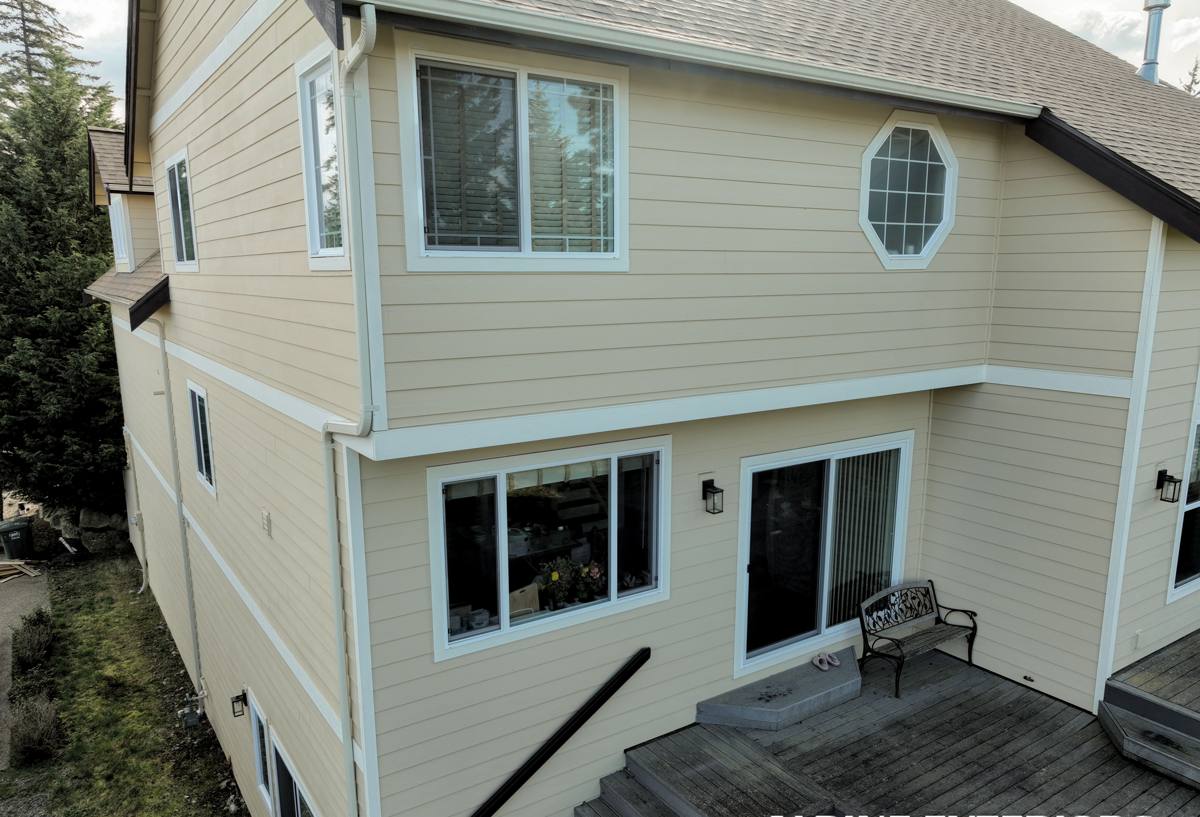
Signs Your Siding Needs a Repair Call
Most siding problems around Snohomish don't start as emergencies — they start small and get worse every winter they're left alone. It's worth having a professional take a look if you notice any of the following:
- Soft or spongy spots when you press on the siding, especially near the bottom courses or below windows
- Visible gaps, cracks, or separation at butt joints, corners, or trim boards
- Bubbling, peeling, or chalky paint that keeps returning in the same spots after repainting
- Dark streaking, green or black growth, or a musty smell near an exterior wall
- Warped, buckled, or bowing panels or boards
- Water stains on interior walls or ceilings that line up with an exterior wall
- Caulk that has cracked, shrunk, or pulled away from joints and trim
What's Actually Causing Most of the Repair Calls We See
Moisture behind the siding, not on it
The siding itself is often the last thing to fail. More often, water is getting behind it — through a gap in flashing, an unsealed nail hole, or a joint that opened up over time — and doing its real damage to the sheathing and framing underneath before it ever shows up on the surface. A repair that only patches the visible board without checking what's happening behind it tends to fail again within a season or two.
Failed caulk and sealant joints
Caulk is a wear item, not a permanent fix. In a climate with this much rainfall and temperature swing, sealant at trim, window, and joint lines has a limited service life. Once it cracks or lets go, wind-driven rain finds the gap fast, often well before the failure is visible from the ground.
Moss, mildew, and trapped moisture
Growth on the surface is both a cosmetic problem and a moisture-retention problem. Left alone, it holds water against the siding and finish far longer than the material was ever meant to sit wet, which accelerates whatever damage is already underway underneath.
Impact and mechanical damage
Cracked or dented boards from storm debris, ladders, or general wear are usually the most straightforward repairs to make. The real question is whether the crack has already let water in behind it before it gets patched or replaced — which is why we check, rather than assume.
Repair or Replace? Reading the Signs
Not every problem area needs a full re-side, and not every issue can be solved with a patch. Here's generally how we sort it out during an inspection:
| What We Find | Usually Points to a Repair | Usually Points to Replacement |
|---|---|---|
| Damage location | Isolated to one or two areas | Spread across multiple walls or elevations |
| Underlying sheathing and framing | Dry and sound once opened up | Soft, stained, or rotted beyond a small area |
| Age and material condition | Newer siding, sound everywhere else | Original material near the end of its service life |
| Root cause | A one-time impact or a single failed joint | A systemic issue like missing flashing or repeated intrusion |
| Match potential | Replacement pieces can blend in closely | Material is discontinued, faded, or unavailable |
What a Correct Repair Actually Involves
Find the water path first
Before anything gets cut or patched, we trace where water is actually getting in. That usually means pulling the affected boards or panels and checking the house wrap, flashing, and sheathing underneath — not just looking at the damaged piece from the outside. Skipping this step is the single biggest reason repairs fail to hold.
Match the material, not just the color
A patch that's the wrong thickness, profile, or exposure will telegraph through the finish and can even create a new spot for water to collect. Getting the replacement piece dimensionally correct matters as much as getting the color right.
Flashing and drainage details get rebuilt, not just caulked
Any repair that touches a window, door, deck ledger, or roofline intersection gets the flashing corrected properly. Caulk is a backup to good flashing, never a substitute for it — a repair that relies on sealant alone is a repair that will need to happen again.
Finish and touch-up
Once the repair is structurally sound, the finish work is what makes it disappear into the rest of the wall instead of standing out as an obvious patch years down the road.
Why We Only Repair and Install James Hardie Fiber Cement
We standardized on James Hardie fiber cement siding for every home we work on, repairs included, and it's worth explaining why in a climate like this one. Fiber cement doesn't rot, and it isn't a food source for the moss and mildew that thrive in Snohomish County's wet, shaded conditions the way some wood-based products can be. It carries a factory-applied ColorPlus finish that's baked on and warranted separately from the substrate, which matters when you're trying to match an existing wall — new pieces come from the same engineered product line rather than depending on a field-mixed paint match that ages differently over time. Hardie's HZ5 product line is also engineered specifically for the wind-driven rain and humidity swings this region sees year after year.
That's also why we don't take on vinyl, LP SmartSide, or cedar siding repairs. Each of those products has real strengths, and we're not here to run them down — but each also comes with trade-offs, whether that's moisture sensitivity, expansion and contraction, or ongoing maintenance demands, that make long-term repairs harder to guarantee in a climate like this one. Rather than patch a material we wouldn't install new, we focus on doing correct, lasting repair work on the product we're willing to stand behind with our own name.
Our Process for a Snohomish Repair Call
- Free on-site inspection, including probing suspect areas for hidden moisture damage — not just a visual walk-around
- A clear explanation of what we found, what's likely causing it, and whether repair or replacement makes more sense, with no push toward the bigger job
- A written scope covering exactly what gets opened up, replaced, and re-sealed
- Correct flashing and drainage detailing at every joint we touch, not just cosmetic patching
- Finish work matched to your existing James Hardie siding and color
- A final walk-through so you can see exactly what was done and why it was done that way
Why Hiring a Crew That Already Works This Area Matters
A contractor who already works Snohomish and the greater Everett area regularly has seen where moisture problems tend to start on homes like yours — which wall orientations hold moss the longest, which older siding installations were flashed correctly and which weren't, and how much margin to build in for the amount of driving rain a given wall actually takes over a winter. That kind of local pattern recognition is what separates a repair that lasts from one you'll be calling about again in a couple of years. It also means straightforward scheduling, honest timelines, and easy follow-up, since we're not driving in from outside the county for a callback.
Just as important is knowing when not to repair. A crew that's only paid when they sell you a bigger job has an incentive to find more wrong with your siding than there is. Our estimate is free either way, and we'll tell you plainly when a targeted repair is the right call and when it isn't.
If you're seeing soft spots, staining, or moss buildup on your siding, it's worth getting ahead of it before another wet season does more damage underneath the surface. Request a free, no-pressure estimate below and we'll take an honest look at what's going on and exactly what it would take to fix it right.