 Everett
 Why Silver Lake Decks Wear the Way They Do
Silver Lake sits in south Everett around one of Snohomish County's larger natural lakes, and a lot of the housing here backs up to trees, water, or both. That's part of what makes the neighborhood pleasant to live in, and it's also exactly why decks here take a particular kind of beating. Between the lake's moisture, the tree cover on many lots, and the long stretch of wet, low-sun months typical of this part of Washington, a deck in Silver Lake deals with more sustained dampness than a deck on an open, sunny lot across town would.
Add in the region's mix of salt-tinged marine air drifting in from Puget Sound and driving rain that comes in sideways during a real Pacific Northwest storm, and you've got conditions that work a deck from several angles at once — moisture that won't fully dry out between rain events, moss and algae that take hold anywhere shade and dampness overlap, and fasteners that corrode faster than they would in a drier climate. None of that means a deck here is doomed. It means repair work has to actually account for what's causing the damage, not just patch what's visible on top.
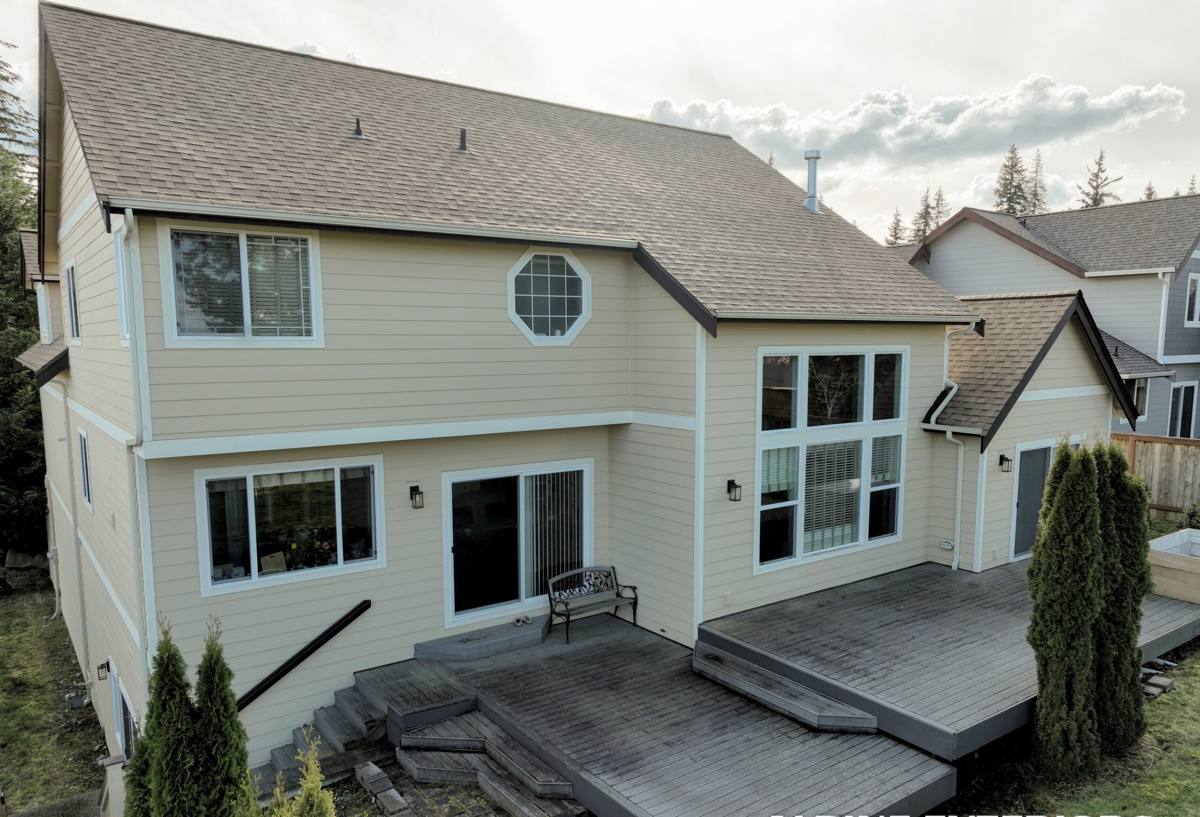
Signs a Silver Lake Deck Needs Attention
Surface Signs
Graying wood, a greenish or black film on boards, and a slick feel underfoot are the most common complaints we hear, and they're mostly about moss and algae rather than structural failure. Silver Lake's tree-shaded lots and lake-adjacent humidity give moss a long growing season here — often close to eight or nine months out of the year compared to a shorter window on more exposed properties. Left alone, that surface growth holds moisture against the wood and accelerates whatever's happening underneath.
Signs That Point to Something Deeper
A board that feels soft or spongy when you press on it, a railing that flexes more than it used to, a faint mustiness near the ledger where the deck meets the house, or visible rust bleeding around fasteners — these are the ones that matter most. They usually mean moisture has gotten past the surface and into the framing or hardware, and that's a different repair than resurfacing a few weathered boards.
| What You're Seeing | Usually Just Cosmetic | Often Points to a Real Problem |
|---|---|---|
| Green or black film, slick surface | Yes — moss/algae from shade and moisture | Only if boards underneath are also soft |
| Grayed, weathered wood color | Yes — normal UV and moisture weathering | Rarely on its own |
| Squeaking or slight give underfoot | Sometimes — loose fasteners | Often — joists or hangers working loose |
| Soft or spongy decking | No | Yes — rot from trapped moisture |
| Rust streaks around screws or bolts | Cosmetic if isolated | Can mean hardware has lost holding strength |
| Gap or movement at the house connection | No | Yes — ledger issue, needs prompt attention |
The honest read is that cosmetic issues can usually wait for routine care, while anything involving softness, movement, or the ledger connection shouldn't be put off through another wet Snohomish County winter.
What a Correct Repair Actually Involves
Starting With a Real Inspection
Before we recommend any repair, we walk the deck and check the parts that don't show from a casual look: the ledger board connection to the house, joist hangers and framing underneath, support posts and footings, and railing attachment points. On shaded, lake-adjacent lots like a lot of what's in Silver Lake, we pay particular attention to airflow underneath the deck and anywhere moisture has an easy path to sit rather than drain or dry.
Fixing the Cause, Not Just the Symptom
A soft board is a symptom. The cause is usually trapped moisture — poor drainage, boards laid too tight with no gap for water to shed, or a shaded spot that never fully dries between rain events. Replacing the board without addressing why it failed just means the replacement fails on a similar timeline. Correct repair work looks at drainage, spacing, and airflow as part of the fix, not as an afterthought.
Matching Hardware to the Climate, Not the Cheapest Option
Standard carbon-steel fasteners and hangers corrode faster in this kind of persistent damp climate, especially anywhere they're shaded most of the day. When we replace corroded hardware, we use stainless steel or coated fasteners rated for exterior, moisture-heavy exposure — not a like-for-like swap with builder-grade hardware that will show the same rust bleed again in a few years.
Structural Repairs Get Full Attention
Ledger connections, joist hangers, and support posts carry the actual load of the deck. When those need work, we repair them to the same standard as new construction — correct fastener grade, proper flashing at the ledger, and connections sized appropriately — rather than treating a repair as a smaller-stakes version of the job.
Moss and Algae: Managing the Real Local Enemy
Moss doesn't just make a deck look neglected — it holds water against wood and finish, which is exactly the condition that leads to soft boards and finish failure over time. On shaded Silver Lake lots, moss and algae growth is close to a year-round maintenance item rather than a once-a-season chore. Part of an honest repair plan here includes talking through what's realistic for ongoing upkeep, because a repair that ignores the moss problem is going to need repeating.
- Boards with wider gapping or grooved profiles that shed water and dry faster than tightly fitted decking
- Periodic cleaning with a deck-safe cleaner rather than aggressive pressure washing, which can drive water into the wood grain or strip finish unevenly
- Trimming back overhanging branches or brush where realistic, to get more light and airflow onto chronically damp sections
- Checking under-deck ventilation, since trapped humidity below the surface feeds moss growth from underneath as much as rain does from above
Repair vs. Replace: How We Actually Decide
Not every deck problem calls for a full rebuild, and not every repair is the more cost-effective path either. The factors that genuinely drive this decision:
| Factor | Leans Toward Repair | Leans Toward Replacement |
|---|---|---|
| Extent of framing damage | Isolated to a few joists or a hanger | Widespread rot through the substructure |
| Age of the deck | Mid-life, otherwise sound structure | Near end of practical service life |
| Original construction quality | Built to hold up with normal upkeep | Undersized framing or fasteners for this climate |
| Surface vs. structure condition | Surface worn, structure solid | Both surface and structure compromised |
| Ledger connection condition | Sound, properly flashed | Failing or never properly flashed originally |
We'll tell you plainly which category a given deck falls into, including when a repair genuinely isn't worth chasing anymore — that's a more useful conversation than defaulting toward whichever job is bigger.
Our Deck Repair Process
- Inspection and honest assessment. We check structure, hardware, drainage, and surface condition, and explain what we find in plain terms — what needs attention now, what can be monitored, and what's purely cosmetic.
- Written scope and estimate. You get a clear description of what's being repaired and why, not a vague line item.
- Repair work. Structural elements first if any are involved, then surface repairs — matching board profile and fastening method to what's already there wherever a reasonable match is available.
- Hardware upgrade where needed. Corroded fasteners and hangers get replaced with coastal-rated or stainless hardware suited to this climate, not a bare like-for-like swap.
- Walkthrough. We go over the completed work and talk through what upkeep will actually keep it holding up, given your lot's shade and moisture exposure.
Materials: Working With What You Have
Most repairs work with the deck's existing material rather than swapping systems mid-repair. For wood decks, that means sourcing matching or compatible lumber and refinishing to blend with the existing surface where practical. For composite or PVC decking, matching board profile and color gets harder the older the deck is, since manufacturers discontinue lines — we'll tell you upfront if an exact match isn't realistic rather than promising one and falling short.
Where a homeowner is deciding what to repair with versus replace toward, the honest trade-offs are usually about maintenance burden and moisture behavior rather than one material being simply "better." Wood costs less upfront and can be refinished, but it needs more regular attention in a climate like this one to keep moisture and moss from getting ahead of it. Composite costs more upfront and doesn't need refinishing, but it isn't repairable in the same forgiving way wood is — a damaged board typically gets replaced outright rather than sanded and resealed.
Keeping a Repair Lasting Once It's Done
- Clean the deck surface a couple of times a year to remove moss, algae, and organic debris before it works into the wood or finish
- Keep gaps between boards clear of leaves and needles so water and air can move through as designed
- Check railing posts and visible hardware seasonally, especially heading into the wet months, for early rust or looseness
- Trim back landscaping that shades the deck more than necessary or blocks airflow underneath it
- Address soft spots or new movement right away rather than waiting for the next scheduled look — those are structural signals, not cosmetic ones
- Reseal or refinish wood decking on a schedule that matches this climate, which usually means more often than manufacturer defaults written for drier regions assume
Why Hiring a Crew That Already Works Silver Lake Matters
A contractor who mainly works drier, sunnier properties can still do competent deck work, but a lake-adjacent, tree-shaded lot in this part of Snohomish County has patterns that show up more here than elsewhere in Everett — moss timelines that run longer than average, drainage details that matter more because boards don't dry out between storms, and corrosion patterns tied to the combination of marine air and persistent shade. Working this neighborhood regularly means we're not guessing at what's actually causing a given deck's problems or working out fastener choices for the first time on your project.
That familiarity also shows up in the estimate itself — a more accurate first look means less back-and-forth once the work is underway, because the inspection already accounts for how a Silver Lake lot actually behaves rather than applying a generic checklist built for a different climate.
Get a Straight Look at Your Deck
Whether you're dealing with one specific issue — a soft board, moss that won't quit, a railing that's started to flex — or just want an honest assessment of where your deck stands heading into another wet season, we're glad to walk the property and tell you plainly what we find, including if the answer is that it doesn't need much yet. Reach out below for a free, no-pressure estimate.