 Everett
 Siding Repair Built for Glenhaven's Marine Climate
Glenhaven sits inside the same weather system that shapes every neighborhood in Everett and the rest of Snohomish County: a marine climate off Puget Sound that delivers salt-tinged air, long stretches of driving rain, and a moss season that can run from fall through spring. None of that is dramatic on its own, but stacked year after year, it's exactly the kind of slow, steady exposure that finds every weak point in a home's siding. A caulk joint that's a season past its prime, a piece of trim with a hairline gap, a spot where moss has been quietly holding moisture against the wall — these are the small things that turn into real repair jobs if they sit too long.
Siding repair in a climate like this isn't just about patching what's visibly broken. It's about understanding why that section failed in the first place, so the repair doesn't just repeat the same problem in two or three years. That's the standard we hold every repair to, whether it's a single damaged board or a full section that needs to come off and be redone.
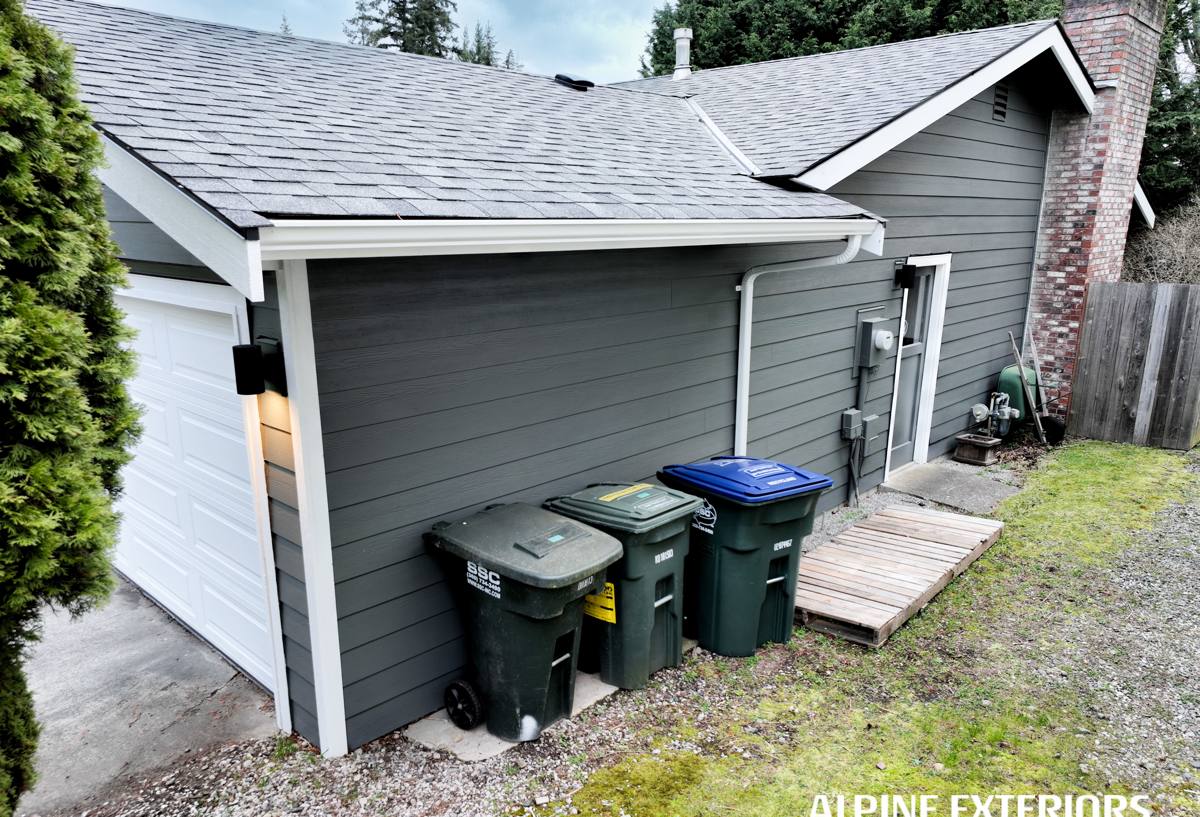
Signs a Glenhaven Home Needs Siding Repair
Most siding problems announce themselves quietly before they become expensive. Homeowners in Glenhaven should walk the exterior at least once a year — ideally before the wet season sets in — and look for:
- Soft, spongy, or discolored spots on siding boards, especially near the bottom of walls or under windows
- Visible cracking, warping, or buckling in individual panels or boards
- Moss or dark green-black staining building up in shaded, north-facing, or tree-covered sections
- Gaps or missing caulk at trim joints, window and door casings, and corner boards
- Paint that's peeling, bubbling, or chalking unevenly rather than just fading
- Small holes, dents, or missing chunks from impact damage — branches, hail, or yard equipment
- Musty smells or visible staining on interior walls that back up to exterior siding
Any one of these can be a minor fix. Several showing up in the same area, or repeat problems in the same spot year after year, usually point to something happening behind the siding — not just on the surface.
What's Actually Damaging Siding in This Area
Salt Air and Driving Rain
Homes closer to the water pick up airborne salt that accelerates the breakdown of fasteners, caulk, and paint film. Combined with wind-driven rain — which doesn't just fall straight down but gets pushed sideways into seams, laps, and trim joints — this is a one-two punch that wears down weak points faster than a drier inland climate would. Siding that's improperly lapped, under-caulked, or missing proper flashing at penetrations is where this shows up first.
Moss and Prolonged Moisture Contact
Moss doesn't just look bad. Where it colonizes siding — usually shaded walls, areas under overhangs with poor airflow, or spots near mature trees — it holds moisture against the surface far longer than an open, sun-exposed wall would. On wood-based products, that sustained dampness is what leads to soft spots and rot. Even on more moisture-resistant materials, heavy moss buildup traps grime and organic acids against the finish and accelerates wear.
Freeze-Thaw and Seasonal Movement
Everett doesn't see extreme cold often, but the freeze-thaw cycles it does get can widen small cracks in caulk or siding material that started as a minor cosmetic issue. Water gets into the gap, freezes, expands, and the gap gets a little bigger — repeated every cold snap until the problem is visible from the street.
Original Installation Quality
A significant share of the repair calls we get trace back to how the siding was originally installed — not the material itself. Missing or short flashing, caulk used in place of proper flashing, nails driven too tight or too loose, and butt joints that weren't sealed correctly all shorten the life of otherwise decent siding. A repair that doesn't correct the underlying installation flaw is a repair that will need to be done again.
Repair or Replace? How We Make the Call
Not every damaged section needs full replacement, and not every repair is worth doing instead of replacing. We look at the extent of the damage, what's causing it, and how much of the wall assembly is affected before recommending either path.
| Factor | Favors Repair | Favors Replacement |
|---|---|---|
| Extent of damage | Isolated to one or two boards or a small section | Spread across a wall or multiple elevations |
| Cause | Impact damage, failed caulk, isolated moss buildup | Widespread rot, failed water-resistive barrier, chronic moisture intrusion |
| Underlying sheathing | Sound, dry, no soft spots when probed | Soft, delaminating, or water-stained sheathing found during removal |
| Material match | Existing siding line/color still available or close enough to blend | Discontinued product, faded mismatch would be obvious |
| Age of existing siding | Mid-life, otherwise performing well | Near or past expected service life |
We won't recommend a full replacement just to increase the size of a job, and we won't patch over a problem that's going to come back through the same wall in a year. If a repair uncovers rotted sheathing or a compromised water-resistive barrier, we'll show you what we found before doing anything further.
What a Correct Repair Actually Involves
A siding repair that holds up in this climate is more than swapping a damaged board for a new one. Done right, it includes:
- Removing enough surrounding material to see what's actually going on behind the siding — not just the damaged piece itself.
- Inspecting the sheathing and water-resistive barrier underneath for softness, staining, or gaps before anything new goes back on.
- Correcting flashing and lap details at windows, doors, and any penetrations in the repaired area, not just replicating what was there before if it was the source of the problem.
- Matching material and finish as closely as possible so the repair doesn't stand out as a patch.
- Proper fastening and sealing using manufacturer-specified nails, spacing, and caulk compatible with the siding material.
- Cleaning surrounding moss or growth so the repaired section isn't immediately recolonized by the same conditions that caused nearby damage.
Skipping steps 1 through 3 is how repairs turn into repeat service calls. A new board over a wet, soft substrate is a cosmetic fix with a short clock on it.
Why We Repair and Replace With James Hardie Fiber Cement Only
When a repair calls for new material — whether it's a few boards or a full section — we use James Hardie fiber cement, and that's the only siding product we install anywhere, including on repair work. We made that decision because fiber cement holds up to exactly the conditions Glenhaven deals with: it's non-combustible, it doesn't rot the way wood-based products can when moisture gets past a seam, and it's engineered specifically for wet, marine climates through Hardie's HZ5 product line — which is the specification for our region.
We don't patch Hardie siding with vinyl, LP SmartSide, or other materials, and we don't install those products as replacements even when a homeowner already has them elsewhere on the house. It's not that those products have no merit — vinyl is inexpensive and low-maintenance in mild conditions, and engineered wood siding has real fans — but we've made a professional call to stand behind one system we know performs, rather than warranty and install multiple product lines with different moisture behaviors, different fastening requirements, and different failure patterns. Hardie's ColorPlus factory finish also means a repaired section can often be matched far more closely in color and sheen than a field-painted alternative, which matters when the goal is a repair that blends in rather than announces itself.
Our Process for Glenhaven Homeowners
Every repair starts with a walk-around inspection of the affected area and, where it's relevant, the rest of the exterior — because siding damage rarely shows up in only one spot. From there:
- We identify the cause, not just the symptom, and explain what we find in plain terms
- We give you a clear recommendation on repair versus replacement, with the reasoning behind it
- We provide a written estimate before any work begins, with no pressure to upsize the scope
- We remove and inspect surrounding material as needed to confirm the sheathing and barrier underneath are sound
- We match material and finish as closely as the product line allows
- We clean up the job site and walk the finished repair with you before we consider it done
Because we're regularly working in Everett and the surrounding Snohomish County neighborhoods, we're familiar with how homes in this area age and where problems tend to show up — which shaded walls hold moss longest, which elevations take the worst of the wind-driven rain, and which older installation methods are common enough locally that we know to check for them.
Why Local Experience in Glenhaven Matters
Siding repair is one of those trades where local familiarity actually changes the outcome. A crew that only occasionally works this area might treat every repair as a generic patch job. A crew that works Glenhaven and the surrounding Everett neighborhoods regularly knows that a soft spot on a north-facing wall under tree cover is a different problem than the same soft spot on a sun-exposed south wall, and that a home a few blocks closer to the water may need more attention to fastener and caulk condition than one further inland. That context shapes the repair, not just the estimate.
It also means faster response. Storm damage, a sudden leak, or an urgent repair before a home sale doesn't wait for a convenient week — having a crew that's already in the neighborhood shortens the gap between the call and the fix.
Get a Straight Answer on Your Siding
If you've noticed a damaged section, a persistent moss problem, or a spot that just doesn't look right, it's worth having it looked at before the next wet season makes it worse. We'll give you a clear, honest read on what's causing it and what it will actually take to fix — no pressure, no inflated scope. Reach out for a free estimate using the form below.