 Everett
 Riverside's Roofs Work Harder Than Most
Riverside sits close enough to open water and heavy tree cover that its roofs take on a mix of stresses you don't see in drier, more open parts of Snohomish County. Salt-laden air moves in off the water and slowly works on exposed metal — nail heads, flashing, gutter hardware — long before most homeowners notice anything wrong. Add driving rain that comes in sideways during winter storms, and you've got a roof that's being tested at every seam, not just the open field of shingles. Then there's the shade. Mature trees are part of what makes Riverside a nice place to live, but they also mean roofs here stay damp longer after a storm and grow moss faster than roofs out in full sun.
None of this means Riverside is a hard place to keep a roof in good shape. It means the installation has to account for these conditions from the start, instead of using the same generic approach you'd use on a roof in a dry, open lot. That's the difference between a shingle roof that looks fine for two years and one that actually holds up for its full service life.
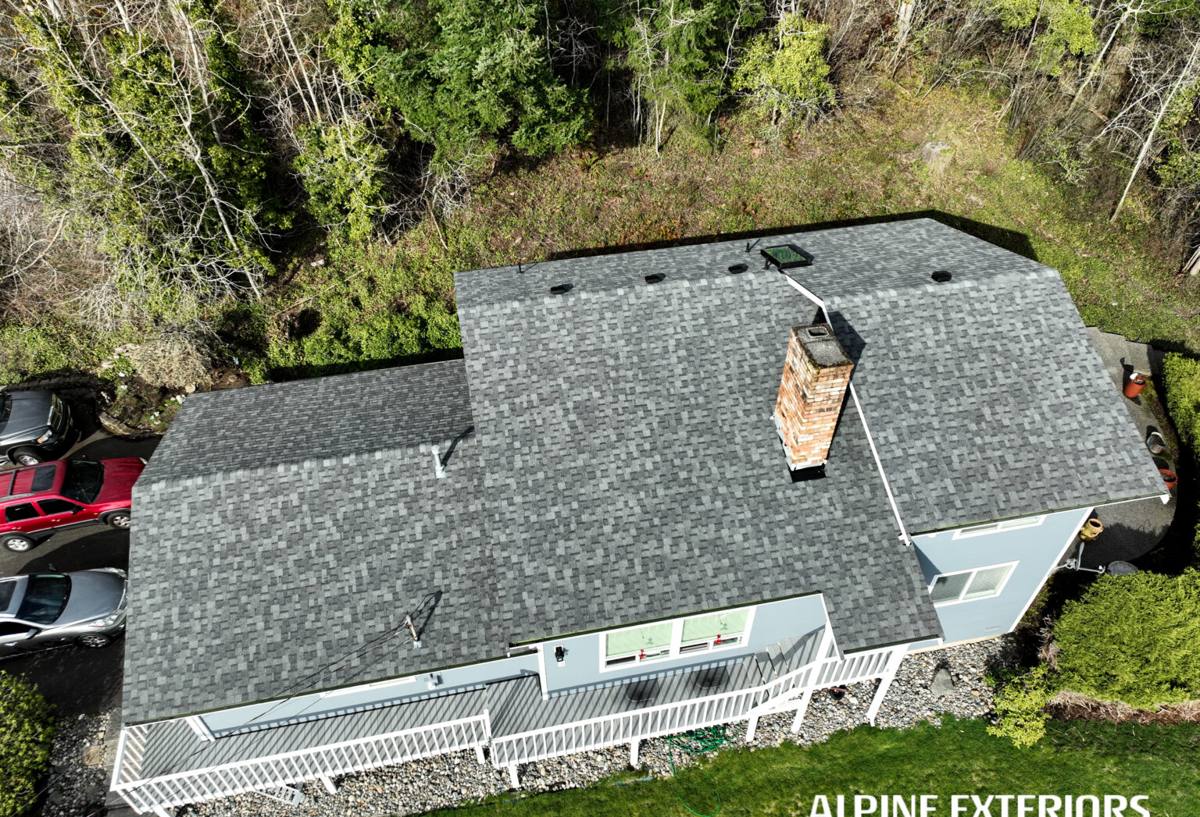
What a Correctly Installed Asphalt Shingle Roof Actually Includes
Asphalt shingles themselves are a mature, well-understood product — most roofing failures we get called out for aren't because the shingles were bad, they're because something underneath or around them was rushed. A correct installation in this climate covers a few things that are easy to skip and hard to see once the roof is finished.
Underlayment and Water Barrier
The underlayment is the roof's backup plan for the rain that finds its way past the shingles — and in a climate with as much driving, wind-pushed rain as this one, that backup plan gets used more often than people assume. We use synthetic underlayment across the field for its tear resistance and consistent moisture protection, with self-adhering ice-and-water barrier at the eaves, valleys, and any low-slope transitions where water tends to back up or pool.
Flashing at Every Transition
Chimneys, skylights, sidewalls, and roof-to-roof valleys are where the overwhelming majority of leaks start — not the open shingle field. Correct flashing means new metal at these transitions, properly stepped and layered with the underlayment (not just caulked over old flashing), so water is always directed downhill and off the roof rather than trapped behind a seam.
Nailing Pattern and Exposure
Every shingle has a manufacturer-specified nailing zone and exposure, and both matter more in a windy, wet climate than a mild one. Nails placed too high, too few per shingle, or driven at an angle reduce wind resistance and let water track down the nail shank into the deck. We follow the manufacturer's nailing pattern exactly — it's the fastest way to void a warranty if it's skipped, and the easiest thing for a rushed crew to shortcut.
Ventilation Balance
Intake at the eaves and exhaust at or near the ridge need to work together, not against each other. An unbalanced system traps heat and moisture in the attic, which shortens shingle life from underneath — a problem that shows up as premature curling or granule loss even though the shingles themselves were installed correctly.
Choosing Shingles That Hold Up Here
Not every asphalt shingle is built for a shaded, wet, salt-air environment, and the differences matter more here than they would in a drier climate. The two biggest factors we weigh with Riverside homeowners are algae resistance and wind rating.
Algae-resistant (AR) shingles use copper- or zinc-infused granules that slow the growth of the blue-green algae responsible for the dark streaking you see on older roofs. In a neighborhood with as much shade and moisture as Riverside, this isn't a cosmetic upgrade — it's a practical one that reduces how often the roof needs cleaning and slows granule loss caused by algae breaking down the shingle surface over time.
Wind rating matters because of the exposed, storm-driven weather that comes through in fall and winter. A higher wind-rated shingle, properly nailed, is far less likely to lift or lose tabs in a wind event than a standard shingle installed the same way.
| Shingle Type | Typical Lifespan | Wind Rating | Best Fit For |
|---|---|---|---|
| 3-Tab (Standard) | 15-20 years | Lower | Budget-focused projects, less wind/tree exposure |
| Architectural / Dimensional | 25-30 years | Moderate-High | Most Riverside homes — good balance of durability and cost |
| Premium / Impact-Rated | 30+ years | High | Heavily treed lots, storm-exposed roofs, longer-term hold |
We don't push homeowners toward the most expensive tier by default — for a lot of Riverside homes, a well-installed architectural shingle with algae-resistant granules is the right balance of cost and performance. Where a lot has heavy tree cover or a history of wind damage, we'll say so and explain why the upgrade is worth considering.
Moss and Algae: Managing a Long Wet Season
Moss doesn't cause damage by sitting on a roof — it causes damage by holding moisture against the shingle surface and, over time, lifting shingle edges as it grows. Roofs with heavier tree cover, which describes a fair number of lots in Riverside, stay damp longer after rain and are naturally more prone to moss and algae growth than roofs in full sun.
A few practices keep this manageable without shortening the roof's life:
- Keep overhanging branches trimmed back so more sunlight and airflow reach the roof surface
- Clear gutters and valleys regularly — trapped debris holds moisture and feeds moss growth
- Have moss physically removed by a professional rather than pressure-washed, which can strip granules and shorten shingle life
- Consider zinc or copper strips near the ridge, which release trace metals with each rain to slow regrowth
- Avoid bleach-heavy DIY cleaners, which can damage landscaping and, over repeated use, degrade shingle surfaces
None of this replaces a well-installed roof — it's maintenance on top of one. A roof with correct underlayment, flashing, and ventilation will tolerate an occasional moss season far better than one with shortcuts underneath, even with identical maintenance.
Ventilation and Moisture: What's Happening Inside the Attic
Homeowners tend to focus on what's visible from the ground, but a lot of shingle roof problems in this climate start in the attic. Warm, moist air rising from the living space meets a cold roof deck in winter, and if it isn't vented out efficiently, it condenses. Over time that condensation can rot decking, grow mold, and cause shingles to fail from underneath — well before their expected lifespan, and often before there's any visible sign on the roof surface itself.
Balanced ventilation — enough intake at the soffits to match exhaust at the ridge — keeps that moist air moving out instead of settling. During any roof replacement, we check existing ventilation as a matter of course, not as an upsell. On an older Riverside home, it's common to find soffit vents that were painted over, blocked with insulation, or never sized correctly for the roof's exhaust in the first place.
Our Installation Process
The steps themselves aren't a secret — most roofing crews will describe something similar. What matters is that each one actually gets done, in order, without shortcuts to save time on a rainy-week schedule.
- On-site inspection of the existing roof, decking, and ventilation before any pricing is finalized
- Written estimate that spells out shingle type, underlayment, and flashing scope — no vague line items
- Tear-off to bare decking so we can check for rot or soft spots hidden under the old shingles
- Deck repair or replacement of any damaged sheathing before new underlayment goes down
- Ice-and-water barrier at eaves, valleys, and vulnerable transitions, synthetic underlayment across the field
- New flashing at chimneys, skylights, sidewalls, and valleys — not caulk over old metal
- Shingles installed to the manufacturer's nailing pattern and exposure specification
- Ventilation checked and corrected where intake and exhaust are out of balance
- Full site cleanup, including a magnetic sweep for stray nails
We also handle the permitting that most roof replacements in Snohomish County require — that's part of the job, not something we hand back to the homeowner to sort out.
Repair, Patch, or Full Replacement?
Not every roof problem calls for a full tear-off, and we'll tell you plainly when a repair makes more sense than a replacement. A few signs point one way or the other:
Usually repairable: isolated flashing leaks, a handful of wind-damaged shingles, minor granule loss confined to one slope, or damage from a single storm event on an otherwise sound roof.
Usually points to replacement: widespread granule loss and shingle curling across multiple slopes, soft or spongy decking found during inspection, a roof already past 20-25 years old with recurring leaks in different spots, or moss and moisture damage that's affected the underlayment itself rather than just the shingle surface.
An honest inspection is the only way to know which category a given roof falls into — age alone doesn't tell the whole story, and neither does surface appearance from the ground.
Why Local Experience in Riverside Matters
A crew that's worked roofs throughout the Everett area already knows how differently a shaded, tree-lined lot behaves compared to an open one a few miles away. That shows up in small but real decisions — where moss tends to concentrate on a given roof orientation, which flashing details hold up best against wind-driven rain off the water, and how to sequence a tear-off around this region's unpredictable rain windows so decking doesn't sit exposed longer than it should. It also means we're familiar with the permitting process in Snohomish County and can move a project through it without it becoming the homeowner's problem to manage.
None of that replaces sound installation fundamentals — correct underlayment, flashing, nailing, and ventilation matter everywhere. But local experience is what keeps those fundamentals from being applied blindly, without regard for what actually wears a roof down in this specific part of Everett.
If you're weighing a repair, planning ahead for a full replacement, or just want a straight answer on what condition your roof is really in, we're happy to take a look. Use the form below to request a free, no-pressure estimate for your Riverside home.