 Everett
 Why West Everett Roofs Take a Different Kind of Beating
Every asphalt shingle roof is rated to handle sun, rain, and wind, but the rating on a shingle wrapper doesn't know which neighborhood the roof will sit in. In West Everett, a shingle roof deals with three things at once for most of the year: salt-tinged air moving off Port Gardner Bay and Puget Sound, driving rain that comes in sideways more often than straight down, and a moss season that barely ever fully stops. None of those three things is unusual on its own for western Washington. Layered together, on a roof plane that faces the water or sits under mature tree cover, they add up to a roof that ages faster than the same shingle would on a drier, more sheltered lot.
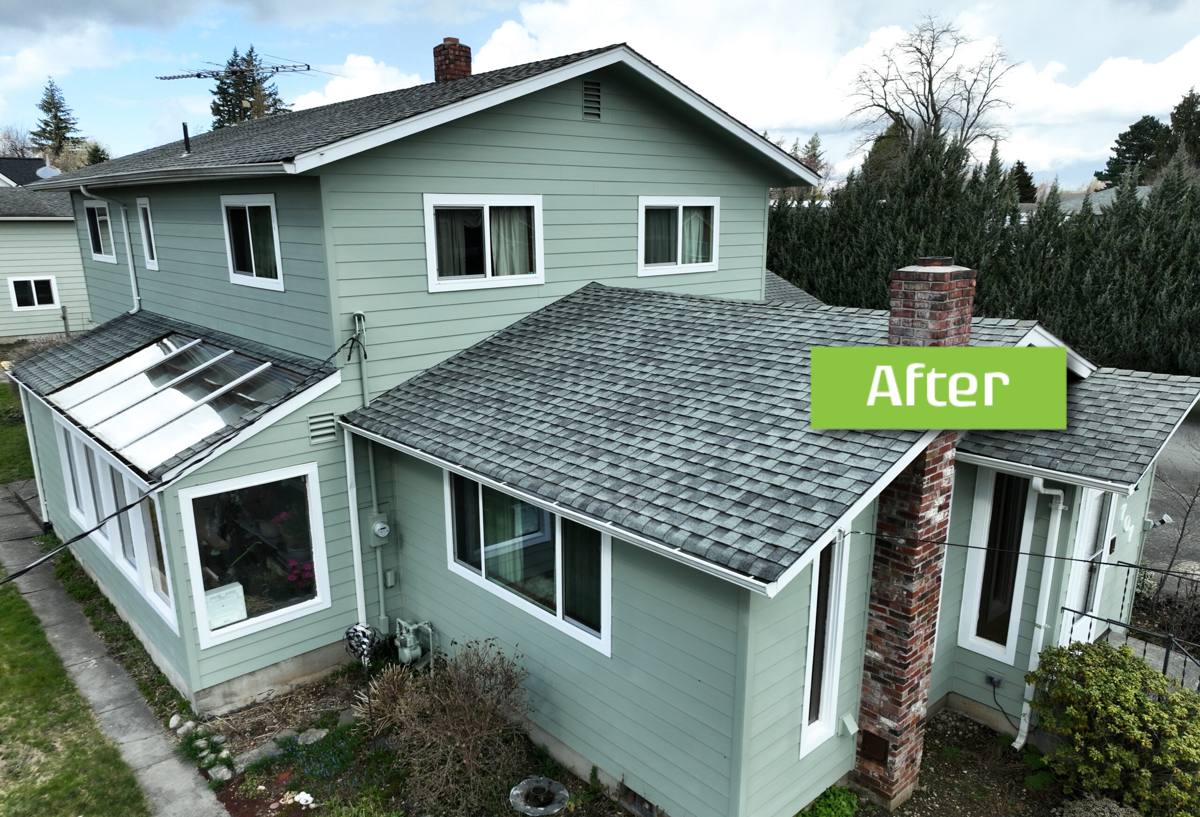
We work in West Everett regularly, and the same patterns show up on roof after roof: granule loss concentrated on the water-facing slope, moss establishing first in shaded valleys and north-facing planes, and flashing failures showing up years before the shingle field itself is actually worn out. This page covers what asphalt shingle roofing specifically needs to hold up here, what a correct installation looks like, and why a crew that already knows this neighborhood's roofs is worth more than a generic bid.
What the Local Climate Actually Does to a Shingle Roof
Salt Air and Corrosion
Homes closer to the water pick up salt-laden air that settles on every exposed metal component of a roof system — nail heads, flashing, vent stacks, gutter hardware. Over years, that accelerates corrosion on lower-grade fasteners and thin-gauge flashing faster than it would further inland. It rarely shows up as a dramatic failure; more often it's a slow rust bloom around a pipe boot or a nail pop where a corroded fastener has lost its grip on the decking. The fix isn't complicated — corrosion-resistant fasteners and properly specified flashing metal — but it only helps if it's specified and installed correctly the first time, since almost none of it is visible or easy to fix later without pulling shingles back up.
Driving, Wind-Driven Rain
Everett doesn't see the heaviest annual rainfall in the state, but it sees a lot of wind-driven rain, especially during fall and winter storms that move through Snohomish County off the Sound. Wind-driven rain doesn't behave like rain falling straight down — it gets pushed sideways and even slightly upward under shingle tabs, around chimney flashing, and along rake edges. A roof that sheds water fine in a calm rain can still leak in a sideways storm if the underlayment, flashing laps, and shingle nailing pattern weren't built with that in mind from the start.
A Moss Season That Barely Takes a Break
Between mild temperatures, shade from the mature evergreens common on West Everett lots, and rain that keeps roof surfaces damp for long stretches, moss and algae have close to a year-round growing window here. Moss doesn't just look bad — it lifts shingle tabs as it grows, holds moisture against the shingle mat longer than the shingle was ever designed for, and works its way toward the fasteners and decking underneath if it's left alone for a few seasons.
Choosing the Right Shingle for This Kind of Exposure
Not every asphalt shingle is built the same way, and the differences matter more here than they would in a drier climate. The table below is roughly how we break down the main shingle classes with West Everett homeowners.
| Shingle Type | Wind Rating | Algae Resistance | Best Fit For |
|---|---|---|---|
| 3-Tab | Lower rating; flatter, single-layer profile | Available with algae-resistant granules, but a thinner mat sheds them faster over time | Budget rebuilds, secondary structures, detached garages |
| Architectural / Dimensional | Higher rating from heavier, laminated construction | Holds algae-resistant granule coatings longer thanks to the thicker mat | Most primary home reroofs in this climate |
| Impact-Resistant (Class 4) | Comparable to or better than standard architectural | Same granule technology; heavier mat resists cracking under debris impact | Lots under heavy tree cover with regular limb or cone fall |
For most West Everett homes we recommend architectural shingles with algae-resistant granules as the baseline — not because 3-tab shingles are a bad product, but because the heavier laminated mat and higher wind rating are a better match for what this specific climate does to a roof over its lifespan. Impact-resistant shingles are worth the upgrade conversation on lots with heavy tree cover, where falling limbs and cones are a regular occurrence, since the heavier mat resists the bruising and cracking that leads to early granule loss.
What a Correct Installation Actually Involves
Tear-Off and Deck Inspection
We don't install new shingles over an old roof, and we don't recommend it as a shortcut. A full tear-off is the only way to actually see the deck — and in a climate this wet, deck problems don't announce themselves until the old material comes off. Soft spots, delaminated sheathing, and old fastener holes all need to be addressed before new material goes down, because covering a compromised deck with new shingles just hides the problem for a few more years instead of fixing it.
Underlayment and Ice-and-Water Barrier
The underlayment layer does more of the actual waterproofing work than most homeowners realize — the shingles shed the bulk of the water, but the underlayment is what protects the deck when wind drives rain up under a tab or ice forms along an eave in a cold snap. We use synthetic underlayment across the field and self-adhering ice-and-water barrier at eaves, valleys, and low-slope transitions, which matters more here than in a drier climate because those are exactly the spots where wind-driven rain and standing moisture find their way in first.
Flashing Details
Flashing failures are the single most common cause of roof leaks that get blamed on the shingles instead. Step flashing at wall intersections, counter-flashing at chimneys, and properly lapped valley metal all have to be installed in the correct sequence with the underlayment and shingle courses — not caulked in afterward as a patch. Given how much salt air this region's metal components deal with, we spec flashing material rated for that exposure rather than the thinnest option that technically meets code.
Ventilation
A shingle roof needs balanced intake and exhaust ventilation to let moisture that builds up in the attic escape before it condenses against the underside of the deck. Poor ventilation shortens shingle life from underneath, which is easy to miss since the damage isn't visible from the ground, and it's a common gap we find on older West Everett homes that have had one or two reroofs without anyone revisiting the original ventilation design.
Signs a West Everett Roof Needs Attention
- Granule buildup collecting in gutters or at downspout outlets, especially after a windy rain
- Dark streaking or green-black growth concentrated on north-facing or shaded roof planes
- Shingle tabs that look lifted, curled, or cupped, particularly on the slope facing the water
- Soft or spongy spots when walking the roof, or visible sagging along a ridge or valley line
- Rust staining running down from a vent pipe, chimney flashing, or roof-mounted fixture
- Daylight visible through the attic decking, or damp insulation after a storm
- Moss thick enough that you can't see the shingle surface underneath it in shaded areas
How Our Process Works, Start to Finish
- On-site inspection — we walk the roof itself, not just look from the ground, and check the attic from inside, noting deck condition, ventilation, and any flashing trouble spots specific to your home.
- Written estimate — a clear breakdown of shingle class, underlayment and ice-and-water barrier scope, flashing work, and disposal, so you know what you're paying for before anything starts.
- Tear-off and deck repair — full removal of the old material, a real deck inspection, and replacement of any compromised sheathing before anything new goes down.
- Underlayment, flashing, and shingle installation — installed in the sequence that actually sheds wind-driven rain, not just laid down fast.
- Cleanup and walkthrough — a magnetic sweep for stray fasteners, haul-away of the old material, and a walkthrough so you can see the finished work and ask questions before we call the job done.
Maintenance That Actually Extends Shingle Life Here
A correctly installed shingle roof in this climate still benefits from some basic upkeep, and skipping it is the most common reason a roof underperforms its expected lifespan.
Keep Gutters Clear
Trapped water backs up under the eave edge and puts stress on that transition even with a well-installed ice-and-water barrier underneath. Clearing gutters a couple of times a year, more often if there's overhanging tree cover, is one of the cheapest things a homeowner can do to protect the roof edge.
Address Moss Before It Establishes
Gentle removal and a zinc- or copper-based treatment approach, done before moss gets a real foothold, is far less disruptive to the shingle surface than removing an established mat that's already lifted tabs and worked into the granule layer. Pressure washing is not the answer — it strips granules and can force water under the shingle courses.
Trim Back Overhanging Limbs
Cutting back branches that shade a roof plane reduces both the dampness that helps moss establish and the physical debris — needles, cones, small limbs — that clogs valleys and can bruise shingles over time.
Why It Matters That the Crew Already Works West Everett
A roofing crew that's only seen your neighborhood's climate on a spec sheet is working from theory. A crew that's already replaced and repaired shingle roofs on West Everett's older homes, on properties closest to the water, and on heavily wooded lots further back from the shoreline has already seen where this specific combination of salt air, wind-driven rain, and moss tends to cause problems — and builds around it instead of finding out the hard way afterward. That local pattern recognition shows up in small decisions: which flashing spec to use on a water-facing slope, where ventilation tends to get shorted on older homes in this area, and which roof planes need the closer look during inspection because they're the ones that shade out and hold moss first.
If your West Everett home is due for a new shingle roof, or you're not sure whether what you're seeing — granule loss, a stubborn patch of moss, a stain on the ceiling after a windy storm — is something to worry about, we're happy to take a look. We'll walk the roof, check the attic, and put together a straightforward, no-pressure estimate with no obligation attached.