 Everett
 Board & Batten Siding for Port Gardner's Waterfront-Facing Homes
Port Gardner sits right up against the bay it's named for, and that proximity to open water shapes what a siding job here actually needs to survive. Homes on the bluffs and blocks overlooking Port Gardner Bay catch weather that inland Everett neighborhoods don't get nearly as directly — salt-tinged wind, rain that comes in sideways off the water, and shaded walls that stay damp long after a storm has passed. Board and batten has become a popular choice in this part of Everett because the vertical lines suit both the older homes that make up a lot of Port Gardner's housing stock and the newer construction going up nearby. It's a good-looking profile. It's also a profile with more seams than standard lap siding, and every one of those seams is a place water can try to get in.
We install James Hardie fiber cement board and batten exclusively. On a wall this exposed to Port Gardner's combination of salt air, driving rain, and a moss season that runs most of the year, the material behind the finish and the way it's detailed matters as much as how the siding looks from the street.
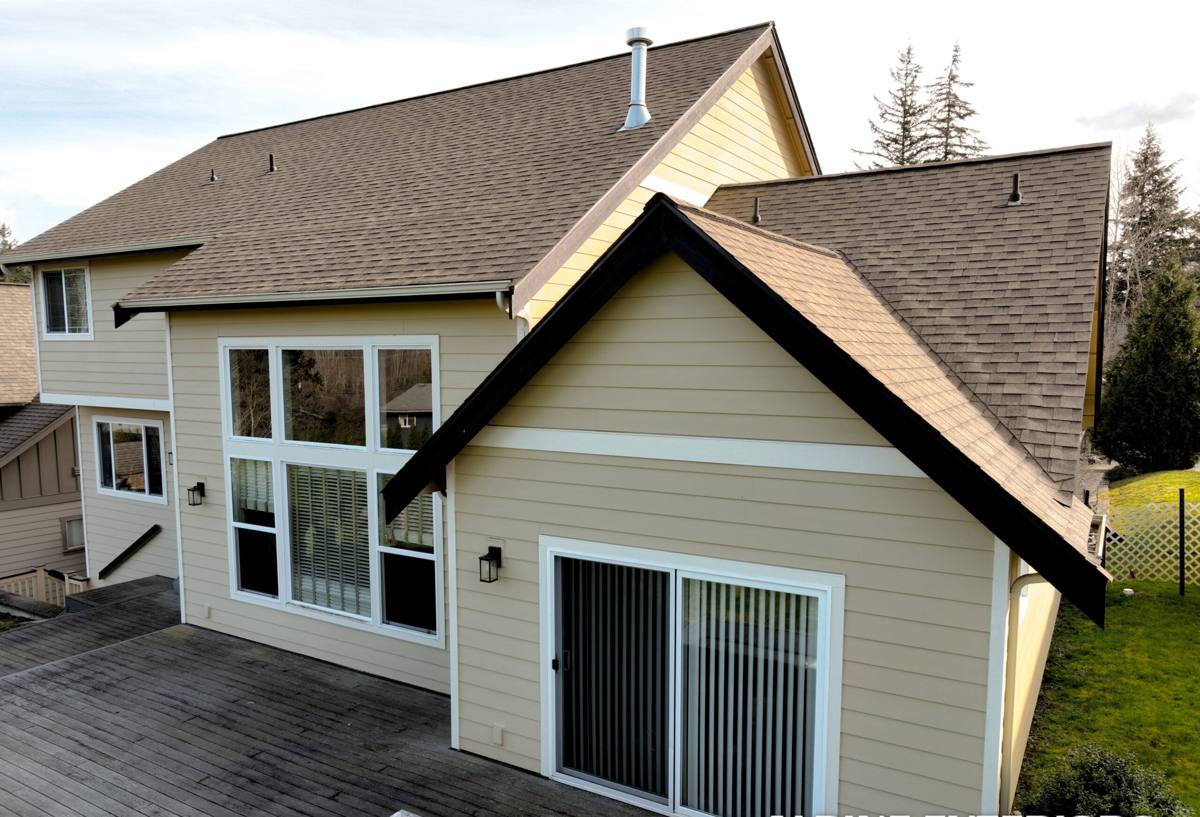
What Port Gardner's Exposure Does to a Board & Batten Wall
Salt Air and Fastener Corrosion
Board and batten uses more fasteners per square foot than lap siding, because both the boards and the battens covering their seams need to be secured independently. On a wall exposed to salt-tinged air coming off Port Gardner Bay, fastener quality isn't a minor spec — it's one of the first things that fails if it's cut. Undersized or poorly coated fasteners corrode faster near the water than they would a few miles inland, and a corroding fastener doesn't just look bad; it loosens its grip on the board over time and opens a path for water right at the seam.
Driving Rain Off the Water
Wind off the bay tends to push rain sideways rather than letting it fall straight down, and homes on Port Gardner's bluffs and open-facing lots take that wind-driven rain directly on walls that a more sheltered inland home would never see. Vertical board and batten gives that rain a lot of joint length to test — every batten seam running the height of the wall is a seam that has to be built to shed water outward, not just cover the gap visually.
A Moss Season That Doesn't Really End
Shaded and north-facing walls in this part of Snohomish County stay damp for most of the year, and that dampness is exactly what moss and mildew need to take hold. A batten set tight against a board with no room to breathe traps moisture right where it can't dry, which is a slow, quiet path toward staining, soft substrate, and paint failure right along the seam line — the kind of damage that doesn't show up until it's already a repair job.
Why the Vertical Profile Raises the Stakes
Every siding profile has to manage water, but board and batten manages it through a repeating pattern of vertical joints instead of the overlapping horizontal shingle-lap that lap siding relies on. That means the total length of exposed seam on a board and batten wall is meaningfully higher than on the same wall sided with standard lap boards. In a climate that's dry and mild for long stretches, that difference might not matter much. In a climate like Port Gardner's — wet more months than not, with real wind exposure off open water — it matters a lot, because every extra inch of seam is an extra inch that has to be flashed, fastened, and spaced correctly or it becomes the wall's weak point.
That's not a reason to avoid board and batten. It's a reason to be exacting about how it's built, and about what material is doing the work behind the finish.
Why We Only Install James Hardie for This Profile Here
We don't offer LP SmartSide, vinyl, Cemplank, Allura, primed spruce, or cedar board and batten. Those are real products, and other contractors install them competently. Our reasoning is specific to this profile and this location: board and batten's seam count amplifies whatever weaknesses a material already has, and Port Gardner's salt air, wind-driven rain, and long wet season are unforgiving of those weaknesses.
Wood-based products — cedar and engineered wood alike — absorb moisture at cut edges and swell or cup slightly with wet-dry cycling, which is a bigger problem on a profile with this many exposed edges than it would be on a single wide lap board. Vinyl board and batten can gap or bow at the battens as it expands and contracts with temperature, and because it's a thinner, more flexible material, it's less forgiving of the wind loads this part of the bay can produce. Fiber cement doesn't share those behaviors — it's dimensionally stable across wet and dry cycles, which is exactly the property that matters most on a wall built entirely out of vertical seams. James Hardie's ColorPlus finish is also factory-applied and cured under controlled conditions, so the number of surfaces depending on field-applied paint to hold up against this climate is small — mainly the field-cut edges we prime on site, not the whole wall face.
That's the trade-off we made: a narrower product lineup in exchange for standing behind a material system we trust completely on the profile where material weaknesses show up fastest.
What a Correct Installation Actually Involves
Board and batten looks simple from the street — vertical boards, battens over the seams — but a correct install has a lot happening behind that surface, especially on a wall facing Port Gardner's weather:
- Weather-resistive barrier installed and correctly lapped before any siding goes up, so the wall has a real second line of defense
- A drainage gap or rainscreen behind the siding so moisture that gets past the surface can dry out instead of sitting against the sheathing
- Corrosion-resistant fasteners at the spacing James Hardie specifies for this profile, not a generic "enough to hold it up" pattern
- Battens set with proper clearance rather than caulked tight, so the wall can shed water instead of trapping it against the board
- Flashing and lapping done correctly at windows, doors, corners, and the base of the wall, where board and batten's vertical run meets a horizontal surface
- Field-cut edges primed before installation, since the factory finish only covers the board as it left the plant
Skip any one of these steps and the wall can still look right for a season or two. The problems that follow — seam staining, soft spots at the base, paint failure along the battens — take a few wet seasons to surface, which is exactly why a corner-cutting install can look fine at the walkthrough and fail quietly a few years later.
Our Process for a Port Gardner Home
We start by looking at the specific walls involved, not just the house as a whole. A wall facing the bay directly, a shaded wall under mature trees, and a wall tucked out of the weather on the same house can all need slightly different attention — different fastener exposure, different drying time, different flashing priorities. If there's an existing moisture or rot issue in the wall assembly, we address it before new siding goes up rather than covering it over, because board and batten over a compromised wall just buries the same problem under new material.
From there, we plan batten spacing, corner details, and how the siding will meet windows, trim, and rooflines before any material gets cut. On a profile with this many seams, working those details out ahead of time avoids the kind of field improvisation that's usually where corners get cut. Installation follows James Hardie's published specifications for this climate zone — not a generic national standard — which is part of what keeps the manufacturer's warranty intact and part of why the wall is built to perform for decades, not just look good on install day. We finish with a walkthrough covering what little maintenance board and batten actually needs, so you know what a healthy wall looks like if you ever want to check it yourself.
What It Costs — Factors Specific to This Area
Board and batten runs more per square foot than standard lap siding, mostly because of the added batten material and the extra labor of fastening and detailing two layers instead of one. A few things move the price further on a given Port Gardner home:
| Factor | Why It Matters Here |
|---|---|
| Bluff or hillside access | Steeper lots common near the water can add staging and labor time |
| Age and condition of the existing wall | Older Port Gardner homes more often reveal moisture or rot at tear-off that needs repair first |
| Direct water exposure | Bay-facing walls typically need tighter fastener spacing and more careful flashing than sheltered walls on the same house |
| Batten spacing and reveal | Tighter spacing uses more material and more fastening labor per square foot |
| Window and trim density | Older homes with more, smaller openings need more flashing and finish detail around each one |
We'll walk your specific home and give you real numbers rather than a rough per-square-foot estimate — two houses with the same footprint can land in different places on cost depending on how many of these factors are actually in play.
Why Hire a Crew That Already Works Port Gardner
Board and batten rewards experience with this specific stretch of Snohomish County in a way a lot of siding decisions don't, because the failure points here are quiet and slow to show up. A crew that's worked Port Gardner through more than one wet season already knows which orientations take the worst of the wind off the bay, how much batten clearance actually holds up in air this consistently damp versus what a generic install guide assumes, and where older homes in this area tend to hide moisture problems behind their existing siding. That judgment doesn't show up on a spec sheet or a bid line item, but it's the difference between a board and batten wall that still looks and performs the same in fifteen years and one that's showing seam staining by year five.
If you're weighing board and batten for a home in Port Gardner, we're glad to walk the property, talk through what your specific walls need given their exposure and orientation, and give you a straightforward, no-pressure estimate. There's a form below — reach out and we'll set up a time to take a look.