 Everett
 New-construction windows are a different job than swapping out an old unit in an existing wall, and Marysville's location — close enough to Puget Sound to catch salt-laden air and wind-driven rain, with a long gray moss season most of the year — makes the details matter even more. Get the rough opening, flashing, and window selection right the first time and the house stays dry and comfortable for decades. Get it wrong and you're chasing leaks, stains, and rot behind the siding within a few years, usually right around the time the builder's warranty runs out.
New Construction vs. Retrofit: Why the Distinction Matters
A retrofit or "pocket" window replacement reuses the existing frame and exterior trim — it's a repair. A new-construction window is installed into a bare, framed rough opening before siding and trim go on, with a nailing fin (or block frame) that gets integrated directly into the house's weather-resistive barrier. That's a much bigger opportunity to get the water management right, but it also means there's no forgiveness for a rushed flashing job. Once siding covers the opening, mistakes are invisible until they show up as a stain, a soft spot in the drywall, or a musty smell.
Whether you're building new in one of Marysville's newer subdivisions, finishing an addition, or replacing windows down to the studs during a remodel, the work is the same category: it's a shell-integration job, not a cosmetic swap.
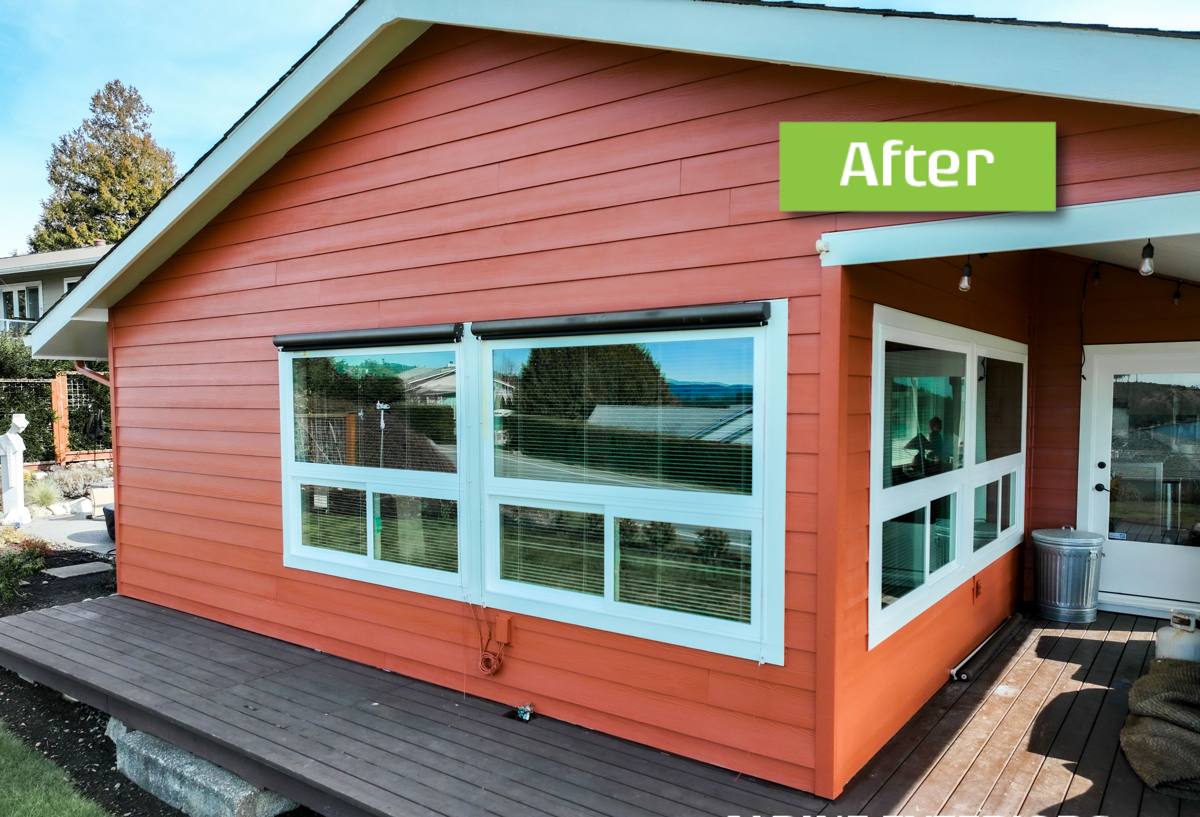
What Snohomish County Weather Does to a Window Opening Done Wrong
Marysville sits close enough to Puget Sound and the estuary flats around it that homes here deal with a real combination of moisture stressors: salt-tinged marine air that accelerates corrosion on cheap hardware and fasteners, wind-driven rain that gets pushed sideways into wall assemblies during winter storms, and a long wet, low-sun season that keeps north- and shade-side walls damp for months at a stretch. Add in the moss and algae that thrive in that dampness, and any gap in the window's water management becomes a slow, hidden leak path rather than an obvious drip.
The failure pattern we see most in this climate isn't a bad window — it's a window installed without proper flashing sequencing, so water that gets past the sill (and some always does, on every window, every brand) has nowhere to drain and instead soaks into the sheathing and framing. By the time it's visible, the repair is a siding and framing job, not a caulk job.
Getting the Rough Opening and Flashing Right
This is the part of a new-construction window job that never shows up in a photo but determines whether the window performs for 30 years or 10. The core sequence, done in the correct order every time:
- Sill pan flashing installed first, sloped and lapped so any water that reaches the sill drains back out over the exterior face — never trapped against the framing
- Weather-resistive barrier (house wrap) lapped shingle-style above the window opening, never taped flat, so water always sheds downward and outward
- Window nailing fin integrated into the WRB using the correct flashing tape or self-adhered membrane at the jambs and head, in the right order relative to the wrap
- Head flashing installed last, over the top of the window fin and behind the upper wrap, so it's the final layer water hits before it's shed away from the opening
- Rough opening sized correctly with shim space for the window to be set plumb, level, and square — not forced into an out-of-square frame
- Fasteners and shims checked so the window isn't racked or bowed, which stresses the sash and causes premature seal failure
Skip or reorder any one of these steps and the window can look perfect from the outside while quietly failing behind the wall. This is also where a crew's local experience shows — installers who've dealt with a Snohomish County winter know to over-build the flashing details rather than treat this region like a dry climate.
Choosing Materials That Hold Up in This Climate
Frame material matters more here than in a dry inland climate, mainly because of moisture cycling and, closer to the water, salt exposure. There's no single "best" window for every situation — it's a trade-off between upfront cost, maintenance, and long-term performance.
| Frame Material | How It Handles PNW Moisture | Maintenance | Typical Trade-Offs |
|---|---|---|---|
| Vinyl | Won't rot or corrode; performs well if properly installed | Low — occasional cleaning | Lower upfront cost; frame color and size options are more limited than fiberglass |
| Fiberglass | Very stable in wet/dry and temperature swings; strong resistance to moisture-related warping | Low | Higher upfront cost; longer lead times on some product lines |
| Vinyl-clad or aluminum-clad wood | Good exterior weather protection if cladding and joints are sealed correctly; wood core still vulnerable if a seal fails | Moderate — depends on cladding integrity over time | Better interior appearance options; more installation-sensitive in wet climates |
| Bare aluminum | Prone to condensation and thermal transfer; can corrode faster in salt-influenced air | Moderate to high | We generally steer new-construction clients away from bare aluminum this close to the Sound unless it's a thermally-broken commercial-grade product |
For most Marysville homes we recommend vinyl or fiberglass for the balance of moisture tolerance and low maintenance, reserving clad-wood for projects where the interior wood look is a priority and the client understands the added care that comes with it. We're not chasing a specific brand here — we're matching the frame material to what the climate actually does to a house over 20-plus years.
Glass Package Considerations
Beyond the frame, the glass package affects comfort and condensation resistance more than most homeowners expect. In this climate, we generally push for double-pane, low-E coated glass with an argon fill as the baseline, and we pay close attention to the whole-window U-factor and Solar Heat Gain Coefficient rather than just the glass spec in isolation — a well-built frame with mediocre glass will still underperform a well-matched full assembly.
Our New-Construction Window Process
The process is straightforward, but the sequencing and coordination matter, especially if you're working with a builder or general contractor on a new build or addition.
- Plan review and window schedule. We review the framing plan or existing rough openings, confirm sizes, and finalize the window schedule (sizes, operating types, glass package) before ordering.
- Site verification. Before windows are ordered, we physically check rough openings on site — plans and framed reality don't always match exactly, and it's far cheaper to catch that before the windows arrive.
- Ordering and lead time. New-construction windows are typically special-ordered to size; we build realistic lead times into the schedule so it doesn't hold up siding or interior trim work.
- Sill flashing and WRB integration. Sill pans and house wrap prep happen before a single window is set, per the sequence above.
- Setting the windows. Plumb, level, square, properly shimmed and fastened — checked on every unit, not just the first one.
- Flashing and sealing. Jamb and head flashing completed, sealants applied at the correct joints (and only the correct joints — over-sealing can trap water just as badly as under-sealing).
- Final inspection. Every opening checked for square, operation, and weather-tightness before we call the job done.
Coordinating With Your Builder or GC
On a new build, window installation sits at a critical point in the schedule — after framing and house wrap, before siding and interior finish work. If the timing slips, everything downstream slips with it. We're used to working alongside builders and other trades in Marysville's active new-construction and infill areas, and we communicate directly with the GC on scheduling so window installation doesn't become the bottleneck. If you're the homeowner coordinating your own build or addition, we'll walk you through exactly where windows fit in your trade sequence and what needs to happen before we can show up.
What Affects the Cost of a New-Construction Window Package
| Factor | Why It Moves the Price |
|---|---|
| Number and size of openings | More glass and larger units mean more material and labor per opening |
| Frame material | Vinyl is typically the lowest upfront cost; fiberglass and clad-wood run higher |
| Operating type | Fixed and single-hung units cost less than casements, awnings, or large sliders with heavier hardware |
| Glass package | Upgraded low-E coatings, tempered glass (required near doors and low sills by code), and sound-dampening laminates add cost |
| Access and site conditions | Multi-story openings, tight infill lots, or scaffolding needs affect labor time |
| Flashing and integration complexity | Doing the water management correctly takes real labor time — this is not the place to shop for the cheapest bid |
We give straightforward, itemized estimates rather than a single lump number, so you can see what you're paying for and where there's room to adjust the scope if budget is tight.
A Quick Checklist Before You Sign With Any Installer
- Do they explain their sill pan and flashing sequence in specific terms, not just "we seal everything"?
- Are they licensed and insured to work in Washington, and can they show it without hesitation?
- Do they specify frame material and glass package in writing, not just "vinyl windows"?
- Will they coordinate directly with your builder or GC on scheduling if this is new construction?
- Do they stand behind their installation work with a written workmanship warranty, separate from the manufacturer's product warranty?
- Have they worked in Snohomish County long enough to understand how local weather stresses a window assembly over time?
Why a Crew That Already Works Marysville Makes a Difference
Window installation guidance in a textbook is written for a generic climate. Marysville isn't generic — it's close enough to Puget Sound to deal with salt air and driving winter rain, and shaded enough in spots to grow moss on anything that stays damp too long. An installer who works this area regularly has already seen what happens when flashing details get cut short here, and builds accordingly instead of learning that lesson on your house. We're based in Everett and work Marysville and the surrounding Snohomish County communities routinely, which means we're not guessing at how this climate treats a wall assembly — we're building to what we've already seen hold up and what we've seen fail.
If you're planning new construction, an addition, or a full window replacement down to the framing in Marysville, we're happy to take a look at your project and give you a straightforward, no-pressure estimate. Use the form below to get started.