 Everett
 Lynnwood's Climate Is Harder on Siding Than It Looks
Lynnwood doesn't get hurricanes or hailstorms, so it's easy to assume siding here just needs to look good and keep the rain out. In practice, this part of Snohomish County wears siding down in quieter, slower ways. Marine air moving inland off Puget Sound carries a fine load of salt and moisture that settles on exterior surfaces year-round, even well away from the water. Add in wind-driven rain during fall and winter storms, heavy tree canopy on many Lynnwood lots, and long stretches of overcast, damp weather, and you get a climate that's constantly testing whatever material is on the wall.
The biggest long-term threat isn't a single storm — it's cumulative moisture exposure. Siding that can absorb water, swell, or delaminate over repeated wet-dry cycles will show it within a decade: soft spots, peeling paint, warping, and rot at the edges. Siding engineered specifically for wet, moderate-temperature climates handles that cycle without breaking down, which is the entire reason product choice matters more here than in a drier part of the country.
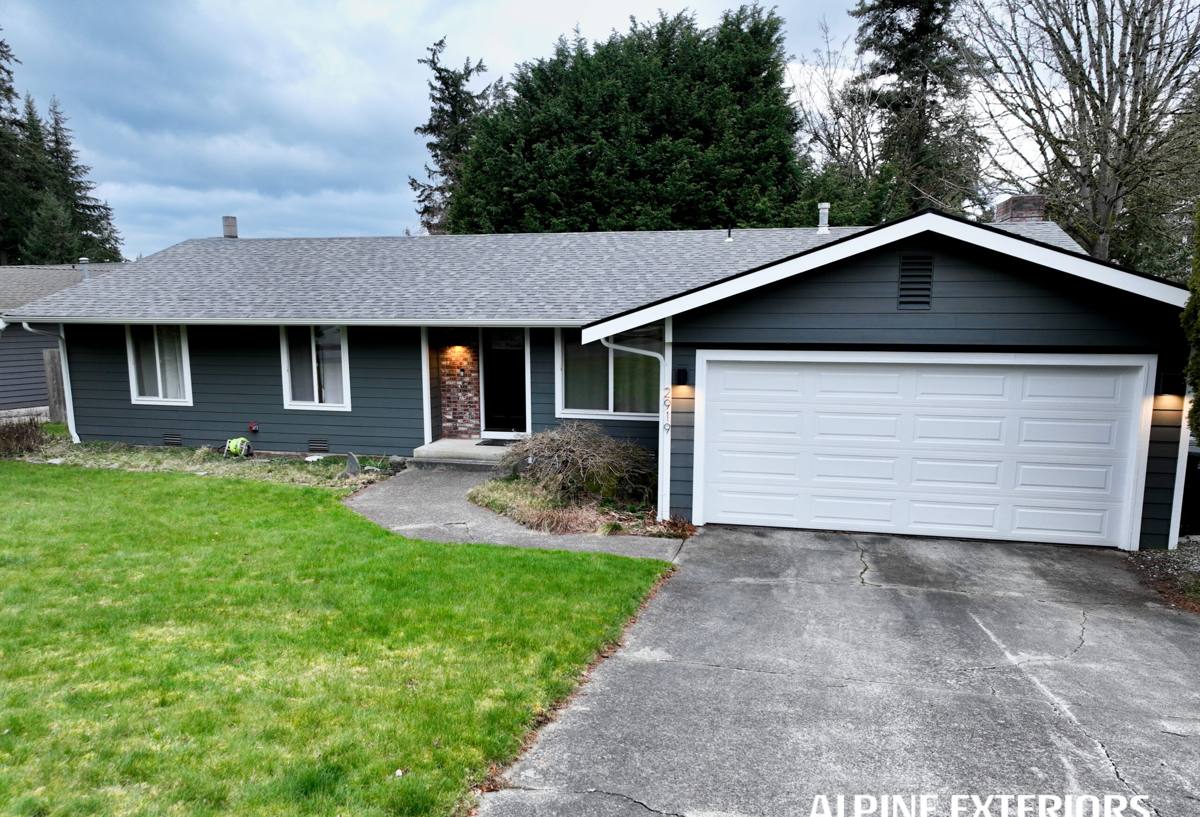
Why James Hardie Fiber Cement Fits This Specific Job
Built for Wet Climates, Not Just Marketed for Them
James Hardie makes a version of its siding, the HZ5 line, engineered specifically for regions with heavy rain and freeze-thaw cycling — which describes western Washington well. Fiber cement doesn't absorb and swell the way wood-based products can, and it doesn't corrode the way some metal trim does under salt-laden moisture. That stability is what keeps a Lynnwood home's siding flat, tight, and properly sealed at the seams year after year, instead of gradually opening gaps that let water behind the wall.
A Factory Finish That Doesn't Rely on Field Paint
ColorPlus, Hardie's factory-applied finish, is baked on under controlled conditions rather than brushed or sprayed on-site. In a climate where a good painting window can be hard to find between rain systems, that matters. It also means the color coat has a more consistent bond to the substrate than field-applied paint typically achieves, which shows up later as better resistance to fading and peeling under the region's UV and moisture combination.
The Product Lines That Make Sense for This Area
Not every Hardie product is the right fit for every part of a house. On most Lynnwood homes, we're working with a combination of a few core lines, chosen by where they sit on the building and how much weather exposure that location gets.
| Product | Best Use | Why It Fits Lynnwood |
|---|---|---|
| HardiePlank lap siding | Main wall surfaces | Traditional lap profile sheds wind-driven rain efficiently when installed with correct overlap and flashing |
| HardieShingle | Accent gables, dormers | Adds architectural detail without the moisture risk of real wood shingle |
| HardiePanel | Modern/vertical sections, porch ceilings | Clean lines for contemporary facades; performs well in sheltered vertical applications |
| HardieTrim | Corners, fascia, window and door casing | Resists the moss and mildew staining that untreated wood trim picks up under shade |
Where Installation Quality Actually Matters
The Details You Can't See Once the Job Is Done
Fiber cement siding is only as good as the water management system behind it. Correct installation in a climate like this depends on details that are invisible after the crew leaves: proper weather-resistant barrier, correctly lapped flashing at every window, door, and roofline transition, and consistent fastener placement so panels stay secure without cracking. Skipping or rushing any of these is how a good product ends up with a bad reputation on a specific house.
Clearance and Gap Requirements
Manufacturer installation specs call for minimum clearances from grade, roofing, and decks, along with small gaps at butt joints and trim to allow for expansion. On a lot with heavy shade or tight landscaping — common in Lynnwood neighborhoods with mature tree cover — those clearances are what keep splash-back moisture and standing leaf debris from sitting against the bottom edge of the siding.
- Weather-resistant barrier installed and lapped correctly behind every panel
- Z-flashing or head flashing at all window and door openings
- Minimum clearance maintained between siding and grade, roof lines, and decks
- Correct nail size, spacing, and depth per the Hardie fastening schedule
- Expansion gaps left at butt joints and trim, then sealed with the specified caulk
- Kick-out flashing at roof-to-wall intersections to divert water away from the wall plane
Fastening and Fit
Hardie panels need to be fastened tightly enough to stay secure in wind but not so tight that the fastener crushes the material — over-driven or under-driven nails are one of the most common field mistakes and one of the biggest causes of early callbacks. Cut edges also need field-applied sealant or paint, since factory ColorPlus coating doesn't extend to a fresh cut made on-site.
Problem Areas We See Most Often on Lynnwood Homes
Moss and Algae on Shaded Elevations
North-facing walls and anything under heavy tree cover stay damp longer between rain events, which is exactly the condition moss and algae need to take hold. It's mostly cosmetic on properly installed fiber cement, but it's worth planning for with siting decisions like trim details and periodic gentle cleaning, rather than ignoring it and letting organic growth trap moisture against the surface.
Roofline and Deck Transitions
Anywhere a roof, porch, or deck meets the wall is a higher-risk zone for water intrusion if the flashing wasn't done correctly the first time. These transitions are one of the first things we check on both new installs and re-siding jobs, because a flashing mistake here can cause hidden rot long before it's visible from outside.
Ground-Level Splash and Grade Issues
Lynnwood's frequent rain means a lot of splash-back at the base of exterior walls, especially where landscaping beds or hardscaping sit close to the foundation. Maintaining the manufacturer's minimum clearance at the bottom course is one of the simplest ways to prevent moisture problems that otherwise show up as staining or soft trim near the ground.
How Our Process Works on a Lynnwood Job
We start with an on-site walk-through to assess the current siding condition, look for existing moisture damage, and check the house's specific exposure — shade, wind direction, roofline complexity, and anything else that affects the install plan. From there we put together a written scope covering product lines, trim details, and color, along with a realistic timeline that accounts for our wet-season scheduling.
During the tear-off, we check sheathing condition before anything new goes up — if there's hidden rot from a prior installation's flashing mistakes, that gets addressed before new siding covers it back up. Then it's weather barrier, flashing, siding, and trim, in that order, followed by a final walk-through with the homeowner before we consider the job done.
Why Hiring Local, Experienced Crews Matters Here
Installation quality is the single biggest variable in how long James Hardie siding actually lasts on a house — the product's engineered performance only shows up when it's installed to spec. A crew that regularly works Snohomish County jobs already knows how local shade patterns, rainfall patterns, and lot layouts tend to create moisture problems, and builds around them instead of discovering them after the fact. That local pattern recognition is hard to replace with a generic install crew working from a manual alone.
It also matters for warranty support. James Hardie's product warranty and workmanship coverage both depend on correct installation — a crew that's done dozens of these jobs in this exact climate is far less likely to create a gap between the two.
Maintenance and What to Expect Long-Term
One of the practical advantages of fiber cement in this climate is how little upkeep it needs compared to wood-based siding. There's no repainting cycle to manage, no risk of rot from trapped moisture inside the material itself, and the factory finish is built to hold color for years under UV and rain exposure. Homeowners mostly need to keep gutters clear, trim back vegetation that's crowding the wall, and do an occasional gentle wash to keep moss and algae from building up on shaded sections. That's a meaningfully lower maintenance burden than the wood or wood-composite products it's replacing on most re-siding jobs we do in this area.
If you're weighing a siding replacement or new install in Lynnwood and want to know what it actually involves for your specific house, we're happy to walk the property with you and put together a straightforward, no-pressure estimate — just fill out the form below.