 Everett
 Marysville's Climate Is Harder on Siding Than It Looks
Marysville sits close enough to Puget Sound and Possession Sound that salt-laden air is a constant, low-grade presence on exterior surfaces, even on homes set back from the water. Combine that with Snohomish County's long wet season, driving rain off the Sound during winter storms, and a moss season that can stretch from fall through spring on shaded north- and west-facing walls, and you get a set of conditions that punishes the wrong siding choice quickly. Paint fails faster. Seams swell. Moss and algae take hold in the grain of untreated wood-look products and never fully let go. None of this is dramatic on any single day, but over ten or fifteen years it separates siding that still looks good from siding that's been patched, repainted, or replaced early.
This page is about one job done right in one area: James Hardie fiber cement siding installed on a Marysville home. Not a general siding overview, and not a sales pitch for every product on the market — just what this climate actually demands and what correct work looks like.
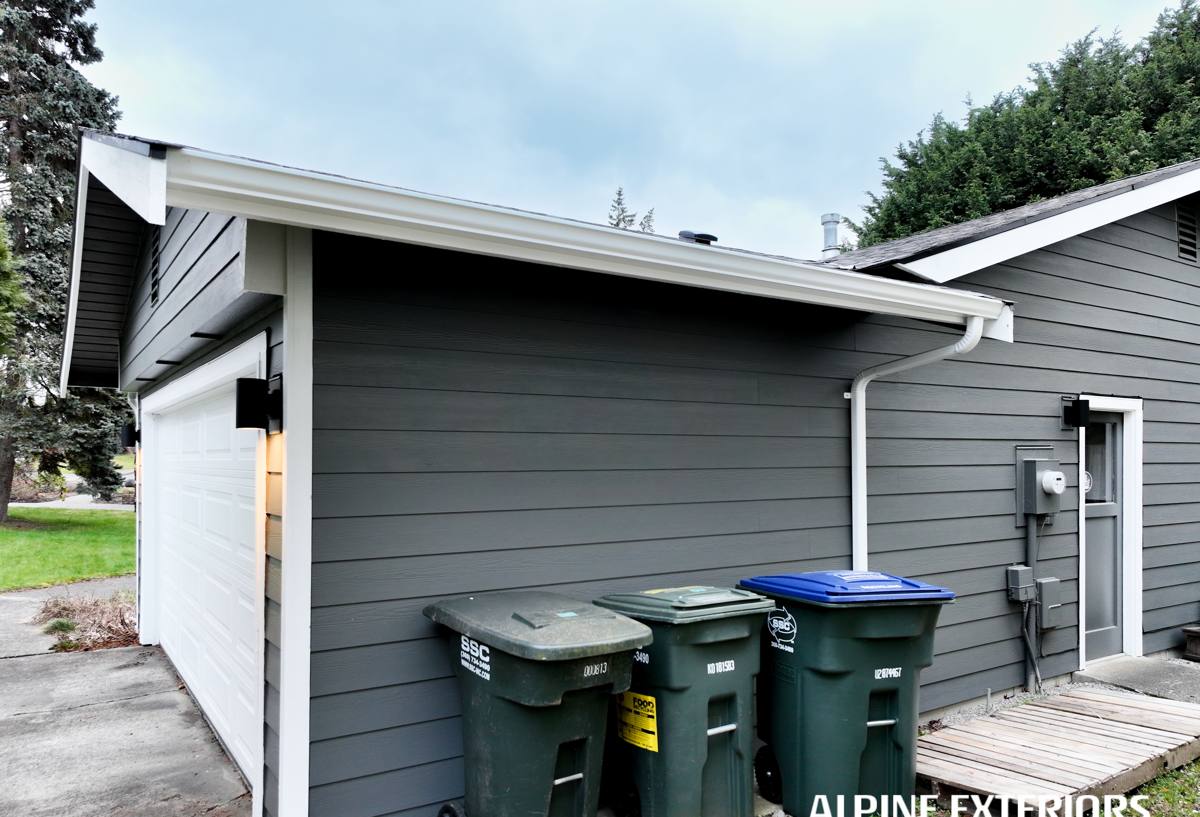
Why We Install Only James Hardie
Our crews stopped installing vinyl, LP SmartSide, Cemplank, Allura, and primed wood siding years ago, and we don't make exceptions for Marysville jobs. That's not a marketing position — it's a maintenance and durability call based on what happens to those products in a marine, high-moisture climate like this one. Vinyl expands and contracts more than fiber cement and can warp or crack in cold snaps. Wood-based and OSB-core products like LP SmartSide are engineered to resist moisture better than raw wood, but they're still an engineered wood product, and any breach in the factory coating exposes a core that doesn't like standing water. Primed cedar or spruce needs a repaint cycle most homeowners underestimate, especially on walls that stay damp longer because of shade or moss growth.
James Hardie fiber cement is cement, sand, and cellulose fiber — it doesn't rot, it's non-combustible, and it's manufactured with regional climate exposure specifically engineered into the product line. That last point matters more here than in drier parts of the country, and it's the reason Hardie, installed correctly, is what we put on Marysville homes instead of anything else.
What "Climate-Engineered" Actually Means Here
HZ5 vs. HZ10 Product Lines
James Hardie makes different formulations for different climate zones. The Pacific Northwest, including Snohomish County, falls into a wetter, cooler zone than much of the country, and Hardie's HZ10 line is formulated with that in mind — different moisture and freeze-cycle performance than the HZ5 product sold in drier, milder regions. Using the correct zone product isn't a technicality; it's the difference between siding engineered for our rain and moss exposure and siding engineered for a climate that doesn't match ours.
ColorPlus Factory Finish
Field-painted siding is the first thing to show wear in a place like Marysville, because paint applied on-site never bonds or cures as consistently as a factory-baked finish. James Hardie's ColorPlus finish is applied and cured under controlled conditions before the boards ever reach the jobsite, giving it a more consistent, longer-lasting bond and better fade resistance than a job-site paint job. In a climate with this much sustained moisture and UV cycling, that factory finish is doing real work, not just saving a paint step.
What a Correct Installation Involves
Fiber cement siding is only as good as the installation behind it. Hardie's own documentation is specific about clearances, fastening, and moisture management, and skipping those details is how a good product ends up with a bad reputation. On Marysville homes, we pay particular attention to:
- Proper rain-screen or drainage plane behind the siding, so any moisture that does get past the surface has somewhere to go instead of sitting against the wall sheathing
- Correct clearance between the bottom of the siding and grade, decks, and roof lines — a common failure point where standing water and moss get a foothold
- Manufacturer-specified fastener type, spacing, and placement, since improper fastening is one of the more common causes of cracking and callback repairs
- Properly sealed and caulked joints, corners, and penetrations, using materials rated for sustained wet exposure rather than whatever caulk is on the truck
- Flashing details at windows, doors, and roof intersections that direct water away from the wall assembly rather than trapping it
None of this is unique to Marysville — it's how Hardie siding is supposed to go on anywhere. What's different here is the margin for error. A gap or a missed flashing detail that might go unnoticed for years in a dry climate shows up fast in a place with this much sustained rain and salt exposure.
Moss, Algae, and North-Facing Walls
Moss season in Snohomish County isn't a minor seasonal nuisance — on shaded, north- or west-facing walls with limited sun exposure, moss and algae growth can be a near-constant maintenance issue for homeowners with the wrong siding. Fiber cement doesn't feed mold and moss the way wood fiber does, and the factory finish resists the kind of surface staining that gives algae something to grip. That doesn't mean a Hardie wall never needs a rinse-down in a heavily shaded, damp corner of a property — it means the underlying material isn't degrading every time it happens, and a simple wash restores the look rather than revealing damage underneath.
Our Process on a Marysville Job
Every home is different, but the sequence stays consistent:
- On-site assessment — we look at existing siding condition, wall assembly, moisture entry points, and any problem areas specific to that property's sun and rain exposure
- Product and color selection — matching the correct Hardie product line, profile, and ColorPlus color to the home's style and the homeowner's preference
- Prep and moisture barrier work — removing old siding, inspecting sheathing for hidden rot or water damage, and installing a proper drainage plane before a single board goes up
- Installation to manufacturer spec — correct clearances, fastening, flashing, and sealing at every joint and penetration
- Final walkthrough — checking trim, caulking, and finish details with the homeowner before we call the job done
We don't shortcut the prep stage to get to the visible work faster. Hidden sheathing damage or a missing drainage plane is exactly the kind of thing that turns into a bigger problem two winters later, and in this climate, two winters is not a long time to wait for a mistake to surface.
Cost Factors on a Marysville Siding Project
Every home prices differently based on size, existing condition, and complexity, so we don't quote generic numbers without seeing the property. What generally moves the price on a project like this:
| Factor | Why It Matters |
|---|---|
| Extent of existing damage or rot | Hidden sheathing repair adds labor and materials before new siding can go on |
| Home size and wall complexity | More corners, dormers, and trim details mean more cutting, fitting, and labor time |
| Siding profile and product line | Lap, panel, and shingle-style Hardie products carry different material and labor costs |
| Access and site conditions | Multi-story sections, tight lot lines, or landscaping obstacles affect scaffolding and staging time |
| Trim, fascia, and accessory work | Coordinating Hardie trim boards with the siding for a consistent, sealed system adds scope |
The honest range for a full siding replacement varies widely based on those factors — an accurate number only comes from a walk-through of the actual house.
Signs Marysville Siding Needs Attention
Homeowners often live with early warning signs longer than they should, because none of them look urgent on their own. Worth a closer look if you're seeing:
- Persistent moss or algae staining that comes back within weeks of cleaning
- Soft spots, bubbling, or visible swelling anywhere on the siding, especially near the bottom courses
- Paint that's peeling, chalking heavily, or has an inconsistent sheen from patch repairs over the years
- Gaps opening up at seams, corners, or trim joints
- Musty odor or discoloration on interior walls that back onto exterior siding
- Visible warping on wood-based or vinyl sections, particularly on south- and west-facing walls
Any one of these is worth a professional look before it becomes a sheathing repair instead of a siding repair.
Why Hiring a Crew That Already Works Marysville Matters
Installation quality is the single biggest variable in how long James Hardie siding actually performs, and installation quality shows up differently depending on the climate a crew is used to working in. A crew that mostly installs in drier regions may not think as carefully about drainage planes, moss-prone shaded walls, or the flashing details that matter most under sustained Puget Sound-region rain. A crew that works Snohomish County regularly has already seen what salt air and driving rain do to siding installed without those details, and builds the job around avoiding it from the start rather than fixing it later.
If your Marysville home is due for new siding, we're glad to walk the property, look at what your walls are dealing with, and put together a straightforward plan — no pressure, no generic sales pitch. A free estimate is a good place to start.