 Everett
 Edmonds Homes and What Puget Sound Weather Asks of Siding
Edmonds sits right on Puget Sound, and that waterfront position shapes what a home's exterior has to withstand year after year. Salt-tinged air drifts in off the water, driving rain gets pushed sideways into walls more often than it falls straight down, and a moss season that runs long by any standard settles into anything that stays shaded and damp. None of that is unique to Edmonds specifically — it's the same pattern that tests homes across Snohomish County — but properties closer to the water tend to feel it first and feel it hardest.
We're an Everett-based crew and we work Edmonds regularly, which means this page isn't a generic siding overview with the city name dropped in. It's specifically about fiber cement siding — what it needs to do here, what a correct installation looks like on a Puget Sound-facing home, and how our process runs from first estimate to finished wall.
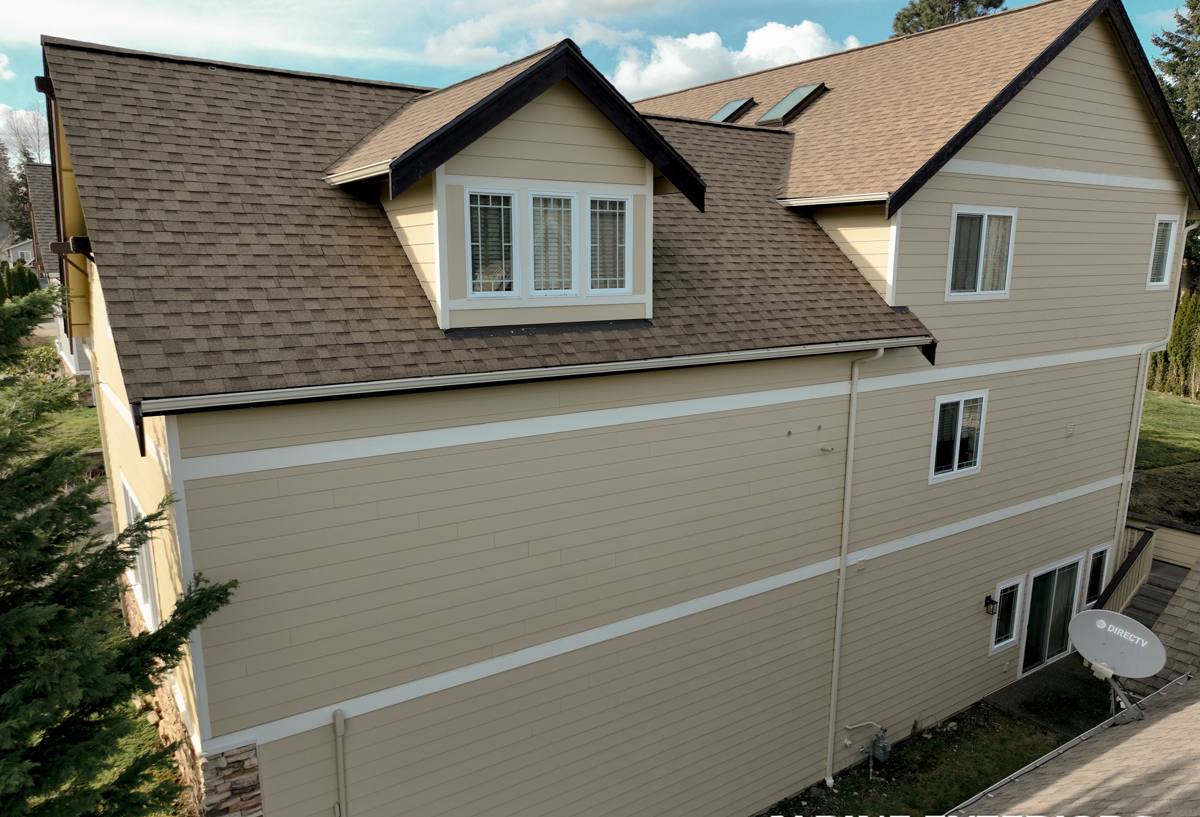
What Salt Air, Driving Rain, and a Long Moss Season Do to a Wall
Salt-laden air is corrosive in ways that aren't always obvious from the street. It accelerates rust on exposed fasteners and hardware, and it keeps surfaces damp longer than they'd stay in a drier, inland climate — which matters because moisture dwell time is a bigger factor in material breakdown than moisture exposure alone. A wall that dries out quickly after a storm holds up very differently than one that stays wet for days.
Wind-driven rain is the second piece, and it changes how a wall needs to be built, not just what it's clad in. Rain that arrives at an angle gets forced into laps, seams, and fastener penetrations that a calmer climate wouldn't stress nearly as hard. Flashing details, house wrap laps, and clearances that would be fine somewhere with mild weather start to matter a lot more on an Edmonds home facing open water.
Then there's moss. Shaded walls, north-facing exposures, and anything under tree cover stay damp through most of the fall, winter, and spring — exactly the conditions moss needs to take hold. On wood-based siding that's not just a cosmetic problem that shows up as green staining; sustained dampness against an absorbent material leads to swelling, softening, and rot at cut edges and seams over time.
Why We Install Only James Hardie Fiber Cement in Edmonds
We don't install vinyl, LP SmartSide, Cemplank, Allura, primed spruce, or cedar. That's a standard we hold ourselves to, not a reflection of what we're capable of installing. In a climate like this one, the materials that tend to struggle over the long run share a common weakness: they either absorb moisture directly, depend on a coating to keep water out indefinitely, or expand and contract enough with temperature and humidity swings that seams gradually work loose.
James Hardie fiber cement is engineered against that specific failure pattern. It's non-combustible, it doesn't swell or feed moss the way wood-based products can, and its ColorPlus factory finish is baked on under controlled conditions and warrantied against the fading and chalking that constant moisture and salt exposure accelerate. Hardie also builds climate-specific formulations rather than one board for the whole country — for the Pacific Northwest we install the HZ5 line, engineered for the moisture cycling and freeze-thaw swings a Puget Sound winter actually delivers. Paired with a strong transferable warranty and installation done to spec, it's the system we're willing to put our name behind on an Edmonds home.
What We Ask Homeowners to Weigh First
None of the alternatives are dishonest products. Vinyl, engineered wood, and primed wood all have legitimate uses in the right climate and budget. But in a salt-air, high-rain, long-moss environment, the maintenance burden on those materials — caulking, repainting, panel replacement — tends to land back on the homeowner within a decade or two in a way fiber cement, installed correctly, largely avoids.
What a Correct Fiber Cement Install Involves
Fiber cement performs the way it's engineered to only when the installation matches the manufacturer's specification, not a generic best guess. That means specific fastener types and spacing, correct clearance above grade and hardscape, house wrap or weather-resistive barrier lapped correctly beneath the siding, and flashing detailed at every window, door, and penetration so water is directed out and away instead of trapped behind the cladding.
Fastening, Flashing, and Clearance
On a wall exposed to wind-driven rain off the Sound, flashing quality is the difference between water that sheds harmlessly and water that finds its way behind the siding and sits there. We pay close attention to how each wall on a given home is oriented — south- and west-facing walls generally take more direct weather, shaded and north-facing walls stay damp longer — and we adjust fastener spacing, clearance, and ventilation detailing accordingly rather than treating every elevation the same.
The HZ5 Difference
Choosing HZ5 board isn't a marketing detail — it's a formulation decision that affects how the material handles sustained moisture cycling over decades, which is exactly the stress an Edmonds exterior faces. Combined with correct installation, it's what lets a Hardie exterior go a long stretch of time without the recoating or resealing that field-applied finishes eventually require.
Our Process for an Edmonds Siding Project
We run every project through the same sequence, adjusted for the specifics of your home and lot rather than a one-size template. The table below walks through what each stage actually involves.
| Stage | What Happens |
|---|---|
| Initial estimate | We walk the property, assess current siding condition, note wall exposure and shading, and talk through product line and color |
| Detailed scope | We identify flashing, moisture barrier, and clearance needs specific to your home before any material is ordered |
| Prep and tear-off | Existing siding comes off, sheathing is inspected for hidden moisture damage, and any repairs are addressed before new material goes up |
| Weather barrier and flashing | House wrap is lapped correctly and flashing is installed at every window, door, and penetration |
| Hardie installation | Fiber cement is fastened, spaced, and clearanced to manufacturer spec, with attention to wall-specific exposure |
| Final walk-through | We review the finished work with you and address anything before calling the project complete |
Comparing Siding Materials Edmonds Homeowners Consider
Most homeowners weighing a siding project have already looked at more than one material, so it's worth being direct about how they actually compare in this climate rather than treating the decision as settled.
| Material | Moisture Behavior Here | Typical Long-Term Maintenance |
|---|---|---|
| James Hardie fiber cement | Non-combustible, doesn't absorb moisture or feed rot the way wood-based products can | Low — factory finish holds up well against sustained damp and salt exposure |
| Vinyl siding | Doesn't rot, but can warp, crack, or blow loose under wind-driven rain and temperature swings | Low upfront, but panels are usually replaced rather than repaired when damaged |
| LP SmartSide / engineered wood | Wood-based core is more moisture-sensitive at cut edges and seams than fiber cement | Moderate — edge sealing and coating upkeep matter more in sustained damp conditions |
| Primed spruce or cedar | Natural wood absorbs moisture readily and is a preferred surface for moss growth | Highest — regular repainting, caulking, and moss treatment needed to hold up |
This isn't a claim that every alternative fails on every home — it's why our own standard, for the climate we work in daily, is fiber cement installed correctly rather than a material that trades a lower sticker price for a heavier maintenance load down the road.
Why a Crew That Already Works Edmonds Matters
A lot of what determines how well siding performs here comes down to details a crew unfamiliar with the area tends to underestimate: how much direct weather a given wall orientation actually takes on this close to open water, where moss is likely to establish first based on shade and drainage, and how flashing needs to be layered so it sheds water through an entire wet season rather than just looking right on install day.
We're based in Everett and work Edmonds and the surrounding Snohomish County waterfront regularly, so these aren't unfamiliar conditions to plan around — they're what we build for by default. That shows up in small, on-site calls: where a J-channel actually belongs, where caulk is appropriate versus where flashing is required, how fastener spacing should shift given how exposed a particular wall is. Homeowners rarely notice these decisions directly, but they're a large part of what separates an exterior that holds up from one that starts showing problems within a few years.
Signs Your Edmonds Home's Siding Needs Attention
- Green or black staining that returns quickly after washing, especially on shaded or north-facing walls
- Soft spots, visible swelling, or a spongy feel when you press on siding near the bottom courses or trim
- Caulk that's cracked, shrunk, or pulled away from joints and window trim
- Paint or finish that's chalking, peeling, or fading noticeably faster on south- and west-facing walls
- Visible gaps at seams, corners, or fastener points where water could be tracking behind the siding
- Rust streaks running down from fasteners or hardware, a sign salt exposure is accelerating corrosion
Any one of these on its own isn't necessarily an emergency, but they're worth having looked at rather than watched for another season, especially heading into another wet Puget Sound winter.
Cost Factors on a Fiber Cement Project in Edmonds
Every home is different, so we don't publish flat per-square-foot pricing — but the factors that move a quote up or down are consistent enough to lay out honestly.
| Factor | Why It Affects Cost |
|---|---|
| Tear-off scope | Removing existing siding down to sheathing costs more than siding over a sound, prepped surface |
| Hidden sheathing damage | Rot or moisture damage found once old siding comes off adds repair work before new material goes up |
| Home size and wall complexity | More corners, dormers, and penetrations mean more flashing and cut work, which adds labor time |
| Product line and texture | Lap, panel, and shingle profiles carry different material costs, as do ColorPlus finish options |
| Access and site conditions | Steep lots, limited staging space, or multi-story walls affect equipment and labor needs |
Getting an accurate number for your home means walking the property, not guessing from a square footage figure over the phone.
Getting Started
If your Edmonds home's siding is showing its age, or you're planning a project and want an honest read on what it actually needs, we're glad to come take a look. We'll walk the exterior with you, talk through what we see, and put together a free, no-pressure estimate — no obligation to move forward.