 Everett
 Why Eastmont's Climate Wears Down the Wrong Siding Fast
Eastmont sits within Everett, close enough to Puget Sound that the marine air moving through Snohomish County carries real salt content, even on lots that feel well inland from the water. Add in a wet season that runs long and heavy with driving, wind-pushed rain, and the mature tree cover common on many Eastmont lots, and you get siding conditions that are tougher than they look. Shaded walls stay damp for days after a storm passes. That combination of salt exposure, sustained moisture, and shade is exactly what fuels a long moss and mildew season on the north and west faces of homes in this part of Everett.
Siding that isn't built for this environment shows it within a few years: swelling at seams, paint that chalks and peels ahead of schedule, and moss establishing itself in joints and behind trim where it holds moisture against the wall. None of that is really about one bad product. It's about materials and installation details that weren't matched to the climate they're being asked to survive in.
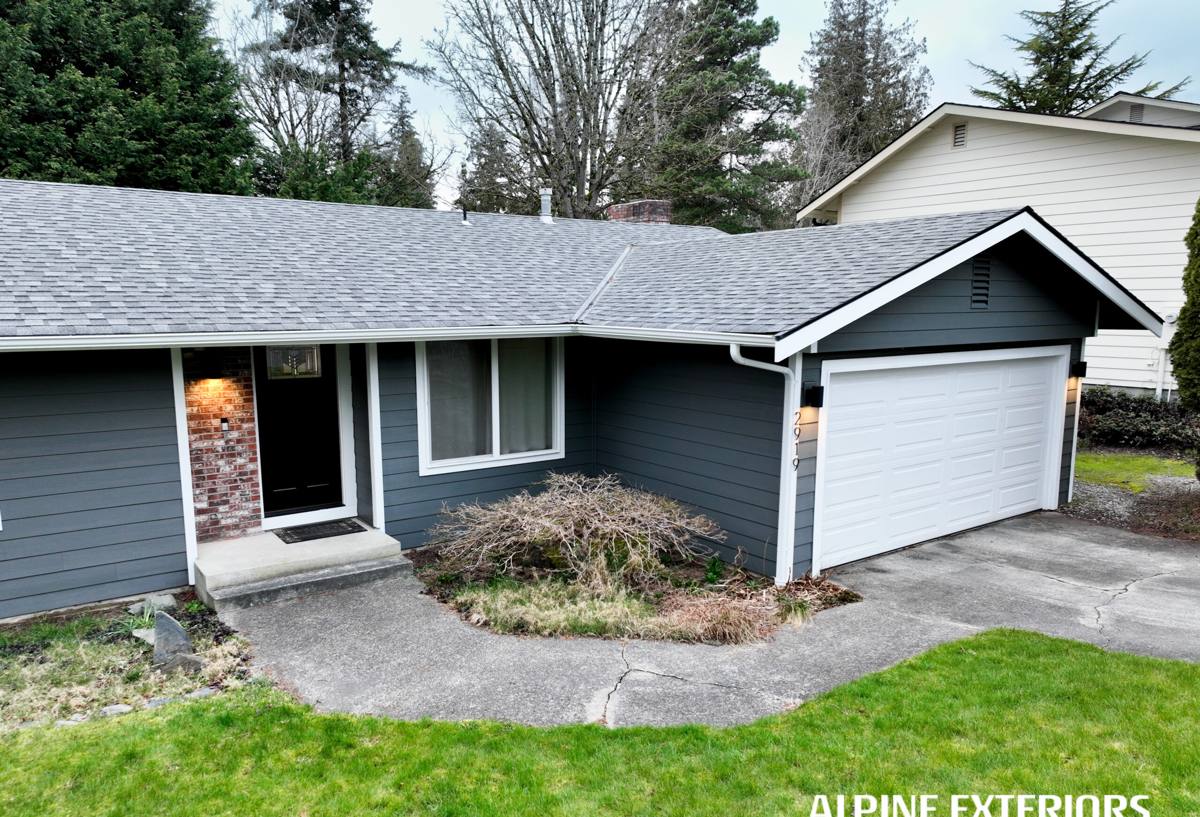
What James Hardie Brings to a Coastal-Adjacent Climate Like Ours
We install James Hardie fiber cement exclusively, and in a climate like Everett's, the reasons are practical, not brand loyalty. Fiber cement is non-combustible and dimensionally stable, meaning it doesn't swell and contract with moisture the way wood-based products can. That stability matters most exactly where Eastmont homes take the worst of it: shaded walls, ground-level runs, and anywhere rain sits against the siding longer than it should.
HZ5 Engineering, Built for Wet Climates
James Hardie makes region-specific product formulations, and the HZ5 line is engineered for the wetter, more moisture-exposed parts of the country — which includes the Pacific Northwest. The formulation is built to resist moisture intrusion and hold up under repeated wet-dry cycling better than a generic, one-size-fits-all board. For a neighborhood dealing with a genuine moss season, that engineering difference isn't cosmetic — it's the difference between siding that sheds water cleanly and siding that slowly absorbs it.
ColorPlus Finish vs. Field-Applied Paint
Most Hardie products we install carry the ColorPlus factory finish, which is baked on in a controlled environment rather than rolled or sprayed on-site. That finish resists fading and is formulated to resist the kind of surface staining and mildew growth that shows up fastest in shaded, damp conditions. It also carries its own finish warranty, separate from field-applied paint, which typically needs recoating far sooner in a climate this wet.
What a Correct Hardie Installation Actually Involves
Fiber cement siding is only as good as the details underneath it. A huge share of the siding failures we get called out to inspect in Everett aren't material failures at all — they're installation shortcuts that let water get behind the siding, where fiber cement can't do its job.
Flashing and Water Management
Every window head, door, deck ledger, and roof-to-wall intersection needs correctly lapped flashing, not caulk used as a substitute for it. Kick-out flashing where a roofline meets a sidewall is one of the most commonly skipped details on older installs, and it's one of the most damaging to skip in a climate with this much sustained rainfall.
Fastening, Clearances, and Caulking
Hardie's own installation instructions specify fastener placement, minimum clearance from grade, decks, and roof lines, and proper gapping at butt joints. Skipping these — nailing too close to a panel edge, tight-butting boards with no gap, or letting siding sit too close to the ground — is what causes moisture wicking and premature paint failure, even on a good product. We install to those specifications because that's also what keeps the manufacturer's warranty intact.
Siding Materials in a Wet, Mossy Climate
We get asked fairly often why we don't offer alternatives like vinyl, cedar, or LP SmartSide. Here's an honest side-by-side of how these materials generally perform in conditions like Eastmont's, which is why we standardized on one product system rather than offering several.
| Material | Moisture Behavior | Moss/Mildew Resistance | Finish Durability |
|---|---|---|---|
| James Hardie fiber cement (HZ5) | Dimensionally stable, engineered for wet climates | Factory finish resists surface growth | ColorPlus finish holds color well beyond field paint |
| Vinyl | Doesn't absorb water, but can trap moisture behind panels if house wrap details fail | Growth still occurs on the surface in shaded, damp spots | Color is molded-in but can fade and become brittle over time |
| Cedar / wood | Absorbs and releases moisture; prone to swelling and cupping | Highest susceptibility to moss and rot without diligent upkeep | Requires regular refinishing to keep protective coating intact |
| LP SmartSide (engineered wood) | Treated to resist moisture, but remains wood-based at its core | Better than raw cedar, still needs consistent field-applied coating maintenance | Field-applied finish and caulked joints need ongoing attention |
None of these are unreasonable products in the right application. We simply concluded that for the wet, shaded, salt-touched conditions common across Everett, a non-combustible fiber cement system with a factory-cured finish is the one we're willing to put our name behind long-term.
Our Process for Eastmont Siding Projects
Every project follows the same sequence, because skipping a step is how moisture problems get sealed in behind new siding instead of solved.
- Site walk and moisture assessment — checking existing siding, trim, and sheathing for hidden water damage before a bid is finalized.
- Tear-off and sheathing inspection — any soft or damaged sheathing found underneath gets addressed before anything new goes up.
- Weather-resistant barrier install or repair — the house wrap layer behind the siding, lapped and taped correctly at every seam.
- Flashing installation — windows, doors, rooflines, and penetrations detailed before panels go on, not patched afterward.
- Hardie panel installation to manufacturer specification — correct fastening, clearances, and joint gapping throughout.
- Caulking and finish inspection — joints, trim, and transitions checked and sealed where the manufacturer calls for it.
- Final walkthrough — reviewing the completed work with the homeowner before we consider the job done.
What Affects the Cost of a Hardie Project in Eastmont
We don't quote a project without seeing the home, but the factors that move a bid up or down are consistent from house to house.
| Factor | Why It Matters |
|---|---|
| Total wall area and home complexity | More corners, gables, and dormers mean more cutting, trim work, and labor time |
| Condition of the existing sheathing | Hidden moisture damage found during tear-off adds repair scope before new siding goes on |
| Trim and accent detail | Board-and-batten accents, trim boards, and detailed transitions add material and labor beyond plain lap siding |
| Access and site conditions | Steep lots, tight side yards, or extensive landscaping near the walls can slow staging and increase labor |
| Tear-off and disposal | Removing and hauling the old siding is its own line item, separate from installing the new system |
As a general rule, a straightforward single-story home costs meaningfully less to re-side than a larger home with steep rooflines, multiple stories, and heavy trim detail — but the only way to get an accurate number is a site visit.
Living With Hardie Siding in a Moss-Prone Yard
Even the right siding still needs basic upkeep in a climate that grows moss this readily. A little routine attention goes a long way toward protecting both the finish and the warranty.
- Rinse siding gently once or twice a year, especially on shaded north- and west-facing walls, using a garden hose rather than a pressure washer.
- Keep gutters and downspouts clear so overflow isn't running down the siding face during heavy rain.
- Trim back shrubs, hedges, and low tree limbs to keep airflow moving along the wall and reduce standing shade and moisture.
- Check caulked joints, trim transitions, and penetrations once a year for cracking or gaps and have them addressed before winter.
- Watch for early moss or dark staining in corners and behind downspouts, and address it while it's still a surface issue.
Why Hiring a Crew That Already Works in Eastmont Matters
Siding performance in this climate comes down to details that vary by exposure — which walls take the worst wind-driven rain, which sides stay shaded and damp longest, how a specific lot's drainage behaves in a heavy storm. A crew that regularly works in this part of Everett has already seen how these patterns play out on similar homes, rather than treating every project as a generic install. That local familiarity, paired with installing strictly to manufacturer specification, is what keeps a siding job performing years after the crew has left.
The James Hardie Warranty — and Why We Only Install to Spec
James Hardie backs its fiber cement products with a substantial, transferable limited warranty, and ColorPlus finishes carry their own separate finish warranty covering fading, chipping, and cracking. Both are conditioned on installation following Hardie's published instructions — clearances, fastening, flashing, and joint treatment all matter to warranty coverage, not just to how the siding performs day to day. That's a core reason we install every project to the letter of those specifications: it's the only way the warranty you're paying for actually holds up.
If you're weighing a siding project on your Eastmont home, we're happy to walk the property, look at what's there now, and talk through what correct James Hardie installation would involve for your specific home — no pressure, no obligation. The form below gets you a free estimate to start that conversation.