 Everett
 Eastmont's Climate Is Harder on Siding Than It Looks
Eastmont sits close enough to Puget Sound that salt-laden air is a real factor in how exterior materials age, not just a talking point. Add in Snohomish County's long wet season, driving rain that comes in sideways during winter storms, and stretches of shade and dampness that let moss and algae take hold on north- and west-facing walls, and you have a climate that is genuinely tough on siding. Homes here don't fail because owners neglected them. They fail because the wrong material was used, or the right material was installed the wrong way.
Wood-based products absorb moisture and swell, then dry and shrink, over and over, all winter and spring. Vinyl expands and contracts with our swinging temperatures and can crack or bow over time. Paint film on primed wood or engineered wood trim breaks down faster under constant damp exposure, opening the door to rot underneath. None of this is unique to Eastmont, but it's more pronounced here than in drier parts of the state, and it's exactly the set of conditions fiber cement siding was engineered to handle.
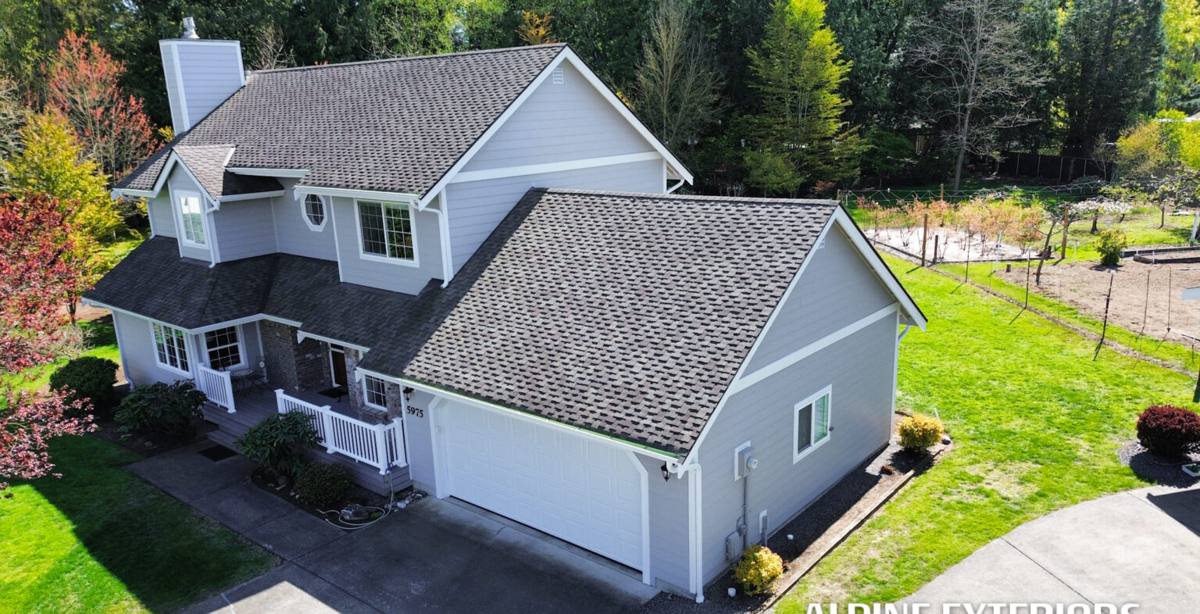
Why We Only Install James Hardie Fiber Cement Here
Fiber cement siding is a blend of cement, sand, and cellulose fibers, pressed and cured into planks or panels. It doesn't absorb water the way wood does, it won't rot, and it's non-combustible — a genuine advantage during dry summer wildfire-smoke seasons even in a wet region like ours. We install James Hardie exclusively, and specifically the line engineered for wet, cool, marine-influenced climates like Snohomish County's. That climate-specific formulation matters more here than in a drier inland market, because the product has to shrug off sustained damp exposure, not just occasional rain.
James Hardie's factory-applied ColorPlus finish is also part of why we standardized on this product. It's baked on in a controlled environment rather than brushed on outdoors, which gives it more consistent coverage and better resistance to fading and moisture intrusion at the finish layer than field-applied paint. Combined with a strong transferable warranty when installed to Hardie's specifications, it's the closest thing to a "install it once, stop worrying about it" siding option that currently exists for this climate.
We get asked why we don't install LP SmartSide, vinyl, Cemplank, Allura, or primed cedar and spruce siding. Each of those products has legitimate uses and each has its own honest trade-offs — engineered wood is lighter and easier to handle but still wood-based at its core; vinyl is inexpensive but moves with temperature and can't match fiber cement's rigidity or fire performance; other fiber cement brands may be viable products, but we've built our installation process, flashing details, and warranty relationships entirely around one system. Standardizing on Hardie lets our crews install one product correctly and consistently rather than switching techniques between different brands.
What Correct Installation Actually Involves
Fiber cement siding performs exactly as well as the installation behind it, and in a climate like Eastmont's, the installation details matter more than the marketing on the box. A rushed or generic install on a high-quality product will still let water in.
Flashing and Moisture Management
Every window, door, and penetration needs proper flashing that directs water out and away from the wall assembly, not just caulk covering a gap. Behind the siding itself, a correctly installed weather-resistant barrier and rainscreen gap allow any moisture that does get past the surface to drain and dry rather than sit against the sheathing. This is the single biggest difference between a siding job that lasts decades and one that causes hidden rot in five years, and it's invisible once the job is finished — which is exactly why it needs to be done right the first time.
Fastening and Gaps
James Hardie publishes specific fastener spacing, butt-joint treatment, and clearance requirements — including gaps at the ground, roofline, and adjoining surfaces — that are engineered for expansion, drainage, and long-term panel stability. Skipping these details doesn't show up as a problem on day one. It shows up as buckling, cracking at joints, or moisture staining a few winters later.
Caulking and Finish Work
Caulk is a backup, not a primary water management strategy. Where a job relies on heavy caulking to compensate for poor flashing or tight joints, that caulk will eventually shrink, crack, or separate — and in a climate with this much sustained rain, "eventually" arrives faster than homeowners expect.
Signs Your Current Siding Is Losing the Fight
Homes throughout Eastmont show a fairly consistent pattern of wear from moss, moisture, and salt air. Worth checking for:
- Persistent green or black staining on north- or west-facing walls that returns shortly after cleaning
- Soft or spongy spots when you press on wood or engineered wood siding, especially near the bottom courses
- Paint that's peeling, bubbling, or chalking faster than it used to, even with regular upkeep
- Visible gaps opening at butt joints, corner boards, or trim where caulk has failed
- Warping, bowing, or waviness along the wall plane, particularly on the weather-exposed sides of the house
- Musty smell or visible staining on interior walls that back up to exterior siding
Any one of these can be a maintenance item. Several together, especially combined with the home's age, usually means the siding system itself — not just the paint — is due for replacement.
Our Process, Start to Finish
We keep the process straightforward and communicate clearly at each stage so there are no surprises mid-project.
| Stage | What Happens |
|---|---|
| Estimate | On-site walk-through of the home, assessment of existing siding condition and any moisture or rot issues, honest scope and pricing conversation |
| Prep | Removal of old siding, inspection of sheathing for hidden damage, repair of any rot found before new material goes up |
| Weather barrier & drainage | Installation of the water-resistant barrier and rainscreen gap that let the wall assembly breathe and drain |
| Flashing | Detailed flashing at every window, door, and penetration point |
| Siding installation | Fiber cement panels or planks installed to James Hardie's fastening, spacing, and clearance specifications |
| Trim & finish | Corner boards, trim, and caulking finished to match the ColorPlus factory finish |
| Final walk-through | Owner walk-through, cleanup, and warranty paperwork |
We don't skip the prep and moisture-barrier stages to save time, even though they're the parts a homeowner can't see once the job is done. Those hidden layers are what determine whether the visible siding lasts twenty years or five.
What Affects the Cost of a Fiber Cement Siding Job
Every home is different, so we won't quote a number without seeing the property, but the main cost drivers are consistent across Eastmont and the surrounding area.
| Factor | Why It Matters |
|---|---|
| Existing siding condition | Rot or hidden sheathing damage found during removal adds repair work before new siding can go up |
| Home size and wall complexity | More corners, gables, and trim detail mean more cutting, fitting, and labor time |
| Siding profile chosen | Lap siding, shingle-style panels, and board-and-batten each carry different material and labor costs |
| Story height and access | Two-story and steep-lot homes require more scaffolding and safety setup |
| Trim and accessory work | Corner boards, window trim, fascia, and soffit work are often bundled with a full re-side |
As a general guideline, a full fiber cement re-side typically runs into the range most homeowners expect for a major exterior project — we'll give you a firm, itemized number after the on-site assessment rather than a rough figure that doesn't reflect your actual home.
Why Hiring a Crew That Already Works Eastmont Matters
Siding installation isn't purely a product decision — it's a local execution decision. A crew that regularly works in Eastmont and the surrounding Everett neighborhoods already understands the moss and moisture patterns specific to this pocket of Snohomish County, knows how local permitting and inspection typically go, and has already worked through the practical realities of narrow lots, mature landscaping, and older home construction common in this area. That familiarity shows up in fewer surprises during tear-off, faster problem-solving when hidden rot turns up, and a finished job that's built for the conditions the house actually faces — not a generic installation dropped in from a different climate.
It also matters for accountability. A local, established crew has a reputation in the neighborhood to protect and is easy to reach if a warranty question comes up years down the road — not a name you found once and can't track down again.
Caring for Fiber Cement Siding After Installation
One of the real advantages of a correctly installed Hardie system is how little ongoing maintenance it needs compared to wood or engineered wood siding. Still, a little seasonal attention goes a long way in this climate:
- Rinse the exterior once or twice a year with a garden hose to clear salt residue, pollen, and organic buildup — avoid high-pressure washing directly at seams and joints
- Trim back plants and tree limbs so siding gets airflow and sunlight, which discourages moss and algae growth
- Check caulking at trim and joints annually and have any cracked or missing caulk redone promptly
- Keep gutters and downspouts clear so water isn't sheeting down the wall face during heavy rain
- Address any impact damage or chipping at the factory finish promptly to keep the moisture barrier underneath intact
None of this is heavy upkeep — it's the kind of seasonal check most homeowners already do for the rest of the exterior.
Ready to Talk About Your Home?
If you're seeing early signs of trouble on your current siding, or you're just planning ahead for a home in Eastmont, we're happy to walk the property with you, answer questions honestly, and put together a clear, no-pressure estimate. There's no obligation — just a straight answer about what your home actually needs.