 Everett
 Decking Built for How Silver Lake Actually Weathers
Silver Lake sits back from Possession Sound, tucked among mature trees and shaded lots around the lake itself. That setting is part of why people love it — but it's also exactly the kind of environment that wears decks out faster than homeowners expect. Less direct sun means slower drying after rain. More overhanging trees means more organic debris landing on deck boards and staying there. And like the rest of Snohomish County, Silver Lake gets the long, wet stretch from October through April where a deck can go weeks without a truly dry day.
Homes closer to the water around greater Everett also deal with salt-laden air off Puget Sound, which accelerates corrosion on fasteners, railings, and any exposed metal hardware. Silver Lake is a bit more inland and tree-sheltered, but it still gets the same driving rain and the same long moss season that defines this part of Western Washington. A deck built here needs to handle standing moisture, shaded growth of moss and algae, and repeated freeze-thaw cycles through the winter — not just look good on install day.
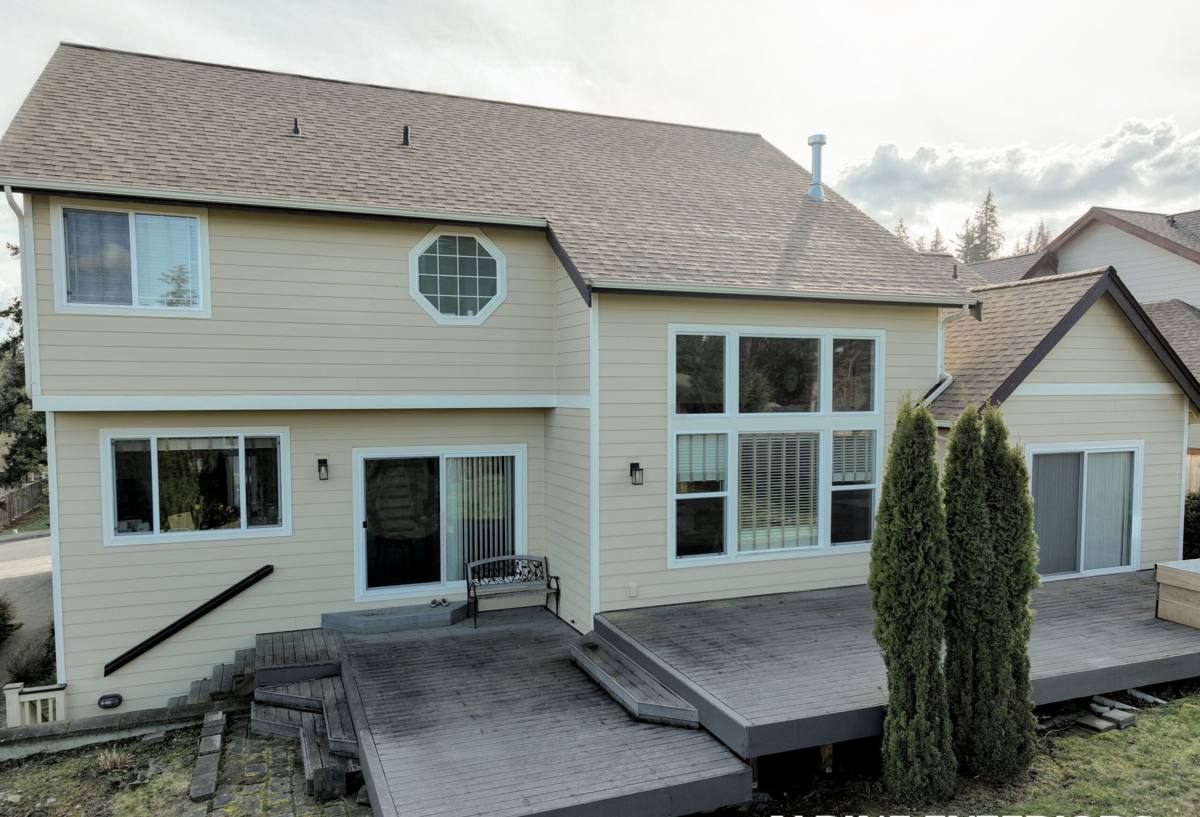
Why Composite Makes Sense for This Neighborhood
Composite decking isn't automatically the right call for every homeowner, but for a shaded, damp lot like a lot of what you see around Silver Lake, it solves problems that wood decking struggles with. Wood decking in a shaded, wet environment needs regular sealing, sanding, and staining to keep moisture out of the grain — skip a year and you're often looking at cupping, splintering, or rot starting at the fastener holes. Composite boards, particularly capped composite, resist moisture absorption at the board level, which matters a lot when a deck spends half the year damp.
That doesn't mean composite is maintenance-free — nothing outdoors in this climate is. It means the maintenance shifts from structural upkeep (sealing to prevent rot) to surface upkeep (rinsing off moss and pollen). For most homeowners, that's a trade worth making, especially on a deck that gets filtered light most of the day and stays damp longer than a deck in full sun.
Where Wood Still Makes Sense
We're honest about this: some homeowners want the look and feel of real wood, or they're working with a tight budget on a smaller deck. Cedar can perform well here if it's maintained on schedule. We'll tell you straight if wood is a reasonable option for your project — we're not going to push composite on a job where it doesn't fit the budget or the goal.
What a Correct Composite Deck Installation Actually Involves
The composite boards get most of the attention, but the substructure underneath them determines whether the deck lasts 10 years or 30. In a wet climate like Snohomish County, this is where most of the long-term problems start if it's rushed.
- Ledger board properly flashed and sealed where it meets the house, so water can't work its way behind the siding
- Joists spaced correctly for the specific composite product — many composite boards require tighter joist spacing than dimensional lumber, especially at angles or picture-frame borders
- Joist tape or a comparable moisture barrier on top of every joist, protecting the framing lumber from the moisture that composite boards will shed onto it
- Proper airflow underneath the deck so the substructure can actually dry out between rain events, not just stay damp all winter
- Corrosion-resistant fasteners and hardware rated for ground contact and coastal-adjacent moisture exposure
- Correct gapping between boards for drainage and for the material's expansion and contraction through temperature swings
Skip any one of these and the composite boards on top can look fine while the frame underneath is quietly failing. We've seen decks where the visible boards were only a few years old but the joists underneath had been rotting for a while because nobody flashed the ledger board correctly or left the substructure without any way to dry out.
Our Process, Start to Finish
- Site walk and assessment. We look at sun exposure, tree cover, drainage patterns, and how the deck ties into the house before we talk product options.
- Design and material selection. We go over composite board options, colors, railing systems, and layout — picture framing, angled boards, multi-level designs — based on your home and budget.
- Permitting. Most new decks and many replacement decks in Snohomish County and the City of Everett require a building permit, especially above certain heights or attached to the structure. We handle that process rather than leaving it on you.
- Demo, if applicable. Old decking, damaged framing, and any rotted structural members get removed and assessed before new material goes down.
- Substructure build. Framing, flashing, joist protection, and ledger work — the part that doesn't show but matters most.
- Composite installation. Boards, fascia, railings, and any accent work like lighting or picture-frame borders.
- Final walkthrough. We check fastener seating, board gapping, railing stability, and clean up the site before we call it done.
Composite vs. Other Decking Materials
| Material | Moisture Performance in This Climate | Upkeep | Typical Lifespan Here |
|---|---|---|---|
| Capped composite | Strong — cap layer resists moisture absorption and staining | Periodic rinsing/cleaning, no sealing needed | 25–30+ years |
| Uncapped composite | Good, but more prone to surface moisture absorption and mold over time | Occasional cleaning, more attention in shaded areas | 15–25 years |
| Cedar | Moderate — naturally rot-resistant but needs a maintained seal | Annual/biennial sealing or staining | 10–15 years if maintained on schedule |
| Pressure-treated pine | Weaker in shaded, wet conditions without diligent sealing | Frequent sealing, more prone to splintering and warping | 10–15 years |
These are general ranges, not guarantees — actual lifespan depends heavily on sun exposure, drainage, and how consistently a deck is maintained. A shaded, tree-covered lot will push any material toward the lower end of its range.
Moss, Algae, and the Shade Problem
Moss and algae need two things to take hold: moisture and shade. Silver Lake's tree cover gives a deck plenty of both for much of the year. Composite decking resists moss growing into the board itself the way it can root into untreated wood grain, but moss and algae can still build up on the surface, especially in corners, under furniture, and in low-airflow spots near railings or the house.
A few things reduce this over time: keeping board gaps clear of leaves and debris so water actually drains through instead of pooling, trimming back branches that keep a section of the deck in constant shade, and rinsing the deck off periodically rather than letting organic buildup sit there all winter. None of this is heavy labor — it's just consistency, which matters more here than it does in drier climates.
Railings, Hardware, and the Details That Get Skipped
A lot of deck problems in this region don't start with the decking boards at all — they start with the metal. Cheap or mismatched fasteners corrode, streak the boards with rust stains, and eventually loosen. Railing posts that aren't properly through-bolted and flashed become the weak point in an otherwise solid deck.
We use fasteners and structural hardware rated for exterior, moisture-heavy use, and we flash post bases and any point where hardware penetrates the decking surface. It's a small percentage of the total job cost but it's one of the most common places we see corner-cutting on decks that fail early.
Maintenance That Actually Matters
- Rinse the deck surface a few times a year, more often under heavy tree cover
- Clear leaves, needles, and debris out of board gaps so water keeps draining
- Check railing posts and stair connections annually for movement
- Trim back overhanging branches that keep sections of the deck shaded and damp
- Inspect fastener heads for rust staining, which usually signals a hardware issue worth addressing early
- Keep the area underneath the deck clear so airflow can do its job
What Drives Cost on a Silver Lake Deck
| Factor | Why It Matters |
|---|---|
| Deck size and shape | Angled cuts, curves, and multi-level designs add labor beyond simple square footage |
| Composite tier | Uncapped, capped, and premium composite lines vary significantly in material cost |
| Substructure condition | Replacing an existing deck may reveal rotted framing that needs to be rebuilt, not just resurfaced |
| Height and railing requirements | Taller decks and code-required railings add material and labor |
| Site access | Tree cover, slope, and tight lot access around the lake can slow material staging and demo |
| Permitting | Permit fees and any required engineering vary by structure and jurisdiction |
We don't quote decks off square footage alone, because the substructure condition and site access change the labor picture more than people expect. A firm number comes after we've actually looked at the site.
Why Local Experience on This Specific Deck Type Matters
A crew that's worked Silver Lake and similar Everett neighborhoods knows the pattern before they show up: shaded lots, damp substructures on older decks, and the moss buildup that comes with tree cover this heavy. That means we're not guessing at joist spacing for a given composite product or discovering rot for the first time mid-job — we've built and repaired enough decks in this exact kind of setting to plan for it upfront. It also means we understand Snohomish County and Everett permitting requirements without treating your project as a learning exercise.
If you're weighing composite decking for a home in Silver Lake, we're happy to walk the site, talk through what your specific lot and sun exposure call for, and give you a straightforward estimate — no pressure, no upsell. Use the form below to get started.