 Everett
 South Everett Siding Has to Work Harder Than the Brochure Suggests
South Everett sits close enough to Puget Sound to pick up salt-tinged air, far enough into Snohomish County's tree cover to stay shaded and damp for long stretches, and squarely inside a weather pattern that delivers driving, wind-blown rain rather than the gentle straight-down kind. Individually, none of those conditions is unusual for western Washington. Stacked together, year after year, they're exactly the combination that exposes cheap siding, sloppy flashing work, and products that were never engineered for a marine climate in the first place.
We install James Hardie fiber cement siding exclusively, and this page is specifically about what that looks like on a South Everett home — not a general siding overview, but the practical reality of choosing, installing, and living with Hardie siding in this particular neighborhood's conditions.
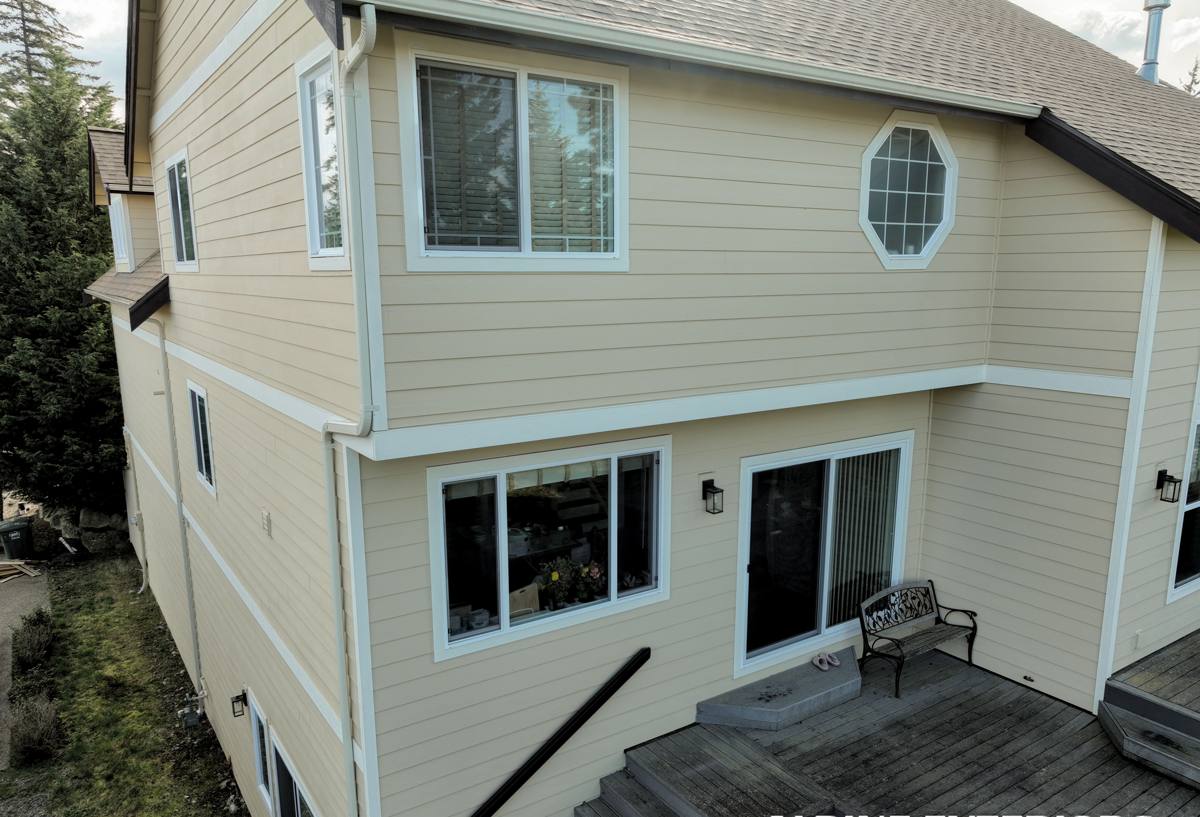
What South Everett's Climate Actually Does to a Home's Exterior
Salt Air and Slow Corrosion
Homes closer to the water pick up airborne salt that settles on siding, fasteners, and trim. Over time this accelerates fading and chalking on lower-grade finishes and can corrode fasteners that weren't rated for coastal exposure. It's rarely dramatic or sudden — it's a slow erosion of whatever margin a cheaper product started with.
Driving Rain and Wind-Driven Moisture
Rain here doesn't fall straight down as often as people assume. Wind pushes it sideways and up under laps, around window and door openings, and into any gap that wasn't properly flashed or caulked. Siding systems that depend on paint film or caulk alone to keep water out — rather than a properly detailed drainage plane behind the cladding — tend to show their weaknesses first in exactly this kind of weather.
Moss and Algae on Shaded Walls
South Everett's mix of mature trees and closely spaced lots means a lot of homes have at least one wall — usually north-facing or tucked under a canopy — that rarely dries out fully between storms. That kind of sustained dampness is where moss and algae take hold, and it's a much bigger problem for wood-based or wood-look products that can absorb moisture than it is for a properly finished fiber cement board.
Why We Only Install James Hardie Fiber Cement
We don't install LP SmartSide, vinyl, Cemplank, Allura, primed spruce, or cedar, and that's a deliberate standard, not an accident of what we happen to stock. Each of those products has genuine strengths — vinyl is inexpensive, cedar is beautiful, engineered wood siding installs quickly — but each also carries a real-world trade-off in exactly the conditions South Everett sees most: moisture absorption, seam and joint vulnerability, maintenance burden, or a finish that doesn't hold up to sustained damp and salt exposure the way a factory-cured cement composite does.
James Hardie's fiber cement is non-combustible, holds its shape and dimension in wet-dry cycling far better than wood-based products, and comes with a factory-applied ColorPlus finish that's cured under controlled conditions rather than painted on a jobsite at the mercy of the weather. For the Pacific Northwest specifically, Hardie makes an HZ5 product line engineered for colder, wetter climate zones — which is what we install here rather than a formulation built for a drier region. That's the whole reason we standardized on one manufacturer instead of offering several: a single system we can install, warranty, and stand behind with full confidence in this exact climate.
What a Correct James Hardie Installation Actually Involves
The board itself is only part of the system. Most of the siding failures we get called out to inspect in this area trace back to installation shortcuts, not the material. A correct Hardie install on a South Everett home involves several steps that don't show up in a finished photo but determine how the wall performs for decades.
Water Management Behind the Siding
Before a single board goes up, the wall needs a continuous weather-resistive barrier, correctly lapped and taped, with flashing integrated at every window, door, and penetration so water that gets behind the cladding — and some always will, in this climate — has a clear path down and out rather than pooling behind the sheathing.
Clearances and Fastening
Hardie specifies minimum clearances from grade, roof lines, decks, and horizontal surfaces, and a fastening pattern and fastener type matched to the climate zone. Skipping these — nailing too close to an edge, tying siding directly into a concrete walkway, using the wrong fastener spacing — is a common shortcut that doesn't show up as a problem until years later, usually as buckling, cracking at fastener points, or moisture intrusion at the bottom course.
Joints, Caulking, and Butt Seams
Every horizontal butt joint is a potential water entry point if it isn't backed, sealed, and detailed correctly. On a home with the wall orientations and exposure South Everett properties typically have, we pay particular attention to joint placement and sealing on the sides that catch the most wind-driven rain.
Finish and Punch-List Inspection
Once the siding is up, a final inspection checks caulk lines, paint touch-up at cut edges (which need field sealing even with ColorPlus factory finish), trim reveals, and that every penetration — vents, hose bibs, light fixtures — was properly flashed and sealed before being reinstalled.
Signs an Older South Everett Home May Need Siding Attention
- Visible moss or persistent green/black staining on one or more walls that doesn't wash off easily
- Soft or spongy spots when you press on wood-based siding, especially near the bottom courses or window sills
- Paint that's peeling, bubbling, or chalking heavily rather than just fading
- Warped, cupped, or separating boards, particularly on walls that face prevailing wind and rain
- Visible gaps or cracked caulk at butt joints, corners, or window and door trim
- Rising utility bills or noticeably drafty rooms along exterior walls, which can point to failed water/air barriers behind old siding
None of these are emergencies on their own, but they're worth having looked at before they progress into sheathing or framing damage, which turns a siding project into a much larger repair.
What Affects the Cost of a South Everett Siding Project
| Factor | Why It Matters Here |
|---|---|
| Tear-off vs. new construction | Removing old siding means dealing with whatever water damage, rot, or mold is hiding behind it — common on older wood or vinyl-clad homes in this area |
| Sheathing condition | Wind-driven rain and moss cover often mean some sheathing repair is needed before new siding goes on; this is usually not knowable until tear-off |
| Home height and stories | Two-story and split-level homes, common throughout South Everett, need more scaffolding/staging time and add labor cost |
| Trim and architectural detail | Gables, dormers, and multiple wall planes take more cutting, fitting, and flashing detail than a simple rectangular elevation |
| Product line and texture | HZ5 lap, panel, and shingle profiles carry different material costs; smooth vs. cedarmill texture is a preference, not a price driver by itself |
| Site access | Narrow lots, mature landscaping, and tight side yards common in older South Everett neighborhoods can slow material staging and add labor time |
We walk every home in person before quoting rather than pricing from a photo or a square-footage estimate alone, because the factors above vary enormously even between two homes on the same street.
How Our Process Works
1. On-Site Assessment
We walk the full exterior, check existing siding condition, note problem areas (shaded walls, water staining, soft spots), and measure for an accurate material takeoff.
2. Material Order and Lead Time
Hardie board, trim, and ColorPlus-matched accessories are ordered to spec for your home — color, texture, and product line locked in before installation begins.
3. Tear-Off and Sheathing Inspection
Old siding comes off and the sheathing underneath gets inspected before anything new goes up. If we find rot or water damage, we address it before installing over it — covering a known problem is how small issues become expensive ones.
4. Water Barrier and Flashing Installation
Weather-resistive barrier, window and door flashing, and any rainscreen or furring detail get installed and inspected before the first board is hung.
5. Siding Installation
Boards go up to Hardie's fastening and clearance specifications, with attention to joint placement and sealing on the walls that take the most wind and rain exposure.
6. Final Walkthrough
We walk the finished job with you, checking caulk lines, trim, and touch-up before calling it done, and register the manufacturer warranty on your behalf.
Why Hiring a Crew That Already Works South Everett Matters
Siding is a system, not just a product, and the details that make it perform — flashing, clearances, fastening, drainage — are the same details a crew unfamiliar with this specific climate is most likely to get wrong. A crew that regularly works South Everett homes already understands which wall orientations take the worst weather, what moss and moisture problems tend to look like in this area's housing stock, and how to sequence a tear-off around our rain patterns instead of leaving sheathing exposed and hoping for a dry week.
There's also the practical side: permitting through the correct local jurisdiction, familiarity with any HOA architectural guidelines common to some South Everett developments, and established relationships with material suppliers that keep a project from stalling out waiting on backordered trim or color-matched accessories.
Questions Worth Asking Any Contractor Before You Hire
- Are you a certified James Hardie installer, and can you show examples of completed work in this climate?
- Will you inspect and address sheathing condition before installing new siding, not just cover what's there?
- What's your fastening and flashing detail for wind-driven rain exposure — can you explain it, not just say "to code"?
- Are you licensed, bonded, and will you pull the required permit yourselves?
- What does the manufacturer warranty cover, and will you register it on my behalf?
- Do you have a plan for weather delays that keeps sheathing from sitting exposed for extended periods?
A Long-Term Investment, Not Just a Facelift
Re-siding a home is disruptive and not cheap, which is exactly why it's worth doing once, correctly, with a product engineered for the climate it's going into. James Hardie's HZ5 line, installed to spec with proper water management underneath it, is built to handle years of South Everett's salt air, wind-driven rain, and shaded, moss-prone walls without the maintenance cycle that wood-based and vinyl products tend to demand in this climate. That's the standard we hold every project to, whether it's a small accent wall or a full tear-off re-side.
If your South Everett home's siding is showing its age, or you're planning ahead for a project, we're happy to walk the property with you and put together a free, no-pressure estimate.