 Everett
 Port Gardner's Climate Puts Real Demands on Siding
Port Gardner sits close enough to Puget Sound that its homes take on a different set of exterior challenges than houses a few miles inland. The combination of salt-influenced air off the water, driving rain that comes in sideways during winter storms, and a moss season that can run most of the year on shaded elevations means siding here has to do more than look good. It has to hold up to constant moisture exposure, resist the slow corrosion that salt air causes on fasteners and trim, and shed water instead of trapping it against the wall assembly.
A lot of siding problems we see on Port Gardner homes did not start as siding problems. They started as water management problems — a flashing detail that was skipped, a gap that should have been left open and was caulked shut instead, or a product that simply was not built for this kind of sustained wet exposure. Getting a siding installation right in this neighborhood means understanding those specific pressures before the first piece goes up.
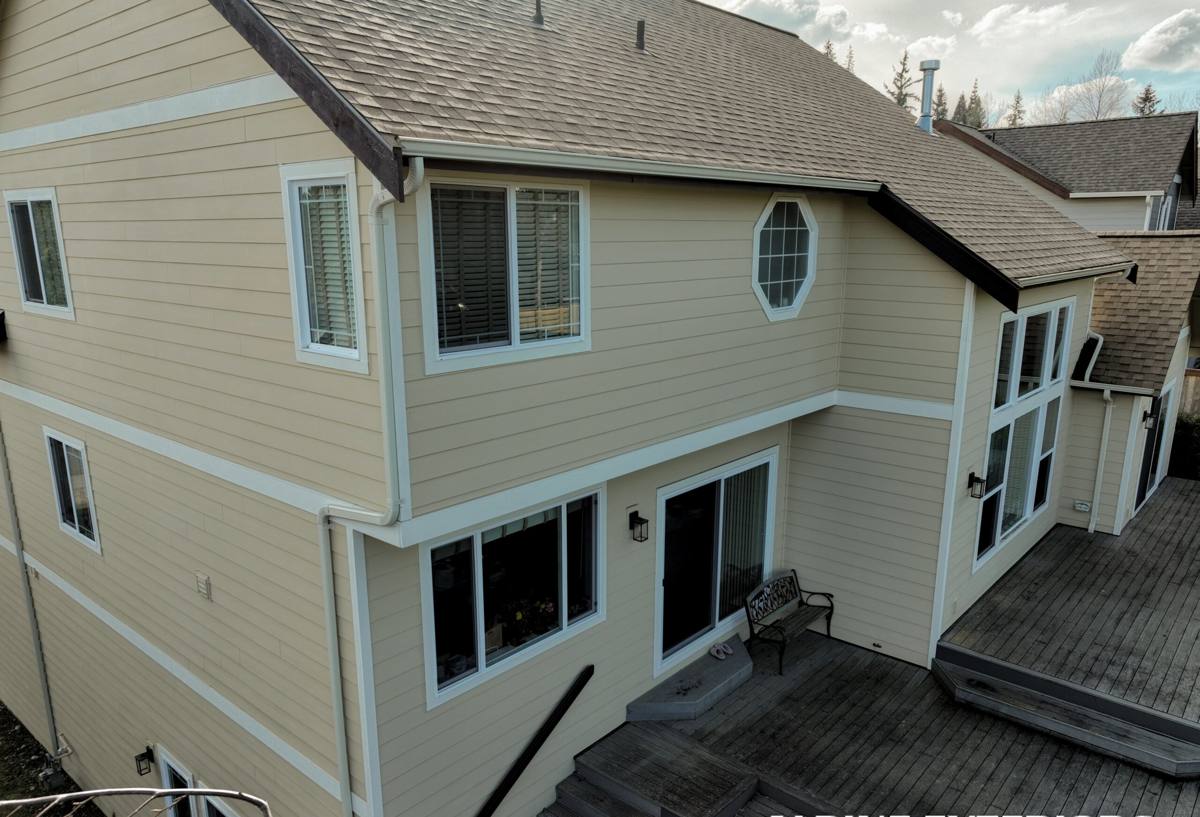
What Salt Air, Driving Rain, and Moss Actually Do to Siding
Salt-Influenced Air
Homes near Puget Sound don't get the same intensity of salt exposure as a beachfront property, but there's enough salt in the air to accelerate corrosion on fasteners, hardware, and any metal flashing that isn't rated for it. Over years, that corrosion can compromise the very details that are supposed to keep water out.
Wind-Driven Rain
Everett's storms frequently push rain horizontally, not straight down. That matters because siding systems are engineered assuming water mostly runs down a wall — wind-driven rain forces water sideways and upward into laps, seams, and penetrations that a calmer rain would never reach. Siding, flashing, and caulking all have to be installed with that reality in mind.
Extended Moss and Mildew Season
North-facing and shaded walls in Port Gardner can stay damp for long stretches, which is exactly the environment moss, algae, and mildew need to take hold. Beyond the cosmetic issue, sustained organic growth holds moisture against the siding surface longer than it would otherwise sit there, which shortens the service life of any material that isn't dimensionally stable when wet.
Why Material Choice Matters More Here Than Elsewhere
In a drier climate, the gap between a good siding material and a mediocre one shows up slowly, if at all. In a climate like Port Gardner's, that gap shows up fast — usually as swelling, delamination, paint failure, or moss that won't stay off no matter how often it's cleaned. This is why we made the decision to install only James Hardie fiber cement siding. We don't install vinyl, LP SmartSide, or primed wood products, and we don't pretend that decision is just a matter of preference.
Vinyl can warp and gap under sustained moisture and temperature cycling, which opens paths for water behind the cladding. Wood-based and engineered wood products, even primed ones, are more vulnerable to moisture absorption at cut edges and seams — exactly the kind of exposure Port Gardner's driving rain creates. Fiber cement is not immune to poor installation, but as a material it does not swell, rot, or feed moss the way wood-based products can, and it holds a factory finish far longer than field-applied paint. That combination is why it's the only product we put our name behind.
What a Correct Siding Installation Actually Involves
The material is only half the equation. A correct installation is what actually keeps a Port Gardner home dry through decades of coastal storms. The details below are non-negotiable on every job we do, regardless of how small the project is.
Water-Resistive Barrier and Flashing
A continuous, properly lapped weather-resistive barrier goes on before any siding, with flashing integrated at every window, door, and penetration so water is directed out and away from the sheathing, never trapped behind it.
Rainscreen Gap
We install fiber cement over a drainage gap rather than directly against the barrier. That gap lets any incidental moisture that gets behind the siding drain and dry out instead of sitting against the wall — a detail that matters far more in a wet climate like this one than in a dry region.
Fastening and Clearances
Fasteners are placed per the manufacturer's engineering specifications, siding is held off grade and hard surfaces at the correct clearance, and butt joints are flashed rather than simply caulked. Caulk is a backup, not a strategy.
Trim and Caulking Discipline
Not every seam should be sealed. Overcaulking can trap moisture in places it needs to escape from. Knowing which joints need a sealant bead and which need to breathe is a judgment call that comes from experience with this exact climate.
Our Process for Port Gardner Installations
- On-site assessment — we look at wall orientation, shading, existing moisture damage, and how exposed the home is to wind-driven rain off the Sound.
- Moisture and substrate check — sheathing and framing are checked for existing water damage before new siding goes over anything.
- Product and line selection — we recommend the Hardie product line and finish suited to the home's exposure, not just its style.
- Installation to manufacturer spec — barrier, flashing, rainscreen gap, and fastening all done to the details above.
- Final walkthrough — trim, caulking lines, and touch-up are reviewed with the homeowner before we call the job done.
James Hardie Product Lines and Colors for This Climate
James Hardie engineers its HardieZone products by climate region, and Snohomish County falls into the HZ5 zone — the moisture-focused engineering built for the Pacific Northwest's wet weather. That's the product line we install on Port Gardner homes.
| Product | Best Use | Notes for Port Gardner |
|---|---|---|
| HardiePlank lap siding | Most homes, classic lap look | HZ5 formulation resists the moisture cycling this climate creates |
| HardiePanel vertical siding | Accent walls, modern facades | Pairs well with board-and-batten detailing on gables |
| HardieShingle | Accent or full-facade shingle look | Good option where a textured, coastal look is desired |
| HardieTrim | Corners, window and door trim | Matched fiber cement trim avoids the rot risk of wood trim |
ColorPlus factory finish is worth calling out specifically for this neighborhood: it's baked on and backed by its own finish warranty, which matters when field-applied paint would otherwise be fighting salt air and constant damp conditions from day one.
Cost Factors for Port Gardner Homes
Every home is different, but these are the factors that most often move the price of a siding installation in this neighborhood specifically.
| Factor | Why It Matters Here |
|---|---|
| Existing siding removal and disposal | Moisture-damaged wood or vinyl underneath often needs extra sheathing repair |
| Home size and wall complexity | More corners, gables, and penetrations mean more flashing detail work |
| Water damage repair | Rot found during tear-off has to be addressed before new siding goes on |
| Product line and finish | Panel, plank, and shingle products carry different material costs |
| Site access | Some Port Gardner lots have limited staging space or steep grades affecting labor time |
We give a firm, written number after the on-site assessment — not a phone estimate — because so much of the real cost here depends on what's found once tear-off begins.
Maintaining Your Siding After Installation
Correctly installed Hardie siding is low-maintenance, but "low" isn't "none," especially in a climate that grows moss year-round. A short annual routine keeps it performing the way it's designed to.
- Rinse down shaded and north-facing walls once or twice a year to keep moss and algae from establishing
- Check caulking at trim joints and penetrations annually for cracking or separation
- Keep gutters clear so overflow doesn't run down the wall face repeatedly
- Trim back vegetation and landscaping that keeps siding shaded and damp
- Have any impact damage or chipped ColorPlus finish repaired promptly rather than left exposed
Why Hiring a Crew That Already Works in Port Gardner Matters
Siding installation isn't a generic task you can transplant from a dry inland town onto a Puget Sound-adjacent neighborhood and expect the same results. A crew that already works Port Gardner and the broader Everett area knows which elevations take the worst of the wind-driven rain, which lots hold onto shade and moisture longest, and which flashing details actually hold up through a Snohomish County winter rather than just passing a one-time inspection. That local pattern recognition is the difference between a siding job that looks right on installation day and one that's still performing correctly ten winters later.
If you're considering new siding for a Port Gardner home, we're happy to walk the property, look at what your current siding and wall assembly are dealing with, and give you a straightforward, no-pressure estimate for a James Hardie installation built for this exact climate. There's no obligation — just a clear look at what your home actually needs.