 Everett
 Fiber Cement Siding Built for Riverside's Weather
Riverside sits along the Snohomish River on the north side of Everett, and that setting puts homes here in a slightly different exposure than a lot in a more sheltered part of the city. Low-lying, river-adjacent ground holds moisture differently than a hillside site does, and combined with the salt air that moves in off Port Gardner Bay and Possession Sound, the driving rain that Snohomish County sees through fall and winter, and a moss season that runs across most of the year, a Riverside home's siding is working harder than most homeowners realize. This page covers fiber cement siding specifically for this neighborhood — what the climate actually demands from it, what a correct installation involves, and why we install only James Hardie fiber cement rather than the wider range of products on the market.
We work in Riverside regularly, and the approach we bring to a siding job here is built around what this specific combination of river dampness, salt exposure, and sustained regional rain does to a wall over time, not a generic install we'd run the same way anywhere in western Washington.
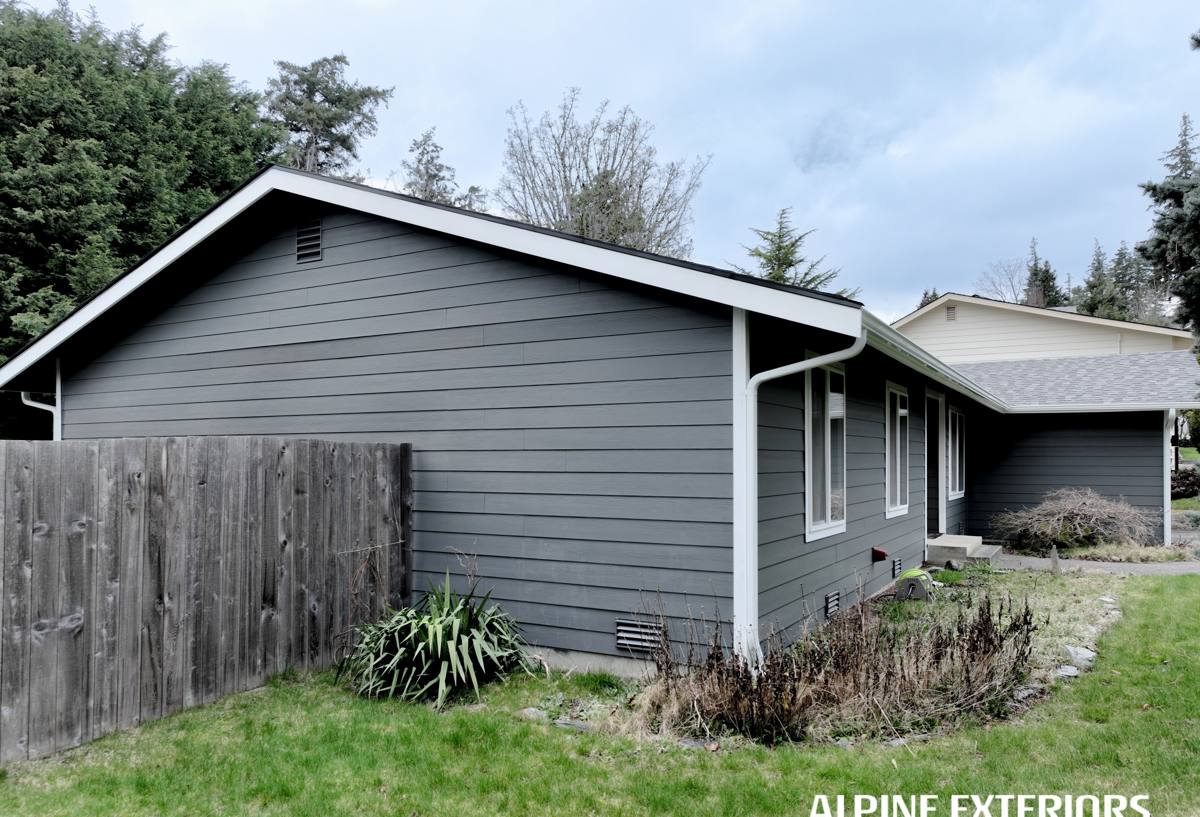
What Riverside's Climate Actually Does to Siding
Salt Air
Salt-laden air moving up from Port Gardner Bay and Possession Sound accelerates corrosion in fasteners, flashing, and metal trim faster than a drier inland location would see. Once a fastener starts corroding, it loses holding strength and can open a small gap right where it penetrates the siding — a direct entry point for water that gets worse with every wet season rather than better.
Driving Rain
Rain in this part of Snohomish County rarely just falls straight down. Storm systems moving through push it sideways into lap joints, trim seams, and butt joints that were only ever designed to shed water moving downward. Walls facing the prevailing weather take the worst of it and are usually the first place problems show up on an aging installation.
River-Adjacent Ground Moisture
Riverside's position along the Snohomish River means the ground here tends to stay damper, longer, than higher ground elsewhere in Everett. That doesn't change what siding material is right for the neighborhood, but it does raise the stakes on details like clearance from grade, drainage behind the wall, and how quickly a wall assembly gets a chance to dry out between storms — margin for error is thinner on lower, damper ground.
A Long Moss Season
Mild temperatures, consistent moisture, and shaded or north-facing wall area on most homes keep moss and mildew active across most of the year here. It isn't just cosmetic — organic growth holds moisture against the siding surface longer than it would otherwise sit there, which extends every wet-dry cycle the material underneath has to survive.
Why Fiber Cement Is the Right Material for This Neighborhood
Fiber cement is made from cement, sand, and cellulose fiber, which gives it a fundamentally different relationship with water than wood-based or vinyl products have. It doesn't absorb moisture into its structure and swell the way engineered or solid wood siding does, and it doesn't distort with temperature swings the way vinyl can. That dimensional stability matters everywhere in this climate, but it matters more on a site like Riverside, where ground moisture and salt air are already putting extra pressure on every seam and fastener.
None of that makes fiber cement immune to problems. The caulk joints, cut edges, and fastener lines around any installation still have to be detailed correctly, and a good material installed poorly can still fail. But the base material itself isn't the weak point the way it can be with wood-based or plastic sidings, and that gives a Riverside home more real margin against a climate that tests every joint on the house.
Why We Install Only James Hardie
We install James Hardie fiber cement siding exclusively. We don't install LP SmartSide, vinyl siding, Cemplank, Allura, primed spruce, or cedar. Each of those products has a place in the broader market, and plenty of homeowners elsewhere are satisfied with them. Our decision to standardize on one system came from watching, job after job, which materials actually held up under sustained Puget Sound moisture and salt exposure and which ones quietly turned into maintenance burdens a few years down the road.
| What Hardie Offers | Why It Matters in Riverside |
|---|---|
| Non-combustible fiber cement core | Doesn't feed a fire the way wood-based or wood-derived siding can, which matters for safety and insurance underwriting alike |
| Factory-applied ColorPlus finish | Cured under controlled conditions rather than brushed on in the field, so it resists fading, chalking, and moisture intrusion far longer than site-applied paint holds up against salt air |
| Climate-engineered HZ5 formulation | Built specifically for regions with sustained moisture exposure, which is a direct match for a low-lying, river-adjacent property |
| Dimensional stability | Doesn't swell, cup, or warp the way engineered wood can after repeated wet-season cycles, which matters more here given how long that wet season runs |
| Strong transferable warranty | Real, documented protection when installation follows spec, rather than a marketing claim |
We made that call as a professional standard, not a sales pitch. A cheaper product can look like a good deal on install day and still shift real maintenance cost and risk back onto the homeowner within a decade, and on a site with this much combined moisture exposure, that trade-off isn't one we're willing to make on someone else's behalf.
What a Correct Installation Involves
Material choice only gets a Riverside home halfway there. The rest comes down to installation detail, and this is where a lot of the long-term performance difference actually gets decided.
Weather Barrier and Flashing
A continuous, properly lapped water-resistive barrier behind the siding, with flashing at every window, door, and wall penetration sequenced correctly with that barrier, is what actually keeps incidental moisture from reaching the sheathing. On lower ground with more sustained dampness, gaps or shortcuts here show up faster than they would on a drier, higher lot.
Fastening and Gapping to Spec
Hardie's installation instructions call for specific fastener types, spacing, and depth, along with defined gaps at joints and around trim to allow for expansion and drainage. Skipping or eyeballing these specs is one of the more common ways an otherwise good product ends up performing poorly — cracked boards, popped fasteners, or water tracking in at a joint that wasn't gapped correctly.
Drainage Behind the Wall
Given how much moisture a river-adjacent property deals with, we pay close attention to drainage behind the siding — making sure incidental water that gets past the outer layer has somewhere to go instead of sitting against the sheathing. That's a detail that's easy to shortcut and hard to notice once the wall is closed up, which is part of why it's worth asking a contractor about directly.
Clearance From Grade
Siding installed too close to grade, a deck, or a roofline stays wet longer and is one of the more common places we find hidden rot on older homes. Correct clearance is a simple detail, but it's frequently ignored on rushed or underbid jobs.
Signs Your Current Siding Is Losing the Fight
A lot of Riverside homes still have older wood, vinyl, or engineered wood siding that's showing its age faster than the homeowner expected. These are the signs worth taking seriously:
- Moss or dark staining that returns quickly after cleaning, especially on shaded or north-facing walls
- Soft or spongy siding when pressed, particularly low on the wall or around window and door trim
- Paint that's chalking, peeling, or failing well ahead of its expected repaint schedule
- Cupping, warping, or visibly uneven boards, most common on wood-based or engineered wood products
- Caulk that's cracked, shrunk, or pulled away from joints and trim lines
- Rusting fastener heads or corroding flashing visible at seams and corners
- Gaps opening up at butt joints or where siding meets trim
Any one of these on its own might just need a repair or a maintenance pass. Several of them together, especially on an older installation, usually mean the siding is past the point where patching makes sense.
Cost Factors for a Riverside Fiber Cement Project
| Factor | Why It Matters Here |
|---|---|
| Tear-off vs. new construction | Removing old siding reveals sheathing condition and any moisture damage hidden underneath, which is common on older river-adjacent homes |
| Substrate repair | Damp ground and long-term moisture exposure can lead to sheathing or framing repair costs that only become clear once old siding is off |
| Siding profile and texture | Lap, panel, and shingle profiles differ in material and labor, and texture choice affects trim detailing |
| ColorPlus vs. field-painted | Factory-finished boards cost more upfront but avoid the recurring cost and risk of repainting in a climate this hard on field-applied coatings |
| Trim and fascia scope | Full trim replacement alongside siding adds cost but avoids mismatched materials aging at different rates |
| Home size and story count | Access, staging, and labor time scale with square footage and height |
Exact numbers depend on the specific property and what we find once we're able to look closely, which is why we walk the home in person before giving a real estimate rather than quoting off a general price sheet.
Our Process, Start to Finish
- A free, on-site inspection where we look at the existing siding, trim, and any visible moisture or rot issues
- An honest assessment of whether the home needs a repair, a partial re-side, or a full replacement
- Product, texture, and color selection, including whether ColorPlus or field-painted primed board is the right fit
- Permitting handled before work begins
- Tear-off of old siding, with a substrate inspection to catch hidden moisture or rot before anything new goes on
- Installation of the water-resistive barrier and flashing at every window, door, and penetration
- Hardie siding installed to manufacturer spec — correct fastening, gapping, and drainage detailing
- Trim, caulking, and any touch-up work
- A final walk-through so you can see the finished job and ask questions before we consider it done
Caring for Fiber Cement Siding After Installation
Fiber cement is low-maintenance compared to wood or vinyl, but "low-maintenance" isn't "no-maintenance," especially in a climate this active for moss and moisture.
- Rinse siding down once or twice a year to keep dirt, pollen, and early moss growth from building up
- Keep gutters clear so overflow doesn't run down the wall and soak siding and trim repeatedly
- Trim back vegetation and tree branches near the house to improve airflow and reduce shade on damp walls
- Check caulking at joints and trim annually, and address any cracking or separation before it lets water in
- Address moss or mildew promptly rather than letting it sit through another wet season
- Watch drainage at grade, especially given how damp the ground stays near the river, and keep soil and mulch from building up against the bottom of the siding
Why a Crew That Already Works Riverside Matters
A contractor who works this neighborhood regularly understands how river-adjacent ground, salt air, and sustained regional rain behave on real homes here over a full year, not just how a product performs on a manufacturer's spec sheet. That experience shapes decisions on install day — which wall orientations stay wet longest, where extra flashing attention actually pays off, and where a shortcut that would be fine on a drier, higher lot elsewhere in Everett isn't worth the risk here. Riverside's exposure is different enough from the rest of the city that treating every property the same way, regardless of where it sits, is how avoidable problems end up back on a homeowner's doorstep a few years later.
If your Riverside home needs new siding, a repair to storm or moisture damage, or just an honest second opinion on what's happening behind an aging wall, we're glad to take a look. Reach out using the form below to schedule a free, no-pressure estimate.