 Everett
 Why New-Construction Windows Need to Be Right the First Time
When you're building new in Forest Park, the windows go in once — and then they get buried behind siding, trim, and insulation for the next several decades. There's no "we'll fix it later" with new-construction windows. Every flashing detail, every fastener, every bead of sealant either does its job quietly for 30+ years or becomes a hidden leak path that doesn't show up until there's already rot in the wall framing. That's a different level of stakes than swapping out an old window in an existing opening, and it's why the installation sequence matters as much as the window itself.
Forest Park is an established Everett neighborhood with a mix of older homes and newer infill construction, and we see both kinds of projects — full new builds and additions that call for new-construction window details rather than a retrofit. Either way, the job has to account for what this part of Snohomish County actually throws at a house year-round.
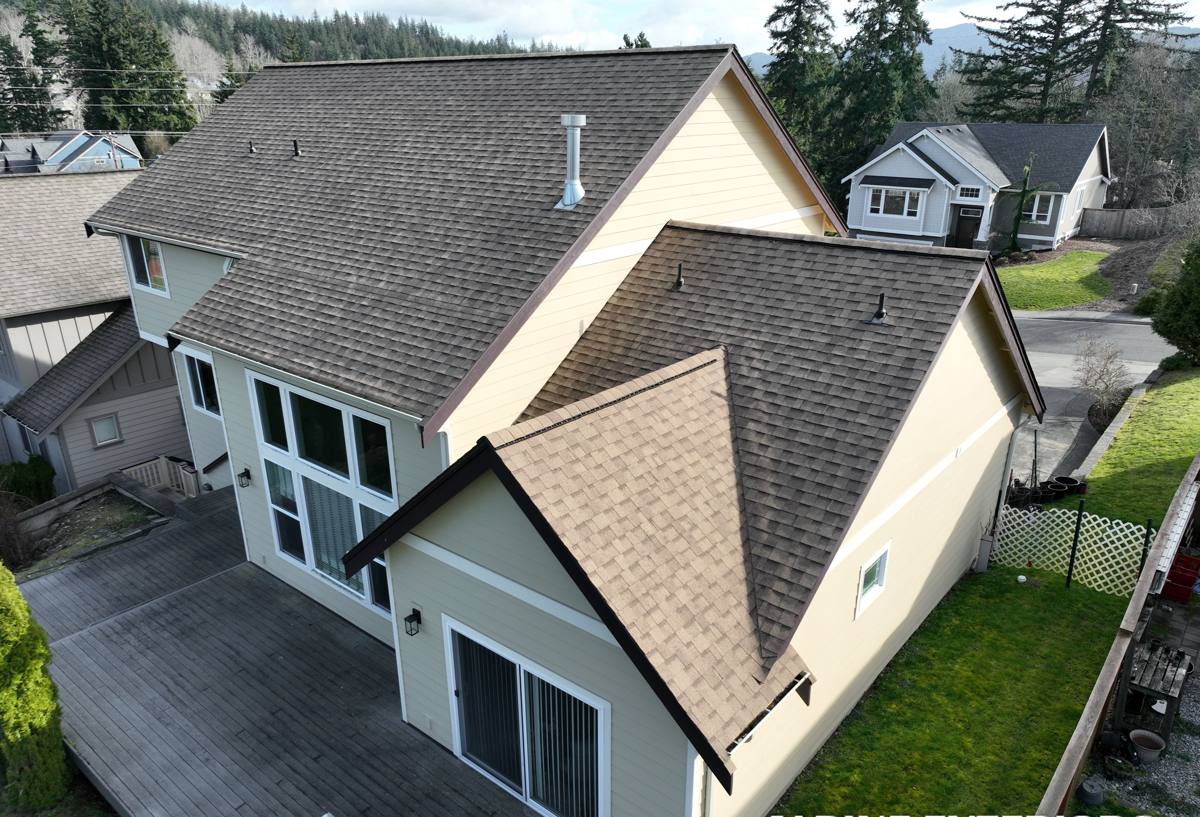
What Everett's Climate Demands From a Window Installation
Forest Park sits close enough to Puget Sound that salt-laden air is a real factor for anything metal on the exterior — hinges, cranks, screws, and cladding fasteners all corrode faster here than they would further inland. That alone pushes us toward corrosion-resistant hardware and fasteners rather than whatever came cheapest in the box.
Then there's the rain. Everett doesn't just get a lot of it — it gets wind-driven, sideways rain during fall and winter storms, which is a much tougher test for a window opening than rain falling straight down. A window that would pass in a calmer climate can still leak here if the flashing isn't lapped correctly to shed water outward and downward, every time, under wind pressure.
And then there's moss season — the long stretch of cool, damp months when anything that stays wet for days at a time starts growing moss and algae. Around windows, that shows up on sills, trim, and any horizontal surface that doesn't drain and dry quickly. A well-detailed sill with the right slope and drip edge sheds water fast enough to avoid it; a flat or poorly flashed sill becomes a moss farm and, eventually, a rot problem.
None of this is exotic knowledge — it's just what happens when you build this close to the water in the Pacific Northwest. But it only gets addressed if the crew treats it as a design requirement, not an afterthought.
New-Construction vs. Replacement Windows: Not the Same Job
It's worth being clear about the distinction, because it changes how the window actually gets installed:
- Replacement (pocket) windows are inserted into an existing frame that's already flashed and sealed into the wall — the new unit relies on the old opening's waterproofing.
- New-construction windows have a nailing flange around the perimeter and are installed directly into a framed rough opening, with the flashing and weather-resistive barrier built around them from scratch, in a specific order.
That second scenario is what applies to a new home or an addition in Forest Park, and it means the window's long-term performance depends almost entirely on installation sequence — the window unit itself is only part of the system.
Flashing and Sill Pan Sequence
The rough opening needs a sloped sill pan so any water that does get past the window drains back outside instead of pooling on the framing. Side and head flashing then get layered in "shingle fashion" — each piece overlapping the one below it — so water always moves down and out, never behind the layer beneath it.
Weather-Resistive Barrier Integration
The house wrap or building paper has to be cut, folded, and taped into the opening in the correct order relative to the flashing, so the whole assembly works as one continuous drainage plane. Get the order backward — wrap taped over flashing that should have gone over the wrap — and you've built a shelf that catches water instead of shedding it.
Fastening and Sealant
Nailing flanges get fastened per the manufacturer's schedule (skipping fasteners to "save time" is a common shortcut that shows up later as a loose or racked window). Sealant goes only where it's supposed to — a bead in the wrong spot can trap moisture just as easily as a missing one lets it in.
Choosing a Frame Material for This Climate
There's no single "best" window material for every project, but some hold up better than others against salt air, constant moisture, and temperature swings. Here's how the common options compare for a Forest Park build:
| Material | Coastal/Moisture Performance | Maintenance | Relative Cost |
|---|---|---|---|
| Vinyl | Good — won't corrode or rot, handles moisture well | Low | Lower |
| Fiberglass | Excellent — very stable in temperature swings, resists moisture and salt exposure | Low | Higher |
| Aluminum-clad wood | Good exterior protection, but relies on the cladding staying intact — interior wood still needs care | Moderate | Higher |
| Bare aluminum | Weaker in this climate — more prone to condensation and, without a thermal break, corrosion near salt air | Moderate to high | Lower to moderate |
We don't push one material on every homeowner — the right call depends on your budget, the home's style, and how much upkeep you want to take on. What we will do is walk you through the honest trade-offs for a Puget Sound-adjacent lot like Forest Park rather than just quoting whatever's easiest to install.
Our New-Construction Window Process
For new builds and additions in Forest Park, our process is built around getting the flashing and drainage details right before the window is ever set in place:
- Rough opening review — we check framing dimensions, squareness, and level before ordering, so units aren't force-fit on install day.
- Sill pan and flashing plan — we confirm the flashing sequence with the builder's weather-resistive barrier system so everything integrates as one drainage plane, not a patchwork.
- Window setting — units are shimmed, squared, and fastened per manufacturer spec, checking for square and plumb at every unit, not just the first one.
- Flashing and sealant close-out — head and side flashing, WRB taping, and sealant are completed and visually verified before siding or trim covers the opening.
- Final walkthrough — operation, locking hardware, and weatherstripping are checked on every window before we call the job done.
Every step gets documented while the opening is still visible, because once trim and siding go on, that's the only proof the flashing was actually done right.
Why It Matters to Hire a Crew That Already Works Forest Park
A crew that's worked around Forest Park and greater Everett knows what this specific stretch of Snohomish County does to a building envelope — the salt air off the Sound, the wind direction storms usually come from, and how long things actually stay damp during moss season. That's not something you get from a spec sheet; it's something you learn from doing the work here repeatedly and seeing what holds up and what doesn't.
It also means fewer surprises with local permitting and inspection expectations, and a crew that's used to coordinating with builders and other trades on an active job site rather than showing up as an outside subcontractor learning the site for the first time.
A Homeowner's Pre-Install Checklist
If you're building new or adding on in Forest Park, these are worth confirming with whoever is handling your windows — whether it's us or another crew:
- Sill pans are specified and sloped to drain outward, not flat
- Flashing sequence is documented in shingle-lap order (bottom to top)
- Fastening schedule matches the window manufacturer's requirements — no skipped fasteners
- Weather-resistive barrier integration is planned before the windows arrive, not improvised on install day
- Frame material is matched to your budget and this climate's demands, not just the lowest bid
- Hardware and fasteners are rated for coastal/corrosive exposure
- Someone photographs the flashing details before they're covered by siding or trim
If your contractor can't answer these plainly, that's worth a second conversation before the windows go in.
Let's Talk About Your Forest Park Project
Whether you're framing a new home or adding a room that needs new-construction window details, we're happy to walk the site, look at your plans, and give you a straightforward estimate — no pressure, no upsell. Fill out the form below and we'll get back to you to talk through what your Forest Park project actually needs.