 Everett
 Mukilteo's Waterfront Climate Asks More of Your Siding
Mukilteo sits right on the water, and that location cuts both ways. The views are part of why people love living here, but the same exposure that gives you a front-row seat to Possession Sound also means your home's exterior takes a beating that inland Snohomish County homes never see. Salt-laden air off Puget Sound accelerates corrosion of fasteners and trim, wind-driven rain finds every gap in a siding system's defenses, and the shaded, damp stretches of fall through spring keep moss and algae established on north- and west-facing walls for months at a time.
Siding that isn't engineered for this combination doesn't fail overnight. It fails slowly — swelling at butt joints, delaminating at the surface, holding moisture behind the cladding where it can't dry out. By the time a homeowner notices, the damage is often already into the sheathing. That's the backdrop for every recommendation on this page: we install James Hardie fiber cement siding exclusively, and in a marine environment like Mukilteo, that choice matters more than it does almost anywhere else in the county.
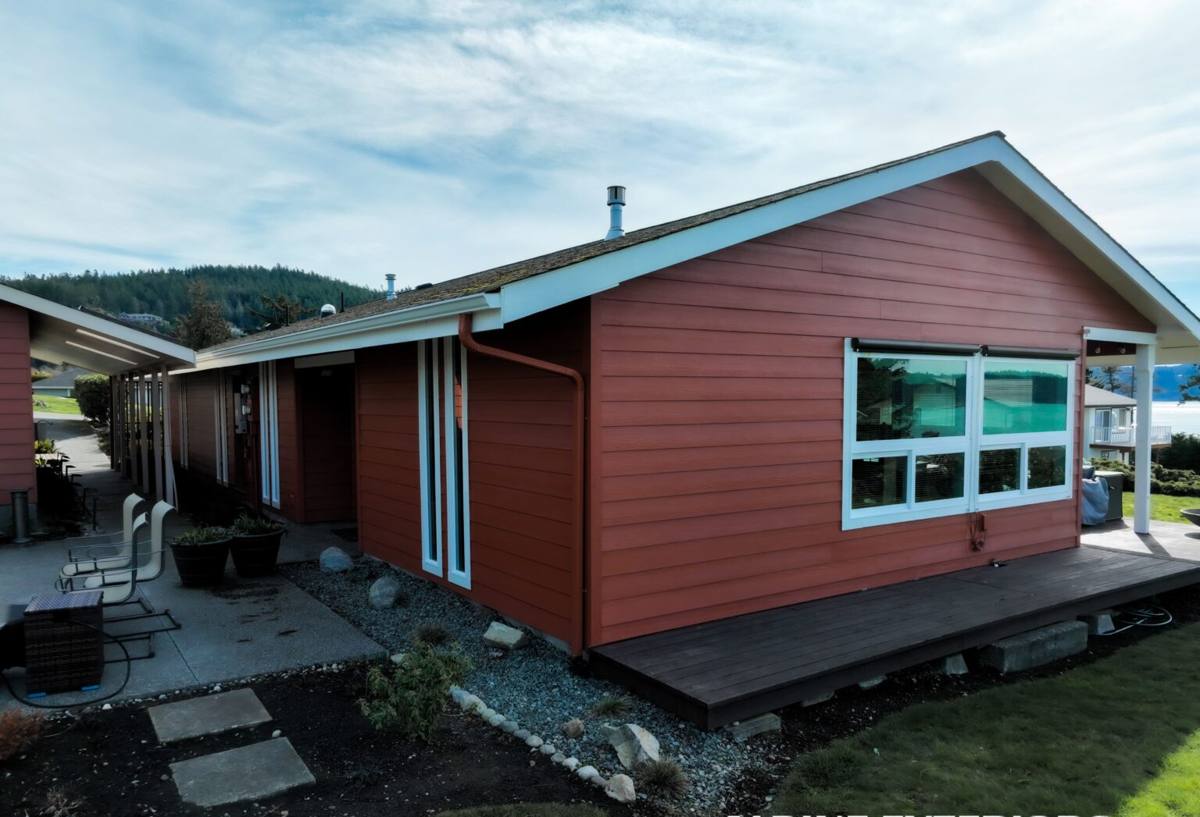
Why We Standardized on James Hardie
We don't install LP SmartSide, vinyl, Cemplank, Allura, primed spruce, or cedar. That's not a marketing position — it's a professional standard we set after weighing how each of those products actually performs over a 20- to 30-year span in a wet, salt-exposed climate. Wood-based and engineered-wood products depend on an intact factory coating and diligent caulking to keep moisture out; once that seal is compromised, the substrate itself is organic material that swells, rots, or invites insects. Vinyl handles moisture fine but moves with temperature swings, can crack in impact-prone areas, and offers no real fire resistance.
James Hardie fiber cement is cement, sand, and cellulose fiber — it does not rot, does not support pest activity, and does not burn. It's also engineered in climate-specific formulations, which is directly relevant to a coastal community like Mukilteo. That combination of moisture indifference, non-combustibility, and a factory-applied finish system is why it's the only product we put our name behind.
The HZ5 Product Line: Built for Where You Live
James Hardie makes region-specific formulations under its HZ (HardieZone) system. HZ5 is the formulation engineered for wetter, harsher climates, and it's what we specify for Mukilteo and the rest of the Puget Sound basin. The difference isn't cosmetic — HZ5 boards are formulated to resist moisture-related expansion and to hold up to freeze-thaw cycling better than the HZ10 formulation sold in drier, warmer regions of the country.
Product Lines Homeowners Choose Between
| Product | Profile | Best Fit For |
|---|---|---|
| HardiePlank | Lap siding, several reveal widths | Traditional and craftsman-style homes, the most common choice |
| HardieShingle | Staggered or straight-edge shingle panels | Accent gables, cottage and shingle-style architecture |
| HardiePanel | Vertical panel with battens | Modern facades, garage gables, mixed-material designs |
| HardieTrim | Fascia, corner boards, window/door trim | Completing the system so trim ages at the same rate as the field siding |
Most Mukilteo projects use HardiePlank as the primary field siding, often paired with HardieShingle or HardiePanel as an accent on a gable end or entry feature. The right mix depends on the home's existing architecture more than personal preference alone — we'll walk that with you on site.
ColorPlus Finish: Why Factory-Applied Color Matters Here
James Hardie's ColorPlus finish is baked on and cured under controlled factory conditions, which produces a more uniform, more UV- and moisture-resistant finish than field-applied paint can match. In a marine environment, that matters for two reasons. First, salt air and driving rain are hard on any painted surface, and a factory finish simply holds up longer than a job-site paint job. Second, ColorPlus comes with its own dedicated warranty coverage against fading and peeling, separate from the substrate warranty — so you're not relying on a painter's workmanship to keep the color looking right for the next decade.
We'll go over the current ColorPlus palette with you during your estimate, including which tones tend to read best against the muted, overcast light common here for a good chunk of the year.
What a Correct Installation Actually Involves
Fiber cement siding is only as good as the installation behind it. This is where a lot of the real risk lives, and it's also where "just siding" turns into a full weather-resistive barrier system.
The Details That Matter Most in a Wind-Driven Rain Climate
- Weather-resistive barrier and flashing sequencing: Every penetration, window, and door needs to be flashed and lapped in the correct shingle-style order so water is directed out, never in.
- Rainscreen or proper drainage gap: A gap behind the siding lets bulk water drain and lets the wall assembly dry, which is especially important on shaded, north-facing walls that stay damp longer.
- Fastener spec and placement: Corrosion-resistant fasteners, set to Hardie's nailing pattern and depth requirements — over-driven or under-driven nails are a common source of premature failure.
- Manufacturer-specified clearances: Keeping siding the correct distance above roof lines, decks, and grade so splashback and standing water don't sit against the bottom edge.
- Caulking only where Hardie specifies it: Sealing joints that should be sealed, and leaving butt joints and other details that are designed to breathe alone.
Skip any one of these and you can install genuine James Hardie product and still end up with moisture problems within a few years. The material is only half of the equation — installation discipline is the other half, and it's non-negotiable on a project this close to the water.
Our Process for Mukilteo Projects
1. On-Site Assessment
We look at your home's specific exposure — which walls face prevailing wind and rain, where moss has already established, condition of existing trim and flashing — before we talk product selection.
2. Scope and Product Plan
We specify HZ5 James Hardie products, profile, and ColorPlus color, and lay out where HardieTrim replaces existing wood trim so the whole envelope ages consistently.
3. Tear-Off and Sheathing Check
Old siding comes off and we inspect sheathing for hidden moisture damage before anything new goes up — this is often where problems from a prior siding system show up.
4. Barrier, Flashing, and Drainage Install
Weather-resistive barrier, flashing, and drainage gap go in per manufacturer spec, not shortcuts.
5. Siding, Trim, and Final Inspection
Siding and trim are installed to Hardie's fastening and clearance requirements, then we walk the completed job with you.
Cost Factors for a Mukilteo Siding Project
Every home is different, but the same handful of factors drive most of the price variation we see on Mukilteo estimates.
| Factor | Why It Affects Cost |
|---|---|
| Home size and wall complexity | More corners, gables, and dormers mean more cutting, flashing, and trim detail |
| Existing wall condition | Rot or moisture damage found at tear-off requires sheathing repair before siding goes on |
| Product mix | Accent HardieShingle or HardiePanel sections cost more per square foot than field lap siding |
| Trim scope | Full HardieTrim replacement versus reusing sound existing trim |
| Access and site conditions | Waterfront lots, steep grades, and limited staging area affect labor time |
We'll give you a real, itemized number after the on-site assessment — not a ballpark based on square footage alone.
Living With Salt Air and Moss Season
Even with the right product and a correct install, Mukilteo's climate still calls for a little routine attention. The good news is that fiber cement asks for far less than wood ever did.
- Rinse siding periodically to clear salt residue and organic debris, especially on walls facing the water or shaded by trees
- Keep gutters clear so overflow doesn't run down the face of the siding
- Trim back vegetation and tree cover that keeps a wall shaded and damp longer than it needs to be
- Have caulking at trim and penetrations checked every few years — it's the one component that does eventually need renewal
- Address moss on adjacent roofing promptly, since roof runoff carries spores onto siding below
None of this is remotely close to the sanding, re-caulking, and repainting cycle that wood or engineered-wood siding demands. It's maintenance, not restoration.
Why Local Experience on This Coastline Matters
A crew that mostly works inland jobs can install James Hardie correctly on paper and still miss the details that matter specifically on a waterfront or near-waterfront property — how much drainage gap a shaded north wall really needs, which corners take the worst of the prevailing wind-driven rain, how far up a wall salt spray realistically reaches on a bluff lot. That judgment comes from doing this work repeatedly in Snohomish County's specific conditions, not from a general specification sheet.
We install exclusively in this region, which means every Mukilteo estimate we write is informed by other jobs we've done nearby, in the same weather, on the same kind of exposure.
If your siding is showing its age or you're planning ahead of a problem, we're happy to walk your home and give you a straight, no-pressure estimate for a James Hardie system built for Mukilteo's climate — just fill out the form below to get started.