 Everett
 Why South Everett's Climate Is Harder on Siding Than It Looks
South Everett doesn't get the dramatic weather that makes headlines, but it gets the steady kind that wears down a house over years instead of days. Homes here sit close enough to Puget Sound to pick up salt-laden air on top of the region's driving winter rain, and the tree cover common throughout Snohomish County keeps siding shaded and damp longer after a storm than it would be in a more open, sun-exposed location. None of that is dramatic on its own. Together, over a decade or two, it's exactly the combination that separates siding that looks good at year 20 from siding that's chalking, cupping, or growing moss by year 8.
A lot of siding failure we see isn't really a failure of the material itself — it's a mismatch between the product and the conditions it was asked to survive. That's the lens we use on every South Everett project: what does this specific house, on this specific lot, with this specific sun and rain exposure, actually need to hold up?
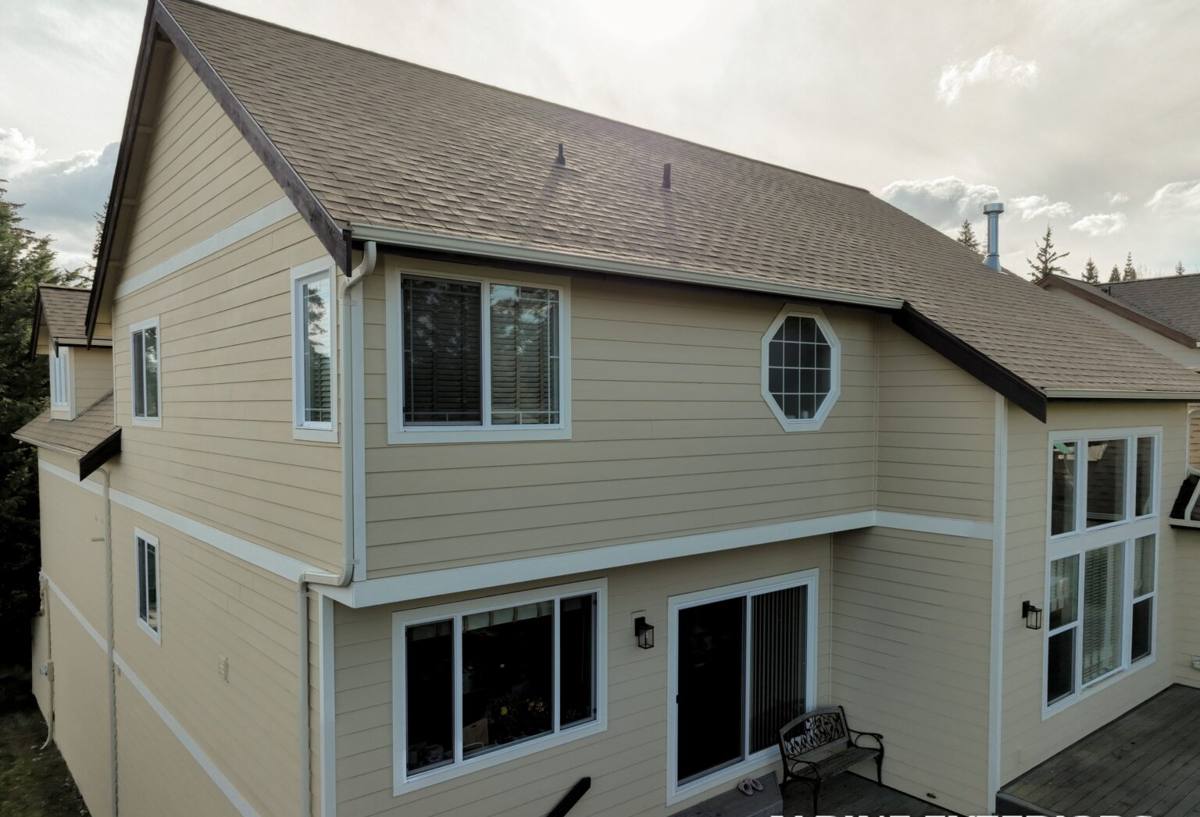
What Salt Air, Driving Rain, and Moss Actually Do to a Wall
Salt air and moisture
Airborne salt from Puget Sound doesn't just sit on a surface — it's hygroscopic, meaning it pulls moisture out of the air and holds it against whatever it lands on. On wood-based siding products, that means longer periods of elevated moisture content right at the surface, which is exactly what accelerates rot, delamination, and paint failure. Fiber cement doesn't absorb moisture the way wood or wood-composite products do, which is one of the main reasons it holds up better in this environment.
Driving rain
Wind-driven rain doesn't fall straight down — it gets pushed sideways into laps, seams, and butt joints. If a siding system doesn't have a proper drainage plane and correctly lapped, flashed joints behind it, water finds its way behind the cladding regardless of how good the surface material is. This is an installation issue as much as a material issue, and it's where a lot of otherwise-decent siding jobs go wrong.
Moss and organic growth
Shaded, north-facing, and tree-covered walls in this area stay damp longer after every rain event, which is prime territory for moss, algae, and mildew growth. Moss holds moisture against the surface it grows on, and on porous or poorly sealed materials that sustained dampness is what eventually leads to soft spots, swelling, or coating failure. Siding that resists moisture absorption and has a durable factory finish gives moss less to hold onto and less damage to cause if it does.
Why We Only Install James Hardie Fiber Cement
We don't install LP SmartSide, vinyl, Cemplank, Allura, or primed wood siding, and that's a deliberate standard, not an oversight. Each of those products has legitimate uses and reasonable people choose them for good reasons — cost, appearance, or familiarity. But after years of siding work in this climate, we standardized on James Hardie fiber cement because it's non-combustible, doesn't swell or rot the way wood and wood-composite products can when moisture gets past the surface, and comes with a factory-applied ColorPlus finish engineered to hold color and resist the kind of coastal weathering that fades and chalks field-painted surfaces faster. For a house that has to survive decades of Puget Sound weather, that combination matters more to us than upfront cost or installation speed.
The Right Hardie Products for a South Everett Home
James Hardie makes climate-specific product formulations, and the versions engineered for the Pacific Northwest (HZ5) are formulated differently than the versions sold in drier, hotter climates — they're built around resisting moisture and freeze-thaw cycling rather than extreme heat. For most South Everett homes, that means:
- HardiePlank lap siding — the most common choice for traditional lap-style exteriors, available in several exposure widths and textures
- HardiePanel vertical siding — used for modern vertical designs or as an accent alongside lap siding
- HardieTrim — matching trim boards around windows, doors, and corners so the whole system ages consistently
- ColorPlus factory finish — a baked-on finish that resists fading and chipping better than field-applied paint, which matters on a house exposed to salt air and UV
Choosing the right combination depends on the home's architecture, existing trim details, and how much sun or shade each elevation gets — which is something we walk through on-site rather than guessing from a brochure.
What a Correct Fiber Cement Installation Actually Involves
Fiber cement siding is only as good as the installation behind it. A rushed or incorrect install can undercut even the best material, especially in a wet climate. A correct job includes:
- A continuous, properly lapped weather-resistive barrier (drainage plane) behind the siding — not just housewrap stapled up and left
- Correct flashing at every window, door, roofline, and horizontal transition, installed so water sheds outward and down, never inward
- Proper fastening — Hardie specifies fastener type, spacing, and placement, and getting this wrong voids warranty coverage and invites splitting
- Correct clearances at grade, decks, patios, and roof lines so siding never sits in standing water or trapped moisture
- Factory-cut or properly sealed field cuts, since an unsealed cut edge is one of the few places fiber cement can take on moisture
- Caulking only where Hardie's install specs call for it — over-caulking joints that are supposed to be able to move or drain can trap water instead of shedding it
Every one of these steps is invisible once the job is done, which is exactly why it matters who's doing them.
Siding Options at a Glance for South Everett Conditions
| Factor | James Hardie Fiber Cement | Vinyl | Wood / Primed Spruce / Cedar |
|---|---|---|---|
| Moisture absorption | Very low | Doesn't absorb, but seams and edges can trap water | Absorbs readily; prone to swelling and rot |
| Moss/algae resistance | Good, especially with ColorPlus finish | Fair; moss grows on the surface film | Poor; moisture retention feeds growth |
| Salt air / coastal exposure | Engineered for it (HZ5) | Can become brittle over time | Vulnerable without diligent maintenance |
| Fire resistance | Non-combustible | Combustible, can melt/warp | Combustible |
| Maintenance burden | Low; repaint cycle much longer | Low upfront, limited repair options | High; regular repainting and moisture checks |
This isn't a claim that other products are worthless — it's the honest comparison that led us to standardize on one system rather than offering all of them.
Our Process for South Everett Projects
Every project starts with an on-site walkaround, not a phone estimate. We look at each elevation's sun and shade exposure, existing moisture damage, trim condition, and how water currently moves around the house — gutters, downspouts, grading, deck ledgers — since siding failure is often a symptom of a drainage problem elsewhere. From there we put together a written scope covering product selection, trim details, color, and a realistic timeline, so there's no ambiguity about what's being installed and how. During the job, we don't cover up work that should be inspected: drainage plane and flashing details get checked before siding goes over them, not after.
A Homeowner's Checklist Before Hiring Anyone for This Job
- Ask specifically what's going behind the siding (drainage plane, flashing details) — not just what the visible product will be
- Ask whether the crew is factory-trained or certified on the specific product they're installing
- Ask how they handle clearances at grade, decks, and roof-to-wall transitions
- Ask what the manufacturer's warranty actually covers, and whether it's tied to who installed it
- Ask for a written scope before any work starts — verbal-only agreements leave too much room for corner-cutting
- Ask how they've handled past jobs in similarly shaded, tree-covered, or moss-prone lots
Why Local Experience in South Everett Matters
A siding system that's correct on paper still has to be installed correctly for the specific house it's going on, and that's where local experience pays off. A crew that's worked lots throughout South Everett and the rest of Snohomish County already understands how tree cover, prevailing wind, and proximity to the Sound affect where moss forms first, which elevations take the worst driving rain, and how existing homes in this area were originally built and flashed — which matters when tying new siding into old trim, rooflines, and window details. That's the kind of judgment that doesn't come from a spec sheet; it comes from doing this work, on these kinds of homes, in this exact climate, repeatedly.
If you're weighing a siding replacement or repair in South Everett, we're happy to walk the property, look at what your current siding is telling us, and put together a straightforward, no-pressure estimate with no obligation attached.