 Everett
 Why Eastmont Decks Wear Out Faster Than You'd Expect
Eastmont sits close enough to Puget Sound and the broader Everett weather pattern that decks here take a different kind of beating than decks built inland. It isn't one dramatic event that ends a deck's life — it's the slow accumulation of small exposures, season after season, until fasteners rust through, boards cup and split, or the substructure quietly loses its strength while the surface still looks fine.
Three things drive most of the deck replacements we do in this part of Everett: salt-laden air that accelerates corrosion on anything metal, driving rain that gets pushed sideways into ledger boards and joist ends by wind off the water, and a moss season that runs far longer here than most homeowners assume — often eight months or more when conditions stay damp and shaded. None of these are dramatic on their own. Together, over ten or fifteen years, they're why a deck that was framed correctly the first time can still fail early if the wrong materials or details were used.
What "Failure" Actually Looks Like
Deck failure rarely means the whole structure collapses. More often it shows up as soft spots near the house where the ledger meets the rim joist, fasteners that have rusted and stained the wood around them, railings that flex more than they should, or a walking surface that stays damp and slick well after the rain stops because moss and algae have colonized the grain. By the time any of that is visible, the damage underneath is usually further along than it looks.
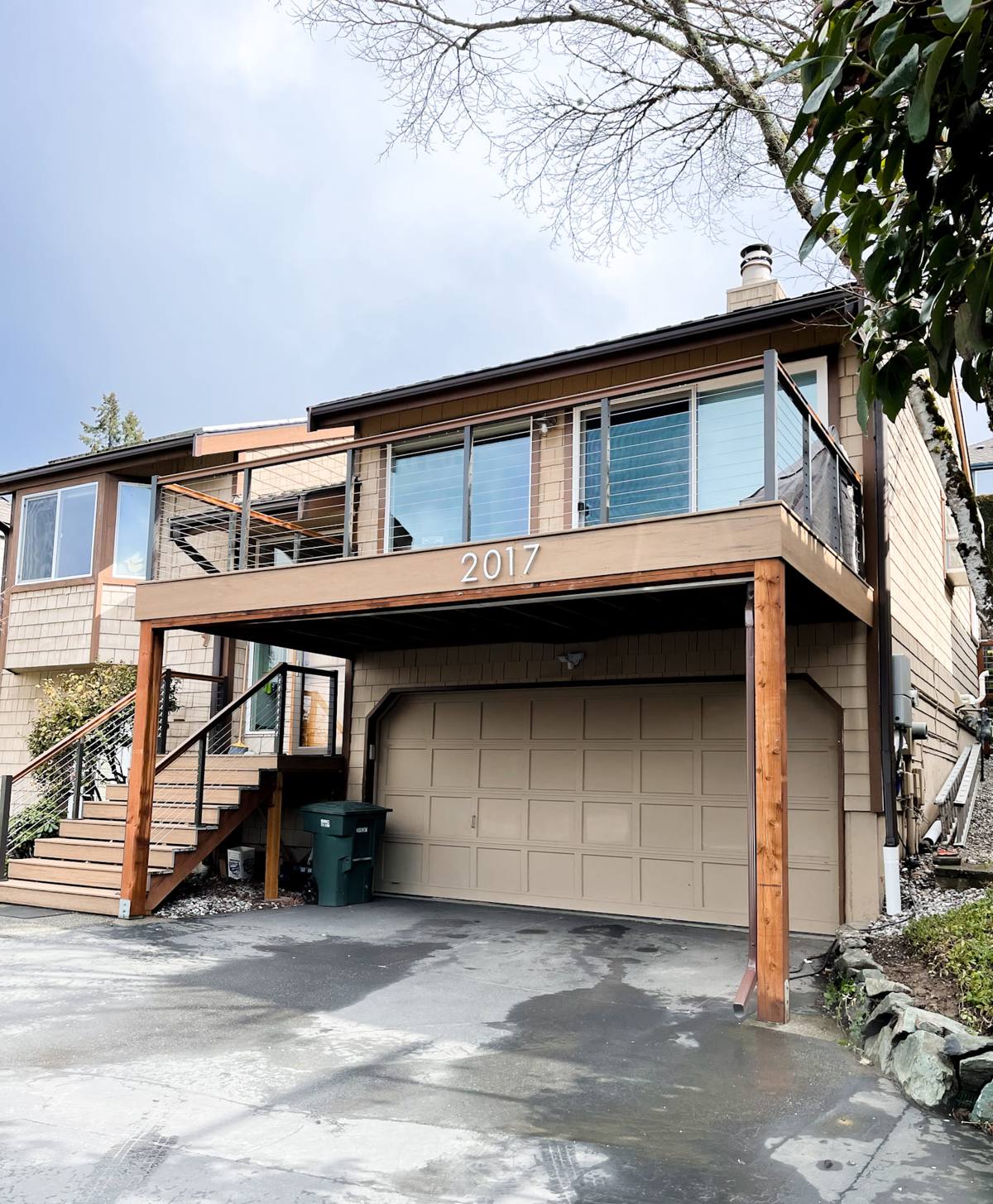
Signs an Eastmont Deck Needs Replacement, Not Just Repair
Not every deck problem calls for a full tear-off. Repair makes sense when the issue is isolated — a few damaged boards, one weak stair stringer, hardware that's due for an upgrade. Replacement becomes the honest recommendation when the problems are systemic rather than isolated. Here's how we tell the difference on site:
- Soft, spongy, or discolored wood at the ledger board where the deck attaches to the house — this is a moisture intrusion point and often the most serious finding on an older deck
- Joists or beams that flex noticeably underfoot, especially near the perimeter
- Multiple deck boards cupping, splitting, or delaminating rather than just a few weathered ones
- Rust streaking from fasteners, post bases, or joist hangers — a sign the hardware itself is failing, not just staining the wood
- Persistent moss or algae growth that returns within weeks of cleaning, indicating the deck stays wet longer than it should
- Railings or stairs that feel loose, wobbly, or under-built for current code
- A deck older than 15-20 years that was built with fasteners or flashing details common at the time but no longer considered best practice
If what we find is confined to one or two of these, we'll say so and scope a repair. If the pattern points to the substructure itself being compromised, replacement is the more honest — and ultimately cheaper — path, since repeated patch repairs on a failing frame rarely hold up through another wet Snohomish County winter.
What a Correct Deck Replacement Involves
A deck replacement done right is more than swapping old boards for new ones. The parts you can't see — flashing, fastener selection, ledger attachment, drainage — are what determine whether the new deck lasts 10 years or 25 in this climate.
Ledger and Flashing Detail
The single most common point of failure we find on older Everett-area decks is the ledger board connection to the house. If it was installed without proper flashing, or with flashing that's degraded, water tracks behind it and rots the rim joist and sill plate — often for years before it's visible from outside. A correct replacement always includes new, properly lapped flashing at this joint, sized and installed so water sheds away from the house rather than into it.
Fastener and Hardware Selection
Given the salt content in the air here, hardware matters as much as lumber choice. We use corrosion-resistant, code-rated fasteners and structural connectors rated for exterior and coastal-adjacent exposure — not standard interior-grade hardware that will streak and weaken within a few seasons. Joist hangers, post bases, and structural screws are matched to whatever decking and framing material is used, since mismatched metals can accelerate corrosion at the connection point.
Framing and Drainage
Joists are spaced and sized to the actual span and load, not just "what was there before." We also pay attention to drainage under the deck — grading, gaps between boards, and airflow beneath the structure all affect how quickly it dries out after a storm. A deck that drains and dries efficiently sheds moss growth far better than one that stays damp in the shade.
Decking Material
Wood and composite decking each have real trade-offs, and we'll walk through them honestly rather than pushing one product line:
| Material | Upfront Cost | Maintenance | Moisture & Moss Behavior |
|---|---|---|---|
| Pressure-treated wood | Lowest | Needs periodic sealing/staining | Absorbs moisture; needs cleaning to resist moss buildup |
| Cedar | Moderate | Regular sealing to hold color and resist decay | Naturally decay-resistant but still needs upkeep in wet shade |
| Composite decking | Higher | Occasional washing; no staining/sealing | Doesn't absorb water like wood; still needs cleaning where moss spores land |
None of these are maintenance-free in a climate like ours — moss spores land on any surface, including composite. The difference is how much upkeep each material demands to stay looking and performing well. We'll size up your site's sun exposure, tree cover, and how the deck is used before recommending a direction, rather than defaulting to one product for every job.
Railings, Stairs, and Code Compliance
Replacement is also the point where we bring older railings and stairs up to current code — something that's often overlooked when only the decking surface gets swapped out. Baluster spacing, railing height, guard requirements at elevated edges, and stair stringer sizing all get checked against current Snohomish County building requirements. If your existing deck predates current code, this is the moment to fix it rather than carry the same gap forward into another decade.
Our Process for Eastmont Deck Replacements
We keep the process straightforward because homeowners deserve to know what's happening to their property and when.
- On-site assessment. We inspect the existing deck from the ledger out — checking framing, hardware condition, drainage, and any moisture damage at the house connection — and give you a clear picture of what we find.
- Scope and estimate. You get an honest recommendation: repair where it's genuinely sufficient, replacement where it isn't, with material options and a written estimate.
- Permitting. Deck replacements of most sizes require a permit through the applicable jurisdiction. We handle that process so you don't have to chase it down.
- Demolition and disposal. The old deck comes out cleanly, with attention to protecting landscaping and the area around the house.
- Framing and flashing. This is the stage that determines the deck's lifespan — ledger flashing, joist layout, and hardware go in to spec before anything decorative is installed.
- Decking, railings, and stairs. Installed per the plan you approved, with attention to drainage gaps and fastening patterns that resist our wet season.
- Final walkthrough. We go over the finished deck with you, note any maintenance recommendations specific to the material chosen, and make sure you're clear on what upkeep (if any) is expected.
Timing a Replacement Around Everett's Seasons
Deck replacement can happen most of the year here, but timing affects both scheduling and how the project goes. Late spring through early fall gives the most predictable weather windows for framing and finishing work. Starting a project heading into the wettest months isn't impossible, but it can extend timelines and requires more careful sequencing to keep the open framing protected from rain before decking goes down. If you're planning ahead, getting on the schedule before the fall rain sets in gives the most flexibility.
Ongoing Care After Replacement
A new deck still needs a little seasonal attention in this climate, regardless of material:
- Clear leaves and debris from the deck surface and gaps between boards before they trap moisture
- Wash off moss and algae buildup at least once or twice a year, more often in heavily shaded yards
- Check railings and stair connections annually for looseness, especially after winter storms
- Reseal or restain wood decking on the schedule appropriate to the product — don't wait until it's visibly gray and worn
- Keep gutters and downspouts near the deck clear so runoff isn't draining directly onto or under it
None of this is complicated, but skipping it is exactly how decks that were built correctly still end up needing early repairs.
Why It Matters to Hire a Crew That Already Works in Eastmont
Deck construction principles are the same everywhere, but the details that make a deck last through a Snohomish County winter — flashing choices, hardware corrosion resistance, drainage planning, moss-prone shade patterns — are things you learn by building and repairing decks in this specific area, not from a general contracting manual. A crew that regularly works Eastmont and the surrounding Everett neighborhoods has already seen which ledger details fail here, which fastener grades hold up against the salt air, and how local permitting works for residential deck projects. That local repetition is what turns a deck that merely looks finished into one that's actually built to last in this climate.
If your deck in Eastmont is showing wear, feels less solid than it used to, or you're simply ready to plan ahead, we're happy to take a look and give you a straightforward, no-pressure estimate using the form below.