 Everett
 Building Decks That Actually Hold Up in Delta
Delta sits close enough to the water and low enough in the tree line that decks here take a beating most inland Snohomish County homes never see. Salt-laced air off the water accelerates corrosion on fasteners and hardware. Driving rain off Puget Sound doesn't fall straight down — it blows sideways under railings and into ledger connections that a lot of builders never properly flash. And the long, wet moss season that runs from October through April coats anything horizontal in a slick green film if the decking and drainage weren't chosen with that in mind. A deck built to a generic national spec might look fine the day it's finished. Whether it still looks and performs the same way in year six is a different question, and it comes down to decisions made before a single board goes down.
We build decks for homes in this neighborhood on purpose, not as an afterthought between jobs somewhere drier. That means the framing, fastener choices, and drainage details below aren't theoretical — they're what we've learned works in this specific stretch of Everett.
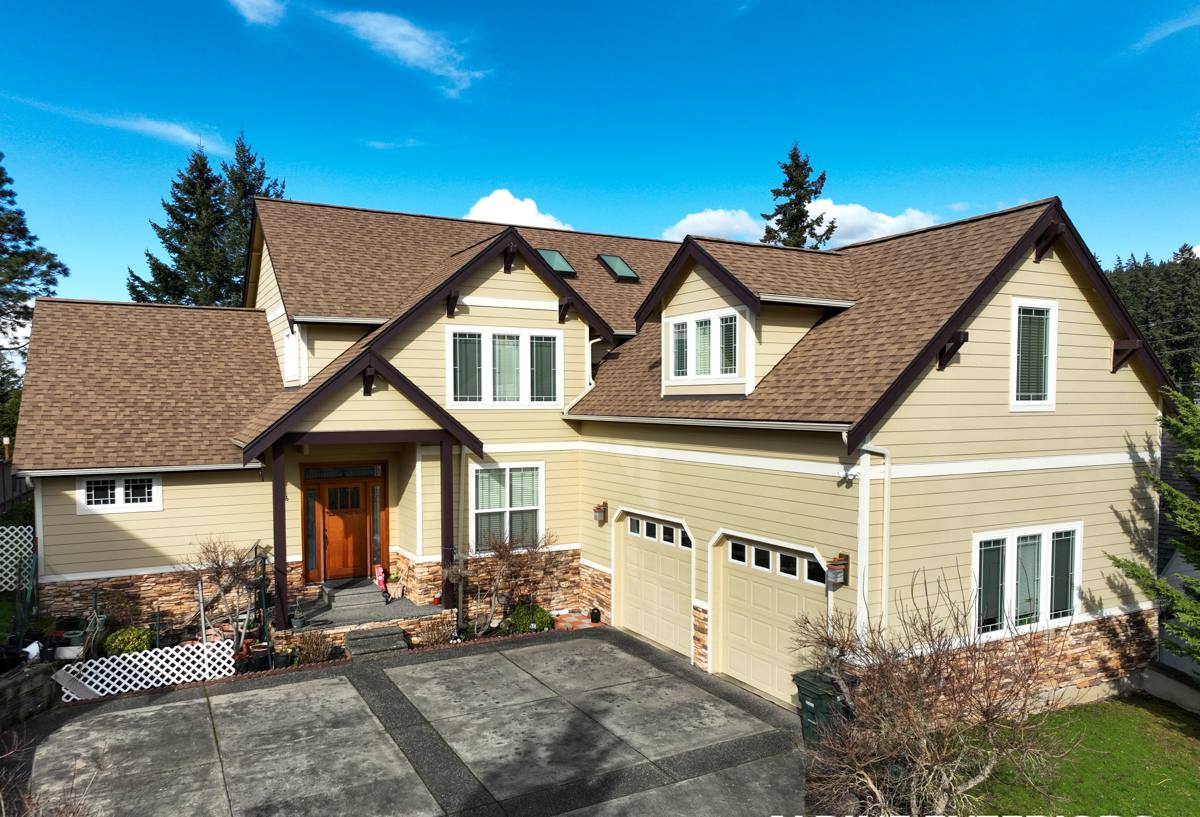
What Delta Homes Need From a Deck
Salt Air and Coastal Moisture
Airborne salt doesn't need direct ocean spray to do damage — proximity to Puget Sound is enough to speed up corrosion on exposed metal. Standard galvanized fasteners, joist hangers, and screws can start showing rust streaks and pitting well ahead of their rated lifespan in this kind of air. Once a fastener starts corroding, it weakens at exactly the point where the deck depends on it most: the connections holding joists to beams and beams to posts.
Driving Rain and Standing Water
Everett gets plenty of rain that falls straight down, but the rain that causes deck damage is the kind that blows in sideways during a windstorm. That rain finds its way behind rim joists, up under poorly lapped flashing, and into the ledger-to-house connection — which is the single most common source of structural rot in decks region-wide. A deck that's never been designed with wind-driven rain in mind will dry out fine on a sunny afternoon and still be quietly rotting from the inside.
Moss, Algae, and Slip Risk
Low winter sun angles, tree cover, and near-constant dampness from fall through spring create ideal conditions for moss and algae on horizontal wood and even some composite surfaces. Beyond looking neglected, a mossy deck surface is a slip hazard on stairs and near entry doors — exactly where people are least expecting it.
Choosing the Right Decking Material for This Climate
There's no single "best" decking material for every Delta home — it depends on budget, how much upkeep you're willing to do, and how the deck is oriented relative to sun and rain exposure. Here's how the common options actually compare under our climate conditions, not generic marketing claims:
| Material | Moisture Behavior | Moss Resistance | Maintenance | Typical Lifespan Here |
|---|---|---|---|---|
| Pressure-treated wood | Absorbs and releases moisture; prone to cupping if not sealed | Needs regular cleaning/treatment | Annual cleaning, re-staining every 2-3 years | 15-20 years with upkeep |
| Cedar | Naturally moisture-resistant but still absorbs over time | Better than pressure-treated, still needs cleaning | Sealing every 2-3 years | 20-25 years with upkeep |
| Composite decking | Doesn't absorb water; no rot risk in the board itself | Can still grow surface algae/moss without occasional cleaning | Occasional wash, no staining or sealing | 25-30+ years |
| PVC decking | Fully moisture-proof | Lowest moss retention of the group | Lowest of all options | 30+ years |
We install all of these depending on what a homeowner wants, but for Delta specifically — with the moisture and moss exposure this area gets — we steer most conversations toward composite or PVC unless there's a strong reason to want the look and feel of real wood. It's not that wood is a bad product; it's that wood decking demands a maintenance schedule that's easy to fall behind on, and in this climate, falling behind shows up fast as graying, cupping, or moss buildup.
What a Correctly Built Deck Involves
Framing and Structural Support
Everything visible on a deck sits on framing decisions nobody sees once the project is done: footing depth and size, post spacing, joist span and spacing, and beam sizing relative to the load the deck will carry. Undersized framing or joists spaced too far apart is one of the more common shortcuts we find when replacing an older deck — it doesn't fail immediately, but it flexes, bounces, and eventually sags.
Ledger Flashing and House Connection
The ledger board — where the deck attaches to the house — is where wind-driven rain does the most damage if it's not properly flashed. A correct install means metal flashing that laps over the house's water-resistive barrier correctly, proper fastener spacing rated for the load, and, in many cases, structural screws or through-bolts rather than lag screws alone. Get this detail wrong and the rot happens behind the siding where nobody sees it until there's a real problem.
Fasteners and Hardware
Given the corrosion risk from salt air discussed above, we use fasteners and structural hardware rated for coastal or ACQ-treated lumber exposure — typically stainless steel or heavy hot-dip galvanized coatings, not the standard-duty galvanized hardware that's fine further inland but corrodes faster this close to the water.
Drainage and Substructure Ventilation
A deck that sits low to the ground or over a patio needs a plan for where water goes — proper board spacing, a slight slope away from the house, and enough clearance underneath for air to move and wood to dry between rain events. Decks that trap moisture underneath are the ones that develop mold and rot fastest, moss season or not.
Our Process, Start to Finish
- Site visit and assessment — we look at sun exposure, drainage, existing structure (if replacing a deck), and how the space will actually be used before recommending anything.
- Design and material selection — sizing, layout, railing style, and decking material chosen around your budget and how much maintenance you want to take on.
- Permitting — most new decks and many replacements in Snohomish County require a permit; we handle that paperwork rather than leaving it on you.
- Framing and structural build — footings, posts, beams, and joists built to span and load requirements, not just "what's always worked."
- Decking, railing, and finish details — board installation, fastening, railing, stairs, and any lighting or finish carpentry.
- Final walkthrough — we go over the finished deck with you, including what maintenance (if any) it'll need going forward.
Permits, Codes, and Inspections in Snohomish County
Deck permitting requirements depend on size, height above grade, and whether it's attached to the house, but a surprising number of homeowners assume a deck replacement doesn't need one because "it's just swapping boards." If the framing, footings, or ledger connection are being touched — which is most replacements — permitting and inspection usually apply. Skipping that step can create real problems at resale, when a buyer's inspector or the county has no record of the work. We pull the required permits as part of the job and coordinate inspections so you're not the one tracking down a county inspector.
Maintenance Checklist for Delta Deck Owners
Whatever material you choose, a little seasonal attention goes a long way in this climate. A short list we give homeowners after every deck build:
- Sweep debris and standing water off the deck surface regularly through fall, when leaves and rain combine to hold moisture against the boards.
- Rinse or lightly scrub moss and algae off the surface and stairs before it builds up — it's far easier to remove early than after a full wet season.
- Check railing posts and stair stringers annually for movement, which can signal a loosening connection before it becomes a safety issue.
- Keep gutters and downspouts near the deck clear so runoff isn't dumping extra water directly onto or under the structure.
- If you have wood decking, plan on re-sealing or staining every 2-3 years rather than waiting until it visibly grays.
- Inspect the ledger board area at the house connection once a year for any staining, soft wood, or gaps in caulking or flashing.
Why Hire a Crew That Already Works in Delta
A lot of deck problems we get called to fix didn't come from bad materials — they came from a builder who did solid work for a drier, less exposed part of the state and didn't adjust for what this specific area throws at a structure. Knowing that ledger flashing needs extra attention here, that standard hardware corrodes faster this close to the water, and that moss season changes which decking material makes sense isn't something you get from a spec sheet. It comes from building and repairing decks in this neighborhood long enough to see what actually fails and why. That's the difference between a deck that looks good at handoff and one that still looks good in year ten.
If you're planning a new deck or replacing one that's showing its age, we're happy to come take a look and give you an honest read on what it needs — no pressure, no obligation. Use the form below to request a free estimate.