 Everett
 Bayside Sits in a Tougher Spot Than Most of Everett
If you live in Bayside, you already know your deck works harder than a deck ten minutes inland. The combination of proximity to open water, near-constant marine moisture, and long stretches of gray, rainy months puts more stress on outdoor structures here than in the drier pockets of Snohomish County. Salt-laden air corrodes metal faster, driving rain finds every gap in flashing and fasteners, and shaded, damp corners of a yard grow moss almost year-round. A deck built without those specific conditions in mind will show it within a few seasons — soft spots, discoloration, corroded hardware, or a slick, moss-covered surface that's genuinely dangerous to walk on.
This page is about composite decking specifically for Bayside properties — what the material needs to do here, how we detail it differently than we would on a dry hillside lot, and what to expect from a crew that already knows this stretch of Everett.
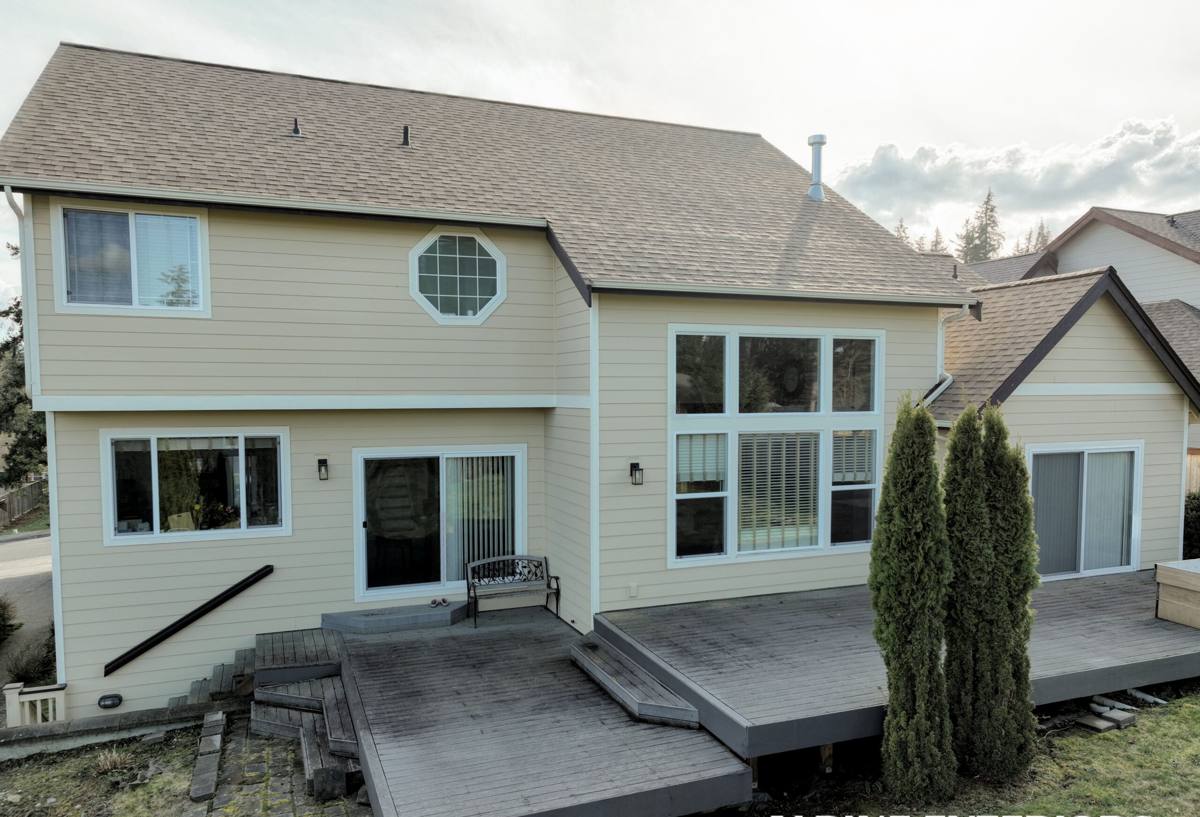
What Salt Air, Rain, and Moss Actually Do to a Deck
Each of these three factors attacks a deck in a different way, and a correct build accounts for all three at once, not just one.
- Salt air accelerates corrosion on any exposed metal — screw heads, joist hangers, railing brackets, post bases. Once corrosion starts, it stains the decking around it and eventually weakens the connection itself.
- Driving rain doesn't just fall straight down here; wind pushes it sideways into ledger connections, rail post penetrations, and stair stringers. Water that would run off a flat surface elsewhere gets driven into joints and fastener holes.
- Extended moss season means any shaded or poorly ventilated area of decking stays damp longer between dry spells. Moss and algae need sustained moisture to establish, and Everett's fall-through-spring stretch gives them plenty of time.
None of this is unique to composite decking — wood decks face the same exposure, often worse. But composite changes which parts of the system need the most attention, which we'll get into below.
Where Composite Decking Genuinely Helps in This Climate
Composite boards solve some of the biggest headaches of a marine climate, but not all of them, and it's worth being straightforward about both sides.
What composite handles well
Composite boards don't absorb water the way wood does, so they don't swell, cup, or rot from surface moisture the way a softwood deck board can. They also don't need annual staining or sealing, which matters when the weather window for exterior maintenance in this area is genuinely short. Modern capped composite products resist mold and algae staining better than wood, though "resist" is not the same as "immune."
What composite doesn't solve on its own
Composite decking is not moss-proof. Algae and moss can still grow on the surface of any decking material — wood, composite, or otherwise — if the board stays damp and shaded long enough. The board itself won't rot from it, but a moss film left unaddressed becomes slippery and eventually stains the board's cap layer. Composite also doesn't fix a bad substructure. If the framing underneath is undersized, poorly drained, or fastened with the wrong hardware, the deck will have problems regardless of what's on top.
Our standard is to treat composite as one part of a system — decking, substructure, fasteners, and drainage all specified together for this climate — not as a material that lets us skip proper detailing underneath.
The Substructure Is Where Bayside Deck Problems Usually Start
Most deck failures we see in coastal-adjacent Everett neighborhoods aren't failures of the decking surface — they're failures of what's underneath it. A few specifics we hold to on every Bayside job:
Fasteners and hardware
We use stainless steel or heavily coated, corrosion-rated fasteners and structural connectors rather than standard exterior-grade hardware. In a salt-air environment, the difference in service life between the two is significant, and it's not a place to cut cost.
Joist protection
Framing lumber gets a proper joist tape or flashing on top of every joist before decking goes down. This keeps rainwater that gets between the boards from sitting directly on cut or fastened wood, which is one of the most common hidden rot points on older decks in this area.
Ledger and house connection
Where the deck attaches to the house, correct flashing matters more here than almost anywhere else, because driving rain pushes water directly at that seam. A poorly flashed ledger is one of the most expensive mistakes to fix after the fact, since it often means opening up siding to correct.
Drainage, Airflow, and Keeping Moss From Taking Hold
Since composite doesn't eliminate moss risk, the real defense is airflow and drainage underneath and around the deck.
We grade and clear the ground beneath the deck so water has somewhere to go instead of pooling and evaporating slowly upward into the underside of the boards. Where a deck sits low to the ground or in a shaded corner of a Bayside lot, we look at gapping and ventilation details that let air move under the structure rather than trapping moisture. Board spacing is also set with this climate in mind — enough gap for water to drain through and air to circulate, without so much gap that debris builds up and holds moisture between boards.
None of this eliminates the need for periodic cleaning, but it substantially reduces how often moss becomes a real problem versus a light surface film that a homeowner can rinse off.
Our Installation Process on Bayside Properties
| Stage | What we do | Why it matters here |
|---|---|---|
| Site assessment | Check grade, drainage path, sun/shade exposure, and existing structure condition | Identifies moss-prone corners and drainage issues before design |
| Substructure | Correctly sized framing, corrosion-rated hardware, joist protection tape | Salt air and moisture attack fasteners and framing first |
| Ledger/flashing | Proper flashing at the house connection | Driving rain targets this seam directly |
| Decking install | Composite boards with climate-appropriate gapping | Balances drainage/airflow against debris buildup |
| Railings and stairs | Corrosion-resistant brackets and fasteners throughout | Same exposure risk as the deck field itself |
| Final walkthrough | Review maintenance expectations with the homeowner | Sets realistic upkeep going into moss season |
Composite Board Options: What Actually Changes the Cost
Composite decking spans a wide price range, and the differences aren't cosmetic — they affect how the board performs in this specific climate. We'll walk through real options and trade-offs during your estimate rather than pushing one line, but here's the general shape of the decision.
| Factor | Lower-cost composite | Higher-tier capped composite |
|---|---|---|
| Moisture/moss resistance | Adequate, more surface-level staining over time | Better cap layer resistance to algae staining |
| Fade resistance | More noticeable fading in sun-exposed areas | Better UV-stable color retention |
| Warranty structure | Shorter or more limited coverage | Longer, often includes stain/fade coverage |
| Upfront cost | Lower material cost | Higher material cost |
| Long-term maintenance | More frequent cleaning to control moss film | Less frequent, but not zero |
There's no universally "right" tier — it depends on your budget, how shaded your specific lot is, and how much upkeep you want to do. A deck in full sun with good airflow can perform fine with a mid-tier product; a shaded, low-lying Bayside yard often justifies spending more on the cap layer.
Homeowner Maintenance Checklist for This Climate
Composite is lower-maintenance than wood, not maintenance-free. In a Bayside microclimate, a few habits go a long way:
- Rinse or sweep the deck surface periodically through the wet months, especially shaded areas, to keep moss from establishing
- Clear leaves and debris from between boards and off the deck's perimeter so water and organic matter don't sit and feed moss growth
- Check railing brackets and visible fasteners once or twice a year for early signs of corrosion staining
- Keep gutters and downspouts near the deck clear so runoff isn't dumping extra water onto or under the structure
- Trim back overhanging vegetation that keeps sections of the deck shaded and damp longer than necessary
- Use a composite-safe cleaner rather than a pressure washer set too aggressively, which can damage the cap layer on some products
Why It Matters That We Already Work in Bayside
A lot of what's above isn't in a manufacturer's install manual — it's specific to what happens when a deck sits near open water with regular wind-driven rain and a long damp season. A crew that installs decks all over a dry region and treats every job the same way will use the same fasteners, the same gapping, and the same drainage assumptions everywhere, and some of those decks will hold up fine and some won't.
Because we work this specific area regularly, we've seen which details matter here — which corners of a Bayside lot stay damp longest, which hardware actually holds up to the salt air, and where flashing gets skipped on lower-quality installs and causes problems years later. That's not a marketing point, it's just what happens when a crew keeps building in the same climate conditions over and over.
Get a Straightforward Estimate
If you're weighing a new composite deck or replacing an aging one in Bayside, we're happy to take a look, walk the site, and give you an honest read on what your specific lot needs — no pressure, no upsell on tiers you don't need. Use the form below to request a free estimate.