 Everett
 Why North Everett Decks Wear Out Faster Than People Expect
North Everett sits close enough to the water and open air that decks here take a different kind of beating than decks twenty miles inland. Salt-laden air off the Sound works into fasteners and hardware, driving rain gets pushed sideways into railings and ledger boards during winter storms, and the long stretch of gray, damp months from October through April gives moss and algae months to establish themselves on any surface that doesn't dry out quickly. A deck that would hold up fine in a drier climate can show fastener corrosion, soft spots, and green staining within a few seasons here if it wasn't built with this specific climate in mind.
We've worked on enough decks in this neighborhood to know the failure patterns aren't random. They cluster around the same weak points every time: ledger connections where wall and deck meet, end-grain cuts left unsealed, joists that never get airflow underneath, and fastener heads that were never rated for coastal exposure. Composite decking solves some of these problems by nature of the material, but only if the structure underneath it and the details around it are done right.
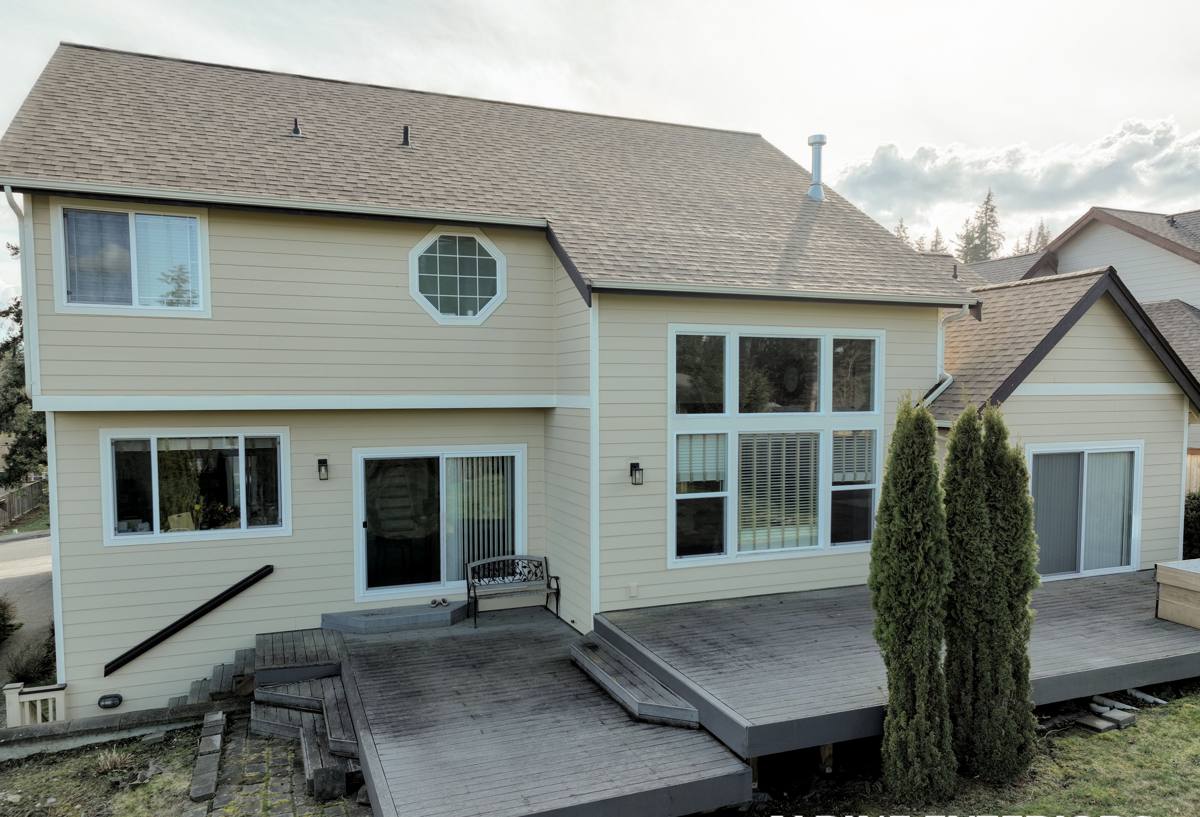
What Composite Decking Actually Solves Here — and What It Doesn't
Composite boards are engineered from wood fiber and recycled plastic, which means they don't absorb water the way solid wood does, they don't need annual staining or sealing, and they resist the surface graying and splintering that Pacific Northwest wood decks are known for. For a North Everett property dealing with driving rain and a long moss season, that's a real advantage — the board surface itself sheds water and doesn't feed mold the way untreated wood does.
What composite decking doesn't do is make the substructure immune to moisture. The framing underneath — joists, beams, posts, ledger board — is still typically pressure-treated lumber, and that wood still needs to be protected from standing water, still needs airflow, and still needs correctly flashed connections. A common mistake we see on composite decks that fail early isn't the decking itself — it's a substructure that was framed like a standard wood deck with no extra attention to the coastal moisture load it would actually face.
Where Composite Still Needs Real Craftsmanship
- Joist tops need protective tape or flashing so the composite boards aren't sitting on bare, moisture-wicking wood
- Fasteners and hardware need to be rated for coastal/marine exposure, not standard interior-grade coatings
- End cuts on composite boards need to be capped or finished per manufacturer spec — exposed core material can wick moisture at cut edges
- Ledger board flashing at the house connection has to shed water away from the wall assembly, not into it
- Gapping between boards needs to account for both drainage and the specific expansion behavior of the composite product used
What a Correct Installation Involves
A composite deck built to hold up in Snohomish County's wet, salt-air climate follows a specific sequence, and skipping steps is exactly how decks end up with soft framing or moss-blackened joists within a few years.
1. Structural Assessment and Ledger Connection
Every job starts with checking what the deck attaches to — the ledger board and the house's rim joist or wall framing. This connection carries a huge share of the deck's load and is also the single most common point of water intrusion if it isn't flashed correctly. We flash it so water is directed out and away from the wall, not trapped behind the decking where it can rot framing you can't see.
2. Framing for Drainage and Airflow
Joists get spaced and supported per the composite manufacturer's span tables (composite requires tighter joist spacing than solid wood in most cases), and the whole substructure gets built with a slight pitch away from the house and enough clearance underneath for air to move. Standing water and stagnant, humid air under a deck is exactly what grows moss and mildew — good framing prevents both.
3. Protective Tape on Joist Tops
Before any decking goes down, joist tops get a self-adhering protective tape. This is a small material cost that pays for itself many times over — it keeps rainwater that gets between boards from soaking directly into the framing lumber, which is the top cause of hidden rot under otherwise good-looking composite decks.
4. Fastening and Board Layout
Boards get installed with hidden fastener systems or manufacturer-approved screws sized for the product, spaced correctly to allow for thermal movement without buckling. In our climate, boards see real temperature and moisture swings across the year, so fastening has to account for expansion — not just look right on install day.
5. Railings, Stairs, and Edge Details
Railing posts get through-bolted to blocking, not just screwed to fascia. Stair stringers and any structural post bases get the same coastal-rated hardware treatment as the rest of the frame. These are the parts of a deck most exposed to driving rain, so they get the most attention to sealing and fastener choice.
Our Process, Start to Finish
- On-site assessment — we look at the existing structure (if there is one), grade, drainage, sun/shade exposure, and how the deck ties into the house
- Design and material selection — board style, color, and railing system chosen based on your home and how much upkeep you actually want long-term
- Permitting — decks above a certain height or attached to the structure typically require a permit through the City of Everett or Snohomish County depending on location; we handle that paperwork
- Demo, if applicable — removal of the old deck, with an honest look at whether the existing framing or footings can be reused or need replacing
- Framing and structural work — built to span tables and flashed at every water-entry point
- Composite installation — decking, railings, stairs, and trim installed per manufacturer spec
- Final walkthrough — we go over the deck with you, including basic care specific to your product and our local climate
Composite vs. the Alternatives, Honestly
| Material | Moisture Behavior in Our Climate | Maintenance | Typical Lifespan Here |
|---|---|---|---|
| Composite decking | Sheds water well on the surface; substructure still needs proper detailing | Periodic washing to prevent moss/algae film; no staining or sealing | 25-30+ years with correct install |
| Pressure-treated wood | Absorbs and releases moisture repeatedly; prone to checking and cupping | Annual or biennial staining/sealing to slow moisture cycling | 10-15 years before major repair/replacement |
| Cedar | Naturally rot-resistant but still absorbs water; grays and softens with UV and rain exposure | Regular sealing to maintain appearance and resistance | 15-20 years with consistent upkeep |
We don't install every product on the market, and that's a deliberate professional choice, not a knock on any single brand. Some lower-tier composite lines have historically had issues with moisture absorption at cut ends or color fading faster than advertised in wet, low-sun climates like ours. We stick to composite lines with a track record of holding up under real Pacific Northwest conditions and warranty terms that back that up, and we're upfront with you about what we recommend and why.
What Drives the Cost of a Composite Deck Project
| Factor | Why It Matters |
|---|---|
| Square footage and shape | Larger decks and complex shapes (curves, multiple levels) mean more framing and cut waste |
| Height and structural support | Elevated decks need engineered footings, posts, and often stairs — more material and labor |
| Board tier chosen | Composite lines range widely in price based on capping technology, color/fade warranty, and texture |
| Railing system | Composite, metal cable, and glass railings all carry different material and install costs |
| Existing structure condition | Reusing sound footings and framing costs less than full tear-out and rebuild |
| Site access | Backyards with limited equipment access can add labor time for material handling |
Composite decking generally costs more upfront than pressure-treated wood, but the gap narrows over the life of the deck once you account for staining, sealing, and earlier board replacement that wood decks typically need in our rainfall and moss conditions. We'll walk through real numbers for your specific project during an estimate rather than quoting a generic per-square-foot figure that may not reflect your site.
Living With a Composite Deck in North Everett's Climate
Composite decking is genuinely low-maintenance compared to wood, but "low-maintenance" doesn't mean "no maintenance" in a climate with this much moisture and moss pressure. A simple seasonal rinse with a garden hose and a soft brush, done a couple of times a year (more often under trees or in shaded, north-facing spots that stay damp longer), keeps organic film from building up on the board surface before it becomes a slip hazard or a stubborn stain. Keeping gutters and downspouts near the deck clear also matters more here than in drier regions, since overflow during a heavy winter storm can dump a lot of extra water directly onto or under the deck.
Simple Seasonal Checklist
- Rinse and lightly brush the deck surface a few times a year, more often in shaded or tree-covered areas
- Clear leaves and debris from between boards before fall rains start, especially in gap-heavy layouts
- Check that downspouts and gutters near the deck are directing water away, not onto it
- Inspect railing posts and stair connections once a year for looseness — hardware is usually the first thing to show wear in salt-air exposure
- Address any moss or algae promptly with a mild cleaner rated for composite — pressure washing on the wrong setting can damage the board surface
Why Hiring a Crew That Already Works This Neighborhood Matters
North Everett isn't a uniform building site. Lot grading, exposure to wind and rain off the Sound, tree cover, and how close a property sits to the water all change what a deck needs to hold up. A crew that already builds and repairs decks in this specific area has already seen which framing details fail here and which hold up, which composite lines perform well in this humidity and salt exposure, and what the local permitting process actually requires — instead of learning those lessons on your project.
That local track record also means we're not guessing about drainage patterns or moss exposure on your lot — we've likely already dealt with something similar a few streets over. It's the difference between a deck that's technically built to code and one that's actually built for how this neighborhood's weather behaves year-round.
Signs Your Current Deck Needs Attention
If you already have a deck and are wondering whether it's a repair situation or a replacement situation, a few signs point clearly toward the latter: soft or spongy spots when you walk across the boards, visible gaps opening up around fastener heads, persistent green or black staining that comes back quickly after cleaning, or any give in the railing posts when pushed. Any of these can indicate the framing underneath has been compromised, not just the surface — and that's worth having assessed before it becomes a safety issue.
If you're weighing composite decking for a home in North Everett, we're glad to come take a look, talk through what your specific lot and exposure will need, and give you a straightforward, no-pressure estimate. There's a quick form below to get that conversation started.