 Everett
 Why Siding in Marysville Has to Work Harder Than It Does Inland
Marysville sits close enough to Puget Sound and the Snohomish River delta that salt-laden air, wind-driven rain, and heavy shade from mature conifers all show up on the same house at the same time. That combination is tougher on exterior siding than most homeowners realize. Salt air accelerates corrosion on fasteners and metal trim. Driving rain off the Sound doesn't fall straight down — it hits siding at an angle and works its way behind poorly lapped boards or gapped joints. And the long stretch of gray, damp months each year means anything shaded by trees or a north-facing wall stays wet longer, which is exactly what moss and mildew need to take hold.
None of this is unique to any one Marysville block — it's a Snohomish County pattern, and it means siding installed here needs to be planned around moisture, not just appearance. A siding job that looks great going up in July can fail quietly by the third or fourth wet season if the water management underneath wasn't done right. That's the part of the job most homeowners never see, and it's the part that matters most.
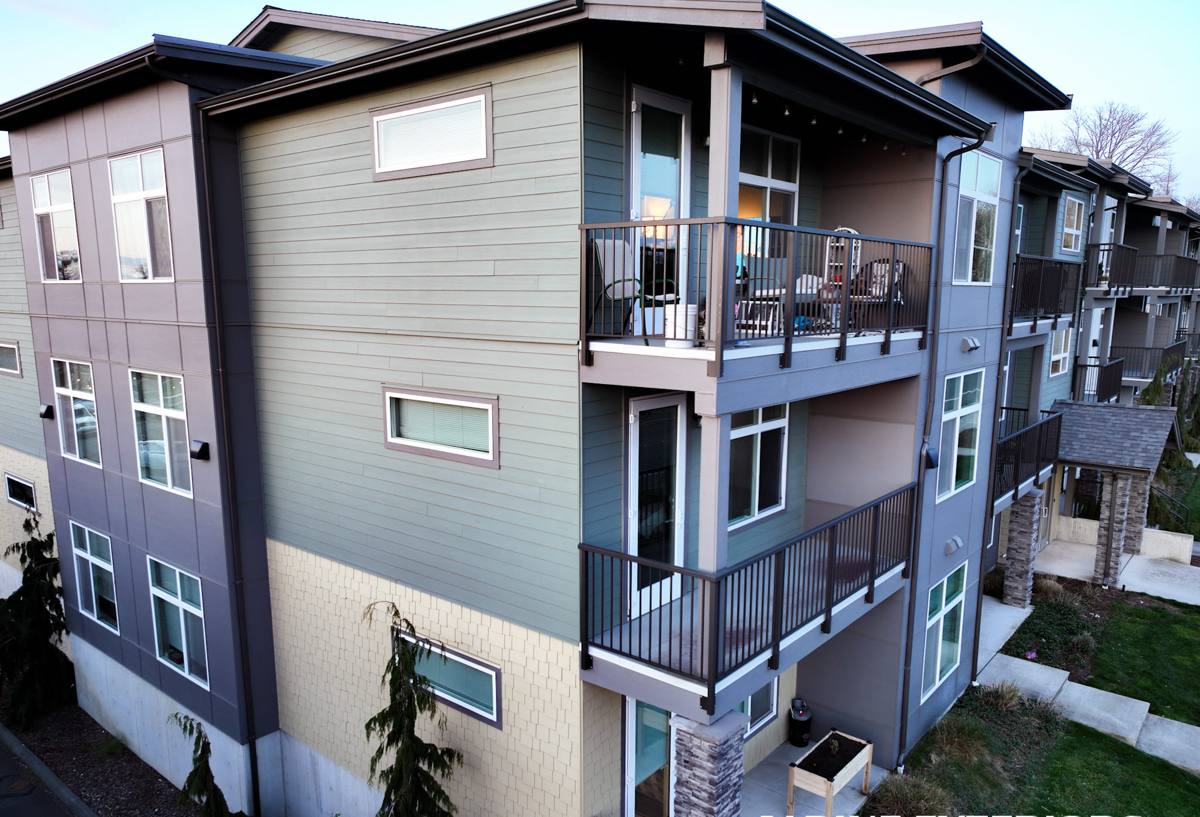
What "Correct" Siding Installation Actually Means
Siding is a system, not a single layer. The visible boards are the last piece; everything behind them determines whether the house stays dry. A correct installation includes:
- A continuous weather-resistive barrier (WRB) installed shingle-style so water sheds outward at every seam
- Properly flashed windows, doors, and any wall penetrations, integrated with the WRB rather than just caulked over it
- Correct fastener type, spacing, and depth for the specific siding product — not generic nails driven at whatever angle is convenient
- Clearance gaps at the bottom of the siding, around trim, and at grade so water and moisture vapor have somewhere to go
- Rain-screen or drainage detailing where wall assemblies need it, especially on shaded or west-facing walls that stay damp longer
Skip or rush any one of these steps and the siding can still look fine from the curb for a year or two while water quietly works its way into sheathing and framing behind it. In a climate like ours, that's not a hypothetical — it's the most common reason we get called out to look at siding that's only a few years old.
Why Installation Sensitivity Matters More Here Than in Drier Climates
Every siding product has an installation tolerance — how forgiving it is of small gaps, minor caulking shortcuts, or slightly-off fastener placement. In a dry inland climate, a marginal install might go years without showing a problem. In Snohomish County, with our rain volume and the salt exposure closer to the water, those same marginal details show up faster: swelling, staining, soft spots, or moss creeping in at the laps. That's a big part of why we're selective about both the product we install and the crew doing the installing.
Why We Install Only James Hardie Fiber Cement Siding
We standardized on James Hardie fiber cement for every home we side, including here in Marysville, and we don't install vinyl, LP SmartSide, or other fiber cement brands. That's a deliberate call, not a sales preference. Fiber cement is non-combustible and dimensionally stable, so it doesn't expand and contract with our wet-to-dry swings the way wood-based or vinyl products can, and it holds up to sustained moisture exposure better than products with an engineered-wood or OSB-based core. Hardie's HZ5 product line is specifically formulated for climates like ours — wet, coastal-influenced, freeze-thaw capable — and the factory-applied ColorPlus finish resists the fading and touch-up cycle that field-painted siding goes through.
We're not going to tell you every other siding product on the market is bad — most have legitimate strengths. But when we're the ones standing behind the installation and the warranty, we want a product with a track record for handling exactly the conditions Marysville sees every winter: sustained rain, salt-influenced air, and long shaded, damp stretches where lesser products show wear first.
Our Installation Process
The steps below are the same core sequence we follow on every siding job, adjusted for the specific home:
- Assessment and tear-off. We inspect the existing wall assembly as we remove old siding, checking sheathing and framing for hidden rot or moisture damage before anything new goes up.
- Sheathing repair. Any soft or water-damaged sheathing gets replaced — covering over a compromised substrate is how good siding fails early.
- WRB and flashing. We install the weather-resistive barrier and flash every window, door, and penetration so water is directed outward and down, never trapped behind the cladding.
- Drainage detailing. Where the wall assembly calls for it, we build in a drainage gap so any moisture that does get behind the siding has a path out instead of sitting against the sheathing.
- Hardie installation. Boards, panels, or trim go up to manufacturer fastening specs — correct nail type, spacing, and clearance at every joint, corner, and penetration.
- Caulking and finish work. Joints and trim get sealed with proper materials, and factory-finished ColorPlus surfaces are protected from job-site damage throughout.
- Final walkthrough. We walk the exterior with the homeowner before calling the job complete, so nothing gets missed.
Signs a Marysville Home May Need New Siding
Because moisture problems often start behind the siding, the exterior clues are usually indirect. Watch for:
- Persistent moss or dark streaking that comes back within weeks of cleaning, especially on shaded or north-facing walls
- Soft spots, bubbling, or visible warping in the siding surface
- Paint that's failing faster than it should, or peeling in a pattern that follows seams and joints
- Rusty streaks near fasteners or trim, a sign salt-air corrosion has started
- Musty odors or visible staining on interior walls that back up to exterior siding
- Gaps, cracking, or separation at butt joints and corners after a stretch of wind-driven rain
Any one of these is worth a look. Several together usually means the wall assembly, not just the surface, needs attention.
Cost Factors for a Marysville Siding Installation
| Factor | How It Affects the Job |
|---|---|
| House size and wall complexity | More corners, dormers, and trim detail mean more labor and material per square foot |
| Sheathing condition | Hidden rot found at tear-off adds repair scope before new siding can go on |
| Siding profile chosen | Lap width, shingle-style panels, and trim board options carry different material costs |
| Story count and access | Two-story walls and limited-access sides require more scaffolding and time |
| Existing siding removal | Full tear-off versus siding over an existing layer (not something we recommend, but it affects scope estimates) |
| Drainage and flashing detail needed | Shaded, damp, or wind-exposed walls may need additional rain-screen detailing |
We walk every factor with the homeowner before quoting, so the estimate reflects the actual home rather than a generic per-square-foot number.
Why It Matters That the Crew Already Works Marysville
A crew that regularly works Snohomish County jobs already knows which walls tend to stay damp longest, how local moss growth behaves through a wet winter, and where salt-influenced air off the Sound tends to accelerate wear on fasteners and trim. That's not something you can fully learn from a spec sheet — it comes from having sided enough homes in this specific area to know where the water actually goes and where a marginal detail will show up first. It also means faster response if a warranty question or a callback comes up, instead of coordinating with a crew that only passes through the area occasionally.
Caring for Your Siding After Installation
Correctly installed fiber cement siding is low-maintenance, but "low" isn't "none." A few habits go a long way in our climate:
- Rinse siding periodically to keep organic buildup from taking hold, especially on shaded walls
- Keep gutters clear so overflow doesn't run down the wall face
- Trim back vegetation and tree limbs that keep a wall shaded and damp
- Have caulking at trim and joints checked every few years and refreshed as needed
- Address any impact damage or chips promptly so the substrate underneath stays protected
A Checklist for Hiring a Siding Contractor
Whether you go with us or someone else, these are the questions worth asking any contractor bidding a siding job in Marysville:
- Will you inspect and repair sheathing before installing new siding, not just cover over it?
- What weather-resistive barrier and flashing method do you use, and how is it integrated at windows and doors?
- Do you follow the manufacturer's published fastening specification for the specific product?
- What's the warranty structure — on materials, on labor, and who backs each one?
- Are you licensed and insured in Washington, and can you provide proof?
- How much local experience do you have with homes in this specific area and climate?
A contractor who can answer all of these clearly, without hedging, is one worth trusting with a job that has to perform for decades, not just look good on installation day.
If your Marysville home's siding is showing wear, or you're planning ahead for a replacement, we're happy to walk the exterior with you and give a straightforward, no-pressure estimate. Use the form below to get started.